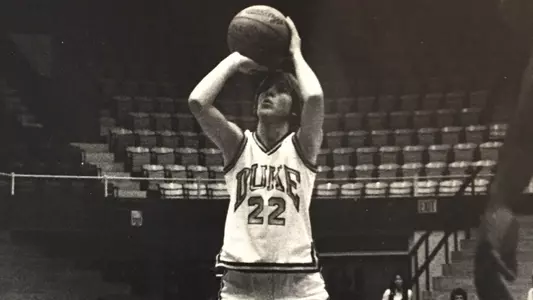
In honor of the 50th season of Duke women's basketball, we had a chance to catch up with some of our storied alums and talk with them about their background, the history and pioneers of the Duke women's basketball program, favorite memories, the growth of women's basketball and women's basketball as a whole, what it means to be a part of The Sisterhood, among other topics.
Next up is Sue Gordon, Duke's first three-time team captain in program history, who played for the Blue Devils from 1976-1980.
Q: TELL US A LITTLE ABOUT YOURSELF. WHEN DID YOU PLAY, AND WHAT LED YOU TO DUKE?
A: I played at Duke from 1976-1980. It's funny we are about to have our 50th anniversary, because that means it was 50 years ago that I graduated from high school. That's mind blowing because it feels like yesterday. I was a jock – I just loved playing sports. I started out playing with the boys in the neighborhood, whatever we were playing. There were some leagues and high school sports. I was probably best at softball, but there weren't a lot of collegiate programs in 1976. I did pretty well in school. When I went looking for colleges, I decided I wanted to be a marine biologist because I watched The Undersea World of Jacques Cousteau. I had a great ninth grade science teacher who convinced me that science was what I should do. It turns out that Duke has a marine science consortium on the East Coast, and you could spend your spring semester there. So, I had this idea to go to Duke – great sports, great academic reputation, in the south. All good things. That was how I got to Duke. Not recruited. Of course, I turned out to be busy every spring semester, so I never got out there.
Q: WHEN YOU GOT TO CAMPUS, HOW DID YOU END UP BECOMING PART OF THE WOMEN'S BASKETBALL TEAM?
A: For at least two years there were tryouts. I remember somehow we kind of hooked up with the people that were already on the team. I remember the first day of practice like it was yesterday. There were four of us sitting there, waiting for someone to come by to pick us up from West Campus and take us to East Campus. That's where I got my nickname. On that first day, Betsy Bergeron and I were talking about what our favorite fruits were, and I said, "I love a peach, but I hate taking the first bite because they're fuzzy." And then Betsy said, "Well you look like a peach." Then she called me Fuzzy in that first practice. So, it was tryouts, and at the end of the week there was a list of the players that were on the team, and I was one of them.
Q: WHAT IMPACT DID COACH LEONARD HAVE ON THE PROGRAM? WHAT ATTRIBUTES MADE HER SUCH A GREAT LEADER?
A: When Debbie came in, she was clearly intending to coach. She was only 24. I don't think we knew then the battles she was fighting with the administration. What we felt was a young woman who had a hard time with circumstances in which she found herself, yet she persisted. By my senior year, taking us to 14-13, beating [North] Carolina, beating UVA, with a set of recruits that became the foundation for the modern generation of players. If you look at Barb Krause, Margo Riddle, Tara McCarthy and Claire Rose – they're still in the record books. Me, Lisa Warren and the other freshmen with us – we were the last vestiges of the jocks rather than the basketball players. Debbie brought that along. I just give her a ton of credit. I give Jacki [Silar] a lot of credit because I don't think we would have survived if Jacki's not there. She's a cooler, more laid-back personality. She was.
Q: TAKE US THROUGH YOUR CAREER PATH AFTER GRADUATING FROM DUKE - WHAT DID YOU DO?
A: I was a zoo major. I concentrated on biomechanics and functional morphology and the engineering of living systems. I thought, and the chairman of the department thought, that I was going to go on and get my PhD in biomechanics. I also wanted to go into law because I love arguing. It turns out that the CIA was recruiting on campus, and my dad had a friend who had worked with the Navy, who had been the director of the CIA. He used to tell me all the time that I ought to be a spy. So, I applied for the CIA, and I got a job. I also, surprisingly, met a really cute guy and we got married right after I graduated. I joined the CIA, got married and then my career took off. I was hired to do [an] analysis of Soviet biological warfare, which makes sense as it was 1980. I arrived, 21 years old, all shiny, and they said, "your job's gone. You have 30 days to find another one or we'll take back your security clearance." So, I found a job doing Soviet missile analysis. Then it just took off. For me, the CIA was like peas and carrots. I satisfied the need to do something of purpose with my life. I'm super curious, and that's a place where you can be curious. The CIA of the 1980s was hugely male dominated, it was like playing pickup basketball with the guys. In other words, if you don't do something with the ball, you won't get it again. I had an unbelievable career and ended up on top. I was grateful every day..
Q: WHAT ADVANCEMENTS HAVE YOU SEEN IN TODAY'S GAME?
A: Oh my God. Training table. Access to medical care. Travel. Massages. I mean, what could we have done with a sports psychologist? I love the television coverage. I love that I could watch my daughter play. We didn't watch any film of my four years. I don't think there's any video of any of my teams playing. The whole thing has just exploded. As I tell my story about my four years, I thought I had the luckiest four years. Now look at what the exposure has done in terms of what young women are doing with their games. I remember when Maya Moore played – how does anyone create their own shot in that way? Because of the exposure and accessibility of leagues and opportunities and coaching [in] our game, it continues to evolve because people can see what they can become.
Q: WHAT DOES THE SISTERHOOD MEAN TO YOU?
A: I have a sisterhood with my teammates, the women I played with, and the women that played with them, pretty much extending all the way up to Krista Gingrich and Alana Beard. We're all pretty close. Three of my teammates came to my confirmation hearing, even though during the years when I was raising my family and so busy with work I wouldn't always see them. These women are still my strength. We all get together and watch games together.
Q: WHAT DOES 50 SEASONS OF WOMEN'S BASKETBALL MEAN TO YOU?
A: If you had told me when I was 18 years old that we are going to have a 50th reunion for women's basketball? I would have been shocked that we'd been around that long! I think it's a remarkable testament. Duke gave me everything important in my life. It taught me how to think, and I've used that pretty well. It gave me the love of my life and it provided me with the best friends that have sustained me throughout. It's provided me the foundation for success in business. I cannot be prouder of being a member of Duke women's basketball and for us to have the 50th anniversary season.
Q: WHAT EXCITES YOU ABOUT THE FUTURE OF DUKE WOMEN'S BASKETBALL?
A: I don't see any reason why we can't achieve the highest levels. We have every advantage in the entire universe. The next milestone I'd want is packed gyms everywhere. I think Kara is a hire that suggests that Duke expects itself to compete for and win the best that is always available, and I think Kara represents that. My hope would be that the ethos of Duke really comes into shape and that's what transports us as much as the talent will. The sky is the limit.
Q: WHAT ADVICE WOULD YOU OFFER TO OUR CURRENT TEAM?
A: Learn to commit to the point of failure. It's the only way to find your limits and then you can figure out how to exceed them. Be grateful for every day and don't squander a single moment of this time you have with your teammates. Live so you have no regrets.