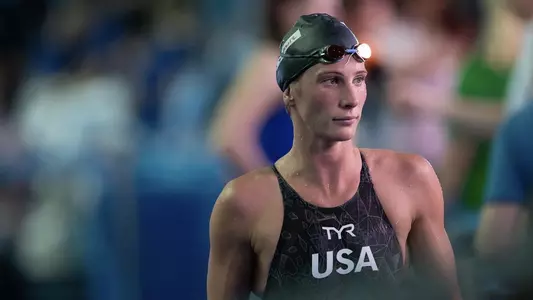
Let's start by talking about the waiting game you've experienced. You qualified in 2019, thinking the next year you would be in Tokyo. Then of course the pandemic hits and now here we are in 2021, two years removed from your qualifying race and the Olympics are finally here. But of course, your story goes well beyond that. Can you take us through your journey to your first Olympics?
AT: Oh, for sure. I graduated Duke in 2011 and after NCAAs that year I felt like I just wasn't ready to be done. I felt like I had more to improve on in the sport and I also just had such a passion for the sport. Coach (Dan) Colella was super helpful in identifying the next steps and where to go, and my parents were incredibly supportive of my desire to keep going as well. That being said, at that point I could never have imagined still swimming now. I thought maybe it would be for a summer, see how that summer went and then go from there.
Two weeks after moving out to California, which is where I decided to continue my career, I qualified for my first international competition, the world championships in open water swimming. I've really taken it year-by-year since then. I narrowly missed making the Olympic team for 2012, again in 2015 for 2016. The open water team is decided a year prior. Then I finally qualified in 2019 and it was such a relief and also to know I had a year, knowing I had already qualified, and I was still going to go for the pool qualifications as well. But to have already qualified in open water and to be able to train without that pressure on my back, which obviously turned into two years when everything got thrown for a loop with the pandemic.
DS: You've spoken in the past about how, at least in 2016, you thought long and hard about potentially calling it a career at that point, but the desire to compete got the better of you and you decided to make another run at it. What was that process like, as it's obviously a significant commitment to make another four-year run at qualifying for the Olympics?
AT: I don't remember having like a formal conversation with my coach or my family and saying like "Do I keep going or not?" I think it just happened naturally. One thing I do specifically remember is about a month or two before the world championships in 2017, I texted my coach out in California, Bill Rose, and said, "I think this might be it, I think I might retire after 2017." And he just said "Really?" At that point we just kind of left it at that, and then in 2017 I won the gold medal in the 5K at worlds, and I was like, "Well, I can't retire now!"
At that point you're only two years away from the Olympic qualifier, so in deciding all of this I've really just tried to take it year-by-year. Really similar to the mindset I touched on when I left college. As long as I feel like I'm still loving the sport and have something to give, I'm going to keep on going with it.
DS: Let's talk about that qualifying race in 2019 in South Korea. A 10K — that's a heck of a swim, and you've touch on those last 800 meters and how you were stunned at how bunched the field was coming to the end. Where did you find the energy to ultimately get in there and qualify?
AT: When I think back to that race my first thought is thank God, I never have to do that again (laughing). I don't even know how I handled the stress of it, because no matter who you are or what sport it is, it's always nerve-racking when you're trying to make the Olympic team. But to be swimming a two-hour race, where you have two hours to think about it — I vividly remember diving in to start that race and immediately thinking in two hours I'm either going to be an Olympian or not. But just as quickly as I had that thought, I told myself I need to stop thinking like that and stay in the moment the entire race.
I do remember thinking, "I hope this pack breaks up eventually," but it never really did. It was a lot of us. So, as we're coming around the last buoy with 800 meters to go, straight into the finish, I had a terrible turn. I think I was 14th coming out of that turn, and the top 10 make it to Tokyo. For a little bit I do remember allowing some negative thoughts to creep in like, "Okay I'm at this point, and the same thing's going to happen again, and I'm going to miss again." But as quickly as that thought came, I pushed it out and told myself, "No matter what happens when I'm finished, whether I'm in the Top 10 or not, I want to know that I'd given everything I could and have no regrets."
At that point, of course if I didn't qualify, I would have been disappointed, but I think there's something to be said for knowing that you gave everything you had and put yourself on the line, knowing there was a possibility you would fall short of your goal. That was my mindset those last 800 meters, and as I started to pass people, I definitely felt more and more adrenaline, which is hard to come by at the end of a 10K, so I was incredibly grateful for that.
DS: I can't even imagine! (Both laughing) So I was hoping we could get into your event specifically, and let's start with just open water swimming in general. Obviously, you still compete in the pool as you did at Duke extremely well. Where did the love for open water swimming come from and how did you decide that that was where you were going to put a good chunk of your focus once you left Duke?
AT: So, when I was growing up, our family would go on vacation in Florida for two weeks every April and then we would vacation in Cape Cod in the summer. On those trips just to stay in the water I would do ocean swims with my dad, nothing long or anything, just a mile or so. Those are some of my fondest memories of growing up, just being able to spend that time with my dad. I loved being out in the ocean and the freedom it allowed as opposed to the pool. That's where my initial love for the sport started, even though it wasn't in a competitive sense.
Then I used to do the Swim Across America Event in the Long Island Sound every summer in memory of my uncle who passed away from cancer, which wasn't a race either, but it was a bit longer, around four miles, and I loved that event as well.
In the summer of 2011, right after I graduated, I was invited to the Open Water Select Camp and learned so much. I had done the nationals the year before and it had gone terribly. I had no idea what to expect, it was freezing water, I had never fed before, so it was not a great experience. But then this camp taught me a lot, just in terms of strategy and feeding and all the ins and outs that you don't have to deal with in the pool. At the end of that camp, we all competed in open water nationals and that was when I placed third and made my first team and it all went from there. That camp was incredibly helpful for me.
DS: You mentioned getting acclimated to the open water. Training in Hawaii before heading to Tokyo — how do you prepare for a two-hour swim, get ready for the conditions…it just feels like there is so much that goes into it.
AT: You might be surprised but I do about 99 percent of my training in the pool. At this point my training doesn't vary much whether I'm preparing to compete in the pool or an open water race. At this point I feel like I have enough of that aerobic background and that aerobic base. A lot of these races now are coming down to a sprint finish so that's just as important as the base, just having that speed — and being able to have that speed at the end of a 10K. I still feel like every open water race you do, you learn something new. One of my advantages is I've been competing in open water for 10 years now and I'm still learning but I'm hoping I can take all that knowledge I've gained over years and use all of those experiences to prepare me for Tokyo.
DS: You've already made some history as the oldest rookie Olympic swimmer in more than a century, but I know you're not just happy to be there. So in your mind what will it take to get on the podium in Tokyo?
AT: I think just executing the race. Open water is pretty hard to plan for. I can go into it with a strategy but a lot of times that strategy gets thrown out the window. That was something that early in my career would throw me for a loop, but now I feel like I'm prepared to handle that unpredictability. Which may be just as important as anything else — know that whatever happens throughout the race I can hopefully counter any moves that are made. I'm very excited to be able to go and swim the race with Haley Anderson. We've been competing together for 10 years now. It's comforting in international competition to see another Team USA cap next to you. I hope we can both get on that podium together, and to be honest, I'm just excited to finally race.
DS: As we wrap up, everyone knows how challenging this last 18 months has been across the entire world as we've battled the pandemic. Symbolically, what do you think these Olympic Games represent in some way showing that we're starting to emerge from a very challenging time?
AT: You know, when we first found out the news, as you said, almost a year-and-a-half ago, I remember saying in an Instagram post that I hoped that next year when the Olympics happened, they could serve as a beacon of hope and bring the world together. At the time we didn't know that the pandemic would still be going on, and that there are definitely countries and areas that are still struggling. But I hope that as we come together, we'll see how special the Olympics are. I know there won't be fans on site, but so many will be watching around the world, and it will be so incredible to see so many come together and compete.
Credit:
David Shumate, GoDuke the Magazine
#GoDuke