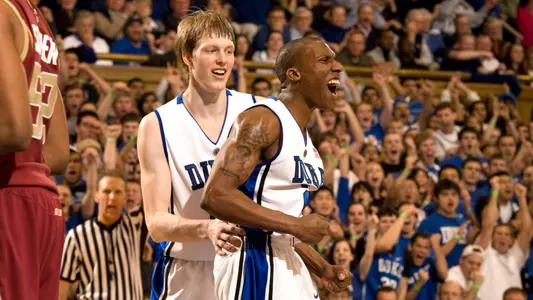
DURHAM, N.C. – It was appropriate that
Nolan Smith should open the 2010 ACC season with a 22-point, three-assist performance against Clemson. It was a year ago in Death Valley when Smith hit rock bottom – the sophomore point guard missed 6-of-7 shots and committed four turnovers without an assist as the Duke offense sputtered in a 74-47 loss to the Tigers.
It was Smith's last starting assignment of the season.
“Going into tonight's game, last year's game was in the back of my mind,” Smith said after helping Duke to a 74-53 victory over Clemson in Cameron on Jan. 3 – a final score that was remarkably similar (in reverse) to last season's debacle. “I knew that game was a turning point – it turned my season around.”
Smith has come a long way in the year since his disastrous trip to Clemson. He's bounced back with a single-season improvement that few players in Duke or even ACC history can match. He's gone from being a promising but erratic sophomore into one of the most dynamic players in college basketball.
“Nolan has been great all year,” Duke head coach
Mike Krzyzewski said recently. “Nolan is just a natural scorer. He's the one guy we have who can get the 'in-between' baskets. Nolan is always on the ball on defense. Moving him off the ball on offense means that he doesn't get worn out.”
Smith is averaging more than 33 minutes a game for the 2009-2010 Blue Devils. His scoring average of 18.3 ppg. is the fourth best in the ACC. His single-season improvement (from last season's 8.4 average) is the best in the ACC this season and the ninth-best single-season jump in Duke history.
“The confidence I've been playing with is coming from the coaches telling me to be aggressive,” Smith said. “So I go out there and have that mentality to be aggressive on the offensive and defensive ends and things just come easily.”
Smith came into the year with one 20-point game in his first two seasons at Duke. Through 15 games in his junior campaign, he has a team-high eight 20+ point efforts, including six in the Blue Devils last eight contests.
But it's not just scoring. Smith has almost doubled his assist average from 1.7 to 3.2 assists a game. His shooting percentages are up significantly – especially from 3-point range (from .346 to .500, which leads the ACC) and he's improved his rebounding, steals and blocked shots.
Clemson coach Oliver Purnell, who got a first-hand view of the worst (in 2009) and the best (in 2010) of
Nolan Smith suggested that there is a simple reason for the big improvement.
“It's all about confidence,” Purnell said. “There's never been any question about his talent, but it just flows out when you're playing with confidence. When you're tentative, that restricts you and slows you down. He's just playing very free now.”
Smith admits that his improved mindset has made all the difference.
“When you have an aggressive mindset, a lot comes easier,” he said. “The game is much easier than when I was playing back on my heels, trying to react to everything that happened.”
N.C. State coach Sidney Lowe, who was one of the most cerebral guards in ACC history, can see the change in Smith's game.
“I think the talent has always been there, but now mentally he understands,” Lowe said. “He's much more aggressive now in looking to score and showing he can do those things—put the ball on the floor and get in the lane; get inside and be able to shoot the floaters; knock down shots on the outside. I think that the experience factor – he went through the lumps of being a young player. He certainly has adjusted to the competition at this level and realizing that he's very capable of being a major factor.”
Lowe, who watched a lot of Smith on tape this week heading into Wednesday night's Duke-State game, feels a personal connection to the Duke guard. He played with Smith's father – former Louisville star Derek Smith.
“He comes from good genes – his dad was a great basketball player and a great person,” Lowe said. “[Derek Smith] was one of the hardest workers I ever played with.”
And Lowe believes that Smith's dynamic improvement is the result of hard work on the part of the son of his late friend.
“Obviously, he worked hard this summer,” Lowe said. “I think his work has paid off.”
Smith followed a strict workout regime over the offseason.
“This summer I stayed home and worked out with a trainer,” he said. “I worked a lot on my shot to get confidence in my shot. I worked on my ball handling, working to be stronger with the ball. I worked out with Gary Lampkin, the coach at Dunbar [High School in Washington, D.C.].”
Smith worked almost every day with Lampkin from 10 in the morning to 1 o'clock in the afternoon. After that three-hour session, he'd go searching for more basketball.
“At nighttime I'd play pickup at Maryland or Georgetown,” he said. “Guys like Michael Beasley and Kevin Durant would be there. It's fun to play against the pros.”
Smith grew up close to Beasley. The current NBA standout lived with the Smith family at one point and the two young basketball players were almost like brothers. He played one season with Durant at Oak Hill Academy in Virginia, before Durant switched to Montrose Christian Academy.
Smith started two seasons at Oak Hill, sharing the backcourt with future pros Ty Lawson (in 2005-06) and Brandon Jennings (in 2006-07).
How do those two NBA rookies compare with Duke senior
Jon Scheyer, Smith's current backcourt partner?
“It's totally different,” Smith said. “They are true point guards and they're jet speedy. Jon's leadership skills are probably better. I think I've stepped up my leadership, but Jon's a veteran.”
Actually, Oak Hill coach
Steve Smith once called
Nolan Smith the best leader he's ever had – he was the only junior ever appointed captain at Oak Hill.
A year ago, Smith started at point guard for the Blue Devils, while Scheyer played off the ball. The responsibility of running the offense – while taking care of his own offensive responsibilities and being the team's primary on-the-ball defender – proved too much for Smith as a sophomore. Krzyzewski tried to lesson his burden this season, moving Scheyer to the point and allowing Smith to flourish as the shooting guard.
“Jon is a leader on the court and I'm off the ball,” Smith said. “It kind of simplifies the game for me. I catch and I'm already in a playmaking mode. That definitely makes it a lot easier.”
Before the season, many outside observers questioned Duke's backcourt. But Smith and Scheyer have proved to be one of the nation's most effective guard tandems, combining to average more than 37 points and almost 9.5 assists a game (with less than 3.5 turnovers per game).
Krzyzewski has explained that his two guards don't fit the traditional “point guard” and “shooting guard” molds. He prefers to call them “players”. Indeed, they do often trade off playmaking and off-the-ball roles at various times. Defensively, their roles usually flip-flop – Smith is normally asked to defend the opponent's primary ballhandler, while Scheyer takes the shooting guard.
It's a delicate balance that could lead to confusion and even disaster if the two guards didn't work so well together.
“The chemistry with Jon is special,” Smith said. “I think our relationship on the court is a reflection of our relationship off the court. We're always talking about the game – before practice, after practice ... he's easy to play with. I think we both give each other confidence.”
And confidence has transformed
Nolan Smith into one of the best “players” in college basketball this season.


.png&width=24&height=24&type=webp)