Upcoming Event: Men's Tennis versus #19 University of Southern California on May 1, 2026 at 2 p.m.
/
2 p.m.

Men's Tennis
vs #19 University of Southern California


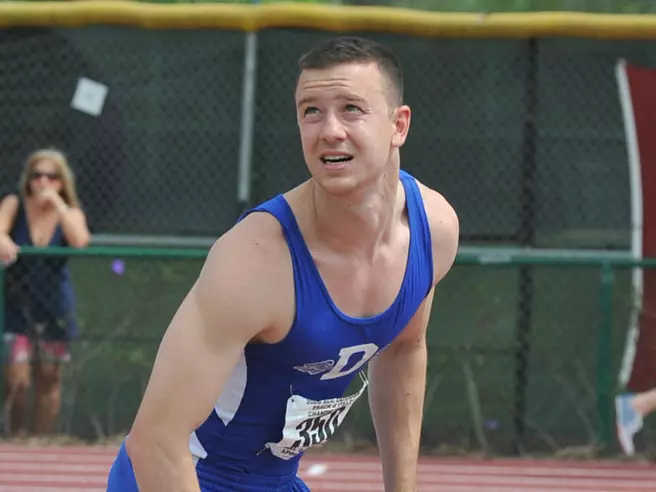
By John Roth, Blue Devil Weekly
DURHAM, N.C. - At the ACC track and field meet last month, Duke senior Tyler Clarke racked up a career-high 7,326 points in the decathlon ? a point total that would have made him the conference champion in 13 of the previous 16 years.
This year, it was good for third place. Although it was the best decathlon score in Duke history ? the first ever over 7,000 points ? it still trailed the totals turned in by UNC’s Mateo Sossah and Daniel Keller.
A subpar performance in the discus kept Clarke from topping 7,400 points ? but it didn’t keep him from appreciating his overall achievement or celebrating his success with his fellow competitors. A couple of weeks after the meet, as semester exams finished up, Clarke headed to Keller’s house in High Point, N.C., to socialize with his two Tar Heel foes and a few other decathletes ? not the sort of gathering you hear much about from some of the more publicized ACC sports rivalries.
“The nice thing about the decathlon is that we build a pretty good camaraderie together,” says Clarke. “We have a really good rapport. It’s pretty funny ? I don’t know how many other athletes can say that about the guys they compete against. But we’re all in it together because of what we’re going through. We get a chance to spend a lot of time together. In between events you talk, hang out, get to know each other.”
The decathlon traditionally is contested over two days, five events each day, a challenging mixture of runs, jumps and throws. Since the days of Jim Thorpe, the Olympic champion in the decathlon has often been referred to as the world’s greatest athlete. At the college level, the reality is that the event is so demanding it can only be attempted a few times each season. Clarke, a fifth-year senior, has tried it just 10 times in his career.
The ACC meet has always been one of the focal points for Clarke, because it offers great competition and comes early enough in the outdoor season to allow sufficient recovery and training time to do it again later in the campaign.
After missing the ACC meet his true freshman year due to injury, Clarke improved from sixth to fifth to fourth to third over his conference career. He initially set the school record at 6,811 points in the 2007 ACC meet and was on target to break that and contend for the championship in 2008 ? before he no-heighted in the pole vault and thus got no points for it, destroying his chances at a meet where he won three other events (long jump, high jump, discus).
“The pole vault is one of those events where you have to do 10 things right just to get up in the air, and I was doing eight things right and not 10,” says Clarke, recalling last year’s ACC meet. “It just didn’t happen for me that day. It was probably the lowest moment I’ve had at Duke ? pretty frustrating. My family comes out for the ACC Championships every year, indoor and outdoor, and that was my season right there. It was hugely frustrating.
“But I think this year has made up for it. I attained the goal of getting a really good score and potentially getting into the NCAA.”
Clarke has nurtured the thought of competing in the NCAA meet throughout his five years at Duke and has a good chance to make it in his final season. His 7,326 ACC score ranks 20th nationally; the NCAA will invite about the top two dozen decathletes from around the country for the championship meet at Arkansas June 10-13. (The decathlon and the 10,000 meters are the only NCAA fields that are not determined by results in the upcoming regionals.)
“That’s been my goal since freshman year. I’ve been building slowly toward it each year and that’s how I want to go out. It’s been in the back of my mind every hard practice I’ve ever had. Every day I’ve been hoping to get there. I’m crossing my fingers right now, hoping that (7,326) mark holds up.”
Shawn Wilbourn, the Duke assistant coach who works with the multi-event athletes, thinks Clarke has a chance to earn All-America honors if he makes it to nationals. In his first year on the Duke staff, Wilbourn is a former NFL player who competed as a decathlete for Team USA in the 1997 World Championships in Athens. He’s been coaching multis for almost 15 years.
“Tyler’s a good hurdler, he’s tall, he runs well and has good range,” says Wilbourn. “He runs the 100, the 400 and the 1,500 pretty well. And that speed carries over into the field events. You need to have that same kind of speed on the runway. He’s just well-rounded across the board. His throws have been a weakness but he’s getting better in those. Nine of the 10 events are explosive speed events, and then there’s the 1,500. Luckily he’s genetically gifted for that.
“The one thing I preach to the multis is that the decathlon is not 10 events, it’s really one event. We try to treat it as one event instead of 10 different ones. That was my strength as an athlete. I was solid in nine of the 10, pretty consistent across the board. I didn’t really have a weak event, other than maybe the 1,500. The way the scoring tables work, to be good, to get over 8,000 points and be (considered) one of the world’s greatest athletes, you can’t have a weak event. You need the mindset that it’s one event.”
Clarke has flourished under Wilbourn’s direction, improving in every implement while trusting that his coach knows precisely how to manage the intricate training schedule the decathlon dictates.
Clarke never did the decathlon in high school. He was Oregon’s state champion in the hurdles and made dramatic improvement in his high jump as a senior, prompting several colleges to recruit him with the multis in mind. Duke track coach Norm Ogilvie entered the mix after looking at a standard questionnaire that Clarke sent to his office. “I liked his hurdle times, his high jump and he had good grades, so I said, ?We have to recruit this guy,” Ogilvie recalls. “I think his visit sealed it. He seemed to fall in love with Duke right away.”
Clarke went on another recruiting visit last spring as his original senior year of college was winding up. He could have graduated then and was considering a move to Texas to finish his eligibility while beginning a master’s program.
“They have a great track program, and I was teetering between Texas and Duke,” he says. “In the end I decided the master’s program wasn’t for me, and I love it here. I could not be happier anywhere other than Duke. So I decided to stay here and it’s probably been one of the best decisions I’ve made.
“When I think back to a year-and-a-half ago, when I was thinking of just ending my career, graduating and entering the work force, I’m so happy I didn’t do that. I’ve had a great year.”
Not needing any more academic credits, Clarke sat out the fall semester to concentrate on training under his new coach. He now hopes to wrap things up with the best decathlon of his life at NCAAs next month ? before heading off to Baltimore for an internship with Under Armour. “It starts June 1, but I told them I hope to show up a little late because I’m still competing,” he says.
Clarke may have wondered briefly if he would be late for graduation last week, since he decided to hitchhike to the ceremony at Wallace Wade Stadium.
“My parents came out for it last year and I went through the ceremony with all of my friends, even though I was deferring,” he explains. “This year it was just me, but it was fun. I left the house wearing my graduation stuff and figured if I stuck my thumb out, somebody would pick me up pretty quickly. Took about two minutes.”
Or about half the time it takes him to run the 1,500 meters at the end of each decathlon.
“The thing about the 1,500 is that we don’t really train for it too much, because any sort of mileage you do will hurt you in the explosive events, which are most of them,” Clarke says.
“So what ends up happening is everyone is toeing the line for the last event of the decathlon, everyone’s in it together, no one has really trained for it, so you just have to go out there and muscle through it, gut it out.”
He’d like to do that just one more time in a Duke uniform.
-d-u-k-e-


