Upcoming Event: Women's Golf at Landfall Tradition on October 23, 2026

Women's Golf
at Landfall Tradition


CHARLOTTE - Mike Krzyzewski considers this weekend’s ACC Tournament as the second of three seasons within a season for his 2008 Blue Devils.
The first “season” was the regular season, which Duke completed last Saturday night against North Carolina. The third “season” will be the NCAA Tournament, starting next week. In between is the “ACC Tournament season”.
“The last two are a lot shooter than the first one, but you have to put an ending and a beginning to each one,” Krzyzewski said.
Duke’s coach obviously has a soft spot for the conference tournament, especially when it’s played ? as it is this year ? in the state of North Carolina.
“Nothing against any of the other sites, but [when the tournament is in North Carolina] there’s like a celebration ? it kind of takes over the city,” Krzyzewski said. “It happens that way in Greensboro also. I just think that separates our tourney from any of the others.”
Indeed, history does make the ACC Tournament special ? even though Krzyzewski doesn’t remember the era (1954-74) when only the ACC Tournament champion represented the league. He doesn’t remember how the league was routinely savaged for using such a ludicrous method of selecting its champion.
UCLA coach John Wooden suggested that the ACC’s infatuation with the tournament was hurting the league where it really mattered ? in NCAA play.
“The ACC hasn’t helped itself in the postseason tournament play,” Wooden told the Greensboro Daily News. “The schools have been engrossed in building up their own conference from within and self-publicizing themselves. It hasn’t made them the best in the competition that counts ? the NCAA.”
In the short-term, he might have been right. But the famous coach clearly missed the long-term point. Yes, the ACC schools were engrossed in building up the conference from within and self-publicizing themselves. There’s a reason the ACC emerged in the 1970s as the nation’s strongest basketball conference. There’s a reason the ACC now owns the best NCAA record of any conference and in the modern era, it’s been far and away the single most successful conference.
The ACC Tournament is a big part of that.
Today, every conference except the Ivy League stages a postseason conference tournament. The ACC Tournament has been copied by all those leagues that used to ridicule it. Of course, it’s easy to hold a conference tournament today, when NCAA rules allow multiple bids per conference
But why did ACC keep the tournament idea alive in the era of one-NCAA-bid-per-conference?
The answer to that question stretches back to 1921.
The first Southern Conference Tournament was held a year before the Southern Conference was formed. The original tournament was sponsored by the old Southern Intercollegiate Athletic Association, which wasn’t really a conference, but was a loose confederation of schools.
In the spring of 1921, the SIAA sponsored a basketball tournament in Atlanta ? open to any Southern college or university. The event drew 15 entries from schools as diverse as Alabama, Georgia Tech, Clemson, Millsaps and Newberry. Kentucky edged Georgia 20-19 in the title game to earn the title as “King of Dixie.”
There is some dispute as to when the newly formed Southern Conference took over the tournament. Some sources claim the new conference ran things as early as 1922, although the field that year included 25 entries ? many from outside the league. North Carolina routed Mercer to claim the ’22 title. By 1924 (also identified by some sources as the first true Southern Conference Tournament) only conference members were allowed in the field ? North Carolina defeated Alabama to win the title.
The White Phantoms (as UNC athletic teams were known in that era) defeated 16 other Southern Conference schools to win the 1924 championship. There were, in fact, 22 conference members by that time, including most of the future members of the SEC and ACC. The sheer size of the conference made it logical to settle the league’s basketball championship in a tournament ? there was no way that many schools could play a balanced regular season schedule.
Duke, which had just transformed itself from Trinity College to Duke University, joined the league in 1928 and in its first Southern Conference Tournament appearance in 1929, the Blue Devils ? coached by Eddie Cameron and led by future Major League baseball standout Bill Werber -- defeated Alabama, North Carolina and Georgia to reach the championship game.
Duke lost that year to N.C. State. A year later, the Devils beat LSU, Georgia Tech and Kentucky before falling to Alabama in the title game.
The Southern Conference underwent a major transformation in 1932, when it divided along strictly geographic lines ? the 10 schools in Maryland, D.C., Virginia and the two Carolinas remaining in the Southern Conference, while the 13 schools in Georgia, Florida, Alabama, Mississippi, Tennessee, Kentucky and Louisiana forming the Southeastern Conference.
The split had a major impact on the postseason tournament. The new SEC continued to play the event in Atlanta for a few years, but basketball interest (except at Kentucky) dwindled and the SEC Tournament died before the decade was out.
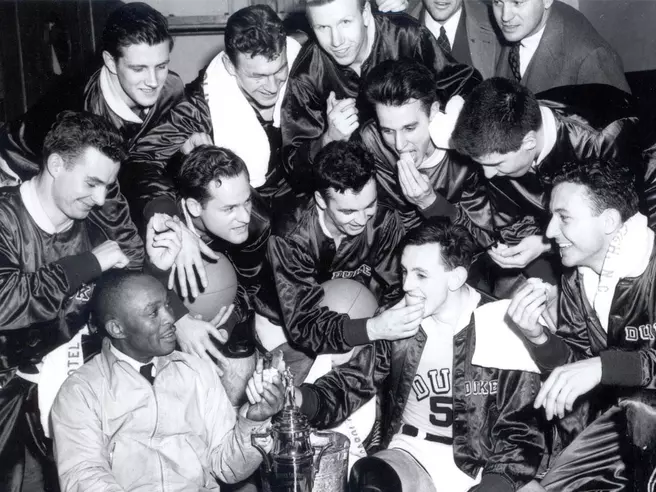
The Southern Conference Tournament moved to Raleigh and prospered. As the new league soon grew to 15 schools, the tournament remained a necessity to decide a champion. And interest in the Raleigh event ? held at old Memorial Auditorium ? continued to grow stronger. When Duke won its first conference title in 1938 ? a surprise triumph by the erratic “Never-a-dull-moment-Boys” ? the Southern Conference Tournament drew the largest crowds ever to see an indoor sporting event in the South.
The Southern Conference Tournament continued to climb in popularity for the next 15 years as North Carolina and Duke dominated the league ? at least until Everett Case arrived in Raleigh for the 1946-47 season and made N.C. State the team to beat. The tournament moved from 5,000-seat Memorial Stadium to the much larger Duke Indoor Stadium and then to Case’s brand new (and larger still!) Reynolds Coliseum.
It’s important to understand that when seven Southern Conference athletic powers got together in 1953 and elected to form a new league so they could pursue football success, the postseason conference basketball tournament was a tradition they brought with them into the new ACC..
The 1953 Southern Conference Tournament, held in Raleigh’s Reynolds Coliseum, drew a full house (12,400) to see Wake Forest pull out a 71-70 victory over N.C. State on a late tap-in by Dickie Hemric.
A year later, another sellout crowd of 12,400 jammed Reynolds Coliseum to see N.C. State edge Wake Forest, 82-80 in overtime, despite Hemric’s 26 points.
The point is ? there was no almost difference between the 1953 and the 1954 tournaments. The same teams were involved ... the same players. When Virginia’s Buzzy Wilkinson scored 42 points in a first-round loss to Duke, the sports writers covering the game didn’t list it as a new record for the first-year ACC Tournament, but wrote that the Virginia star had broken Gene Shue’s old record of 41 points ? set by the Maryland star the year before in the Southern Conference Tournament. And when N.C. State claimed the first ACC championship, it was reported as the seventh title in eight years for the Wolfpack ? no matter that six of those titles were won in the Southern Conference.
The ACC Tournament wasn’t a new event in 1954. It was the heir to 33 years of basketball history, dating back to the original SIAA Invitational in 1921. Yes, the remnants of the Southern Conference ? no longer a major conference ? claimed that heritage, but the new/old league continued the tournament with teams that couldn’t get out of the first round before the split.
True, there were ACC coaches who hated the event and thought the league should choose its champion just like everybody else ? by using the regular season results. McGuire, who saw his undefeated 1957 team almost miss its date with destiny when it narrowly escaped an ACC Tournament semifinal loss to Wake Forest, called the tournament “Russian roulette” and lobbied to kill it. However, N.C. State’s Case, who grew up in Indiana believing that basketball was a tournament sport, had more clout in those days than the pugnacious Irish carpetbagger from New York. Case was supported by a generation of administrators (including Duke’s powerful Eddie Cameron) who had grown up with the Southern Conference Tournament as a big part of their lives.
The irony is that after three decades of holding the tournament because a regular season round-robin was impossible for a league with anywhere from 15 to 23 members, the new eight-team ACC promptly adopted a balanced round-robin schedule. But by that point, the tournament was so entrenched in the league’s heritage that it was too late to change.
The double irony is that now that the league has expanded to 12 teams and can no longer hold a balanced round-robin schedule in the regular season, the tournament once again becomes the fairest way to decide a champion.
Duke has won 16 ACC championships, tying North Carolina for the most of any ACC school. Those titles have come in four spurts:
Krzyzewski will head back to Charlotte Friday, looking for his 11th ACC championship and the school’s record-setting 18th title. His 1992, 1999, 2000 and 2002 titles were all won in the Queen City.
"I think Charlotte’s been great,” he said. “The [new Bobcats] arena ? we played Davidson there ? is beautiful.”
Krzyzewski insists that the ACC Tournament has been a good preparation for the NCAA Tournament.
“Our league has done an amazing job of making this like a Final Four atmosphere,” he said, praising former tournament manager Fred Barakat and currect director Karl Hicks. “I like the fact that our league uses a lot of resources to create that atmosphere. We’ve always celebrated the game very well in our conference.”
It’s that celebration and the memory of 87 years of tournament history that causes the ACC Tournament to stand out from the crowd.


