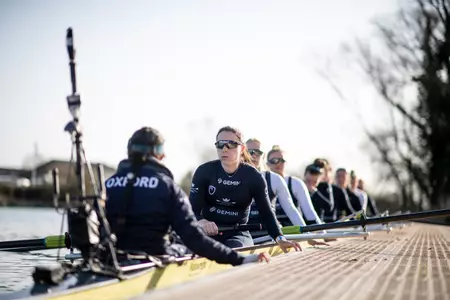
For each athlete, there exists one event that sits atop any athletic bucket list. This usually is established through watching that event as a child, or growing up in close proximity to where it resonates with everyone in the community. In the case of
Katherine Maitland, both aspects were realized on April 4, when she competed in The Boat Race on the River Great Ouse in Ely, Cambridgeshire, England.
A two-time All-ACC performer at Duke, Maitland enrolled as a graduate student at Oxford University in 2019 and brought her rowing prowess to the Dark Blues' storied program. She watched The Boat Race – an annual contest between Oxford and Cambridge – year in and year out as a London native, with hopes of one day being able to suit up in one of the sport's most publicized traditions.
Yet like many athletes over the past year, Maitland's dream was delayed due to the COVID-19 pandemic. After the 2020 race was canceled, she shifted much of her focus towards her responsibilities as a medical student at an elite academic institution. When it was time to make a decision on if she would begin training for 2021, however, Maitland recommitted herself with a firm goal of winning the historic event.
The coverage of the race did not faze Maitland throughout the winter training period. While COVID-related restrictions forced the team to adjust preparations, she remained focused on cracking the lineup for Oxford's top boat, 'AstraZeneca.' Even when it was announced that the race, typically held on The River Thames, would this year take place in Ely, Maitland saw it as an opportunity to defeat Cambridge on its home course.
However, once April 4 began to creep closer, she became even more aware of the race's magnitude.
"Up until they told the athletes who had made the crew, it didn't feel real," Maitland said. "Then, the day they told us who was in the boat, they had media down and there were launches filming us, and suddenly it felt very real. We were three weeks from The Boat Race and people were taking photos, and you had to wear the right kit and make sure you had the sponsors and all that sort of stuff. There was a lot of red tape to jump through. We went up to Ely the Wednesday before. We didn't spend that long there, but that's when it really started to kick in. I don't think I've been that nervous for a race ever."
While the increased media attention would understandably have an effect on a collegiate rower, Maitland felt that it provided more of a motivating factor than a distraction.
"Once I'm in the boat, I kind of forgot that they were there. If anything, you want to put on a little show for the cameras, in which case you just want to row well and look like you're having a good time, so then you do end up having a good time. I think it was more that the nerves came from the fact that we had to race this race, and all the uncertainties around what the other crew was going to be like, rather than specifically the media filming."
Maitland recalls what others before her said about their experience in The Boat Race. It was often a sentiment of unpredictability, where nothing could prepare someone for the intensity of that moment. Leading into the day of the race, she did not buy into the notion. She admitted that with a rigid training structure at Duke and then at Leander Club near London, her mindset was that it would just be another 5,000-meter race. But after going through the event herself, Maitland noted that it was "one of the hardest things I've ever done and unlike anything else I've ever experienced."

"I don't think I've ever been so tired that early on in a race," she said. "You can tell by my face on the footage – it's somewhat embarrassing how hard I was working. They gave me a heartrate belt to wear, and they showed that on the coverage. It shows me at 140, which was a complete lie – I was way up in the 180's and maxed out at 200 beats per minute by the end, which is very high for me. It's hard to explain the feeling, but it was simultaneously taking forever, but very quickly. I've never had that before in a race where I wanted the end to appear, but also was like 'The end is coming too soon, we have more to do.' I was so focused on pulling hard and just getting my bow ball ahead of Cambridge."
The Dark Blues were able to overcome a fast Cambridge start, but the home side ultimately took the race by three-quarters of a length. It marked the closest finish on the women's side since 2011. With the months of training and anticipation yielding an unfavorable result, Maitland and her teammates were left to absorb a crushing defeat, but faced an unusual reality of keeping their emotions in check.
"On the water, I was sad but trying to hold it together, partly because I knew we had media coming to talk to us and would want something semi-coherent," she said. "I remember we all just sort of sat on the dock at the end. It was very strange – because of COVID, we weren't allowed to hug each other or anything, so it just felt very impersonal because there was no physical touch. You couldn't console anyone who was crying. It wasn't until we knew we were out of the way of the cameras that we could actually come together as a crew and all be sad about how it didn't go the way we wanted."
Once back at the boarding house at King's Ely School, where they had stayed throughout the week, the team was able to process the events of the day in a more natural setting.
"It ended up being us sitting quietly," Maitland said. "We were with each other and feeling all the emotions, and just talking about anything that came to mind, really."
Maitland remembers driving the minibus back to London herself with a group of exhausted teammates resting behind her. She gave herself three days to cry, reflect and recapture everything that had happened, not just on the day of the race but in the months leading up to it. As a medical student, she witnessed a number of patients battle COVID-19 without the presence of their families, which according to her helped put the race in perspective.
"I just thought, 'You absolutely cannot be sad. There are people who are having such a worse time than you and people who are having to go through so much," she said. "Then, after that I was like, 'You have to remember how much of an amazing experience it was.' Looking back on it now, I'm not sad anymore. I got to do The Boat Race – not many people even make it to the boat. I got to do all the fun interview stuff, have some amazing photos taken, meet some Olympians and be part of such an amazing experience. The outcome doesn't matter anymore."
Maitland has been on her surgical placement since returning from The Boat Race, which she acknowledges has been a welcome experience, particularly after an emotionally-draining few months. She was able to sit in and observe a robotic surgery, and enjoys being back in a solely academic routine.
However, she admits that her hiatus from rowing will likely be short-lived, as a long summer season awaits her and the Oxford squad. Events will ramp up again in June, beginning with the Metropolitan Regatta on Dorney Lake, set for June 5-6.
For now, though, Maitland values the time she is getting away from the sport. When she looks back on her experience in The Boat Race, there are aspects that stand out more than the result.
"I think it's strange as a rower, because we're not used to being in the spotlight," she said. "To have so much attention on one race is terrifying, but refreshing. There's a lot of pressure to show the sport and show the university in a good light. I was completely aware of a younger version of myself, if I was watching this on television, how much that would have inspired me. If anybody watched this and thought, 'I want to be her, I want to do that, I want to get involved,' – that would be amazing as well."
What Maitland cherishes most, however, is the amount of support she received both going into the race and in the aftermath. In the days leading up to April 4, one of the texts she sent out was to her college coach,
Megan Cooke Carcagno.
"I reached out to her during the week of the race to just ask for advice," she said. "She gave me some very good words of wisdom. I think because of the nature of the event being so public, there were texts from lots of people. I got things from professors and the president of my college emailed me to say good luck. People I hadn't spoken to in a while reached out to say good luck, which was quite nice. My housemates made a little thing on the refrigerator – a whiteboard drawing of a good luck message. It was really lovely to have so many people show support."
Following the race, it was a text from a coach at Leander, Ross Hunter, which stood out from the rest.
"I saw his message just saying that it was a really good race and I should be proud of myself. Then, I bawled my eyes out. I don't know why it was his message, but I read it and was immediately in tears."
Seeing the positive messages from people she admires in the rowing community helped Maitland further understand how special of an opportunity it was to compete in The Boat Race. As she continues her career in the sport while also growing in the medical field, Maitland will have many memorable moments both on and off the water. But for the 2018 Duke graduate, April 4 will forever be recalled as once-in-a-lifetime experience, and a moment in rowing history that will always include her name.
#GoDuke