Upcoming Event: Football versus Tulane on September 5, 2026 at 3:30 p.m.

Football
vs Tulane


11/5/2007 12:00:00 AM | Football, Athletics
DURHAM, N.C. -- In the fall of 1963 an Ahoskie, N.C., eighth-grader became a Duke football fan.
By the time he was a high school senior, he was a football standout ? 6-foot-3, 200 pounds, fast and skilled. A member of a family of educators, he was also an excellent student. Recruited by a number of high-level institutions, he turned them down to accept a football scholarship to Duke.
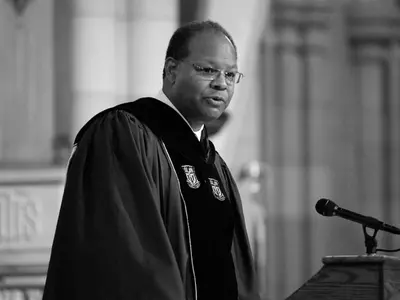
If you follow Duke athletics, you're heard the outlines of this story many times before. But there's a twist with this one. We're talking about Clarence G. Newsome, who along with classmate Ernie Jackson, integrated the Duke football program in the fall of 1968. Forty years after arriving at Duke, Newsome now is the president of Shaw University, a noted scholar, and remains an active and influential member of the Duke community.
C.G. Newsome attended Vann High School through his sophomore year before transferring to integrated Ahoskie High School. His father, Clarence Shaw Newsome, was the principal at Vann and one of the leaders of Ahoskie's black community. Assorted grandparents, aunts and uncles also were educators.
C.G. Newsome was all set to go the United States Military Academy when Duke called. He turned down West Point after "moments of deep introspection and reflection." Why Duke? "The school just resonated with excellence," Newsome recalls. "It was where I wanted to go. It was an opportunity for me. Helping to desegregate Duke was a useful by-product, but it never was the primary goal."
Newsome spent the summer before his matriculation at Duke in a summer program at nearby Hampton, honing his math skills. Duke didn't have a lot of African Americans in 1968 and the school was still figuring it all out. "It was difficult, challenging times for African American students," says Newsome. "The attrition rate was high. I benefited from the academic support provided by the athletic department, but that support wasn't available to everyone. It was very tough. Many professors assumed I was unprepared. One professor made a general statement in class that blacks can't write, especially black males."
Newsome was a key recruit. Tom Harp and Mike McGee tried him at wide receiver and tight end, but chronic knee problems held him back. "I went to Duke fully expecting to play in the NFL," he says. "It had been my goal since the ninth grade. My size, speed and dedication all pointed in that direction. I still think I would have made the pros if I had I stayed healthy. I still haven't stopped playing the game in my mind."
But the knee problems didn't affect his work in the classroom. Newsome was a superb student. He was twice named to the All-ACC Academic football team. He graduated in three-and-a-half years with a degree in religion and immediately started graduate school. Howard Wilkinson, one of his professors, approached Newsome about speaking at the 1972 graduation ceremony. "It wasn't that daunting," Newsome says. "I had been a public speaker all my life. The African American church encourages public spoken word as a way of making contributions to society."
So one of Duke's first African American football players became the first African American to speak at a Duke commencement. Newsome's talk was entitled "An African Concept of Time and a Theme of Liberation in the World Community." Newsome shared the podium with featured speaker Walter Cronkite.
Newsome had some decisions to make. "I still wasn't certain I wanted to give up football. Mike McGee arranged a tryout with the St. Louis Cardinals. The 1972 semester in graduate school convinced me that I was in the right place." Newsome canceled the tryout.
He earned a master's and a doctorate and made the switch from student to teacher, becoming a member of the Divinity School faculty for eight years. Newsome also pastored a local Baptist church and was active in the General Baptist Convention of North Carolina. "I had been called to the ministry for some time but had been fighting it. I felt that I had to honor that call. To be in position to counsel to students effectively, I had to pastor one day in order to understand the full sense of the call."
He stayed at Duke until 1986, when he was approached by Howard University. By that time Newsome and his wife, Lynne Platt Newsome, also an educator and a Duke graduate, had two daughters, Brittany and Gina. They decided to move to D.C. because of Howard's status as the nation's top divinity school associated with a historically black university. Newsome started as assistant dean of the divinity school, became associate dean in 1988 and dean in 1992. It was a good fit. Newsome elevated Howard's already high profile and solidified his reputation as a scholar, speaker and administrator of the first rank.
Back in the Triangle, Raleigh's private Shaw University was looking for someone to replace retiring president Talbert Shaw. Shaw was founded in 1865 as the first African American college in the South. Newsome was a candidate. "I was not interested at first but I kept thinking about it," he says. Aging parents in North Carolina were a factor. "Shaw had a sense of legacy in the family. My father's middle name came from the school. My grandmother had helped raise money for Shaw as part of her commitment to the Baptist church. It was a pedigreed school for the Newsome family."
Newsome became president of Shaw University in April 2003. One of his first calls was to Herman Thomas, a former Duke divinity school colleague and a professor at UNC-Charlotte. "I had been at UNCC for 28 years and was looking for retirement, not a career change and move," says Thomas. "After one meeting with Dr. Newsome, I was packing my bags."
Thomas gave up teaching to become Shaw's vice-president for academic affairs. He has a bird's eye view of how Newsome is doing at Shaw. "His greatest asset is directed energy, under-girded with passion and ability. His mission is to enhance the quality of academics for Shaw. Everything he does works towards that goal. He is a master of details, with high standards and very clear leadership in goals and objectives. You had better have it together when you approach Dr. Newsome. If you don?t, he will help you get it together, lovingly but effectively."
Under Newsome's leadership Shaw has become a leader in technological sophistication. "We've made great strides in that area," Newsome says. "We have a wired campus. Numerous courses are available online, while we video conference all over the world."
Duke and Howard are both research institutions and one of Newsome's priorities is raising Shaw's research profile, both at the faculty and student level. "We're on to something," Thomas says. "Our goal is to become the premier private historically black research institution in the nation."
Shaw is building a 35,000 square foot building devoted to studying African American health issues. Newsome hopes to see more expansion but space is tight. "Downtown Raleigh is a great place for Shaw," he notes. "There's so much going on, so much energy. We need to create space for the school while controlling gentrification and working with the community to guarantee access to affordable housing for working people of all races."
Early in his tenure at Shaw, Newsome almost shut down the school's baseball program. CIAA schools are dropping baseball, it was becoming harder to find nearby opponents and playing more distant schools is expensive. "My mind was changed by the players, their commitment and passion for the sport," says Newsome, who reinstated the program. "It's the best decision I ever made." The school's revived football program "enhances the quality of life at Shaw and gives us another way to connect with our alumni."
Newsome feels that sports, properly utilized, develop commitment and passion. "Football prepared me well," he says. "I believe in the student-athlete and the total experience. I want it all, excellence in the classroom and on the field of play. No compromises."
The Shaw president remains close to his alma mater. Among other commitments, he's a member of the Board of Trustees, where he follows Duke's efforts to regain its previous stature in football. "We must invest more dollars in this program," he insists.
"Money is not the panacea but it is a critically important component. Duke needs to be able to recruit all over the world. Duke needs to find the best football players in the world and convince them to come to the best university in the world. A successful football program at Duke is important to reinforce the overall excellence of the university.
"I love Duke absolutely. I want to give back to Duke for the way Duke prepared me, and show my gratitude for the commitment the school made to me. My Duke family has done so much to prepare me for what I can do for my Shaw family."