Upcoming Event: Track & Field versus NCAA Outdoor Championships on June 10, 2026

Track & Field
vs NCAA Outdoor Championships


%20(1).png&width=24&height=24&type=webp)


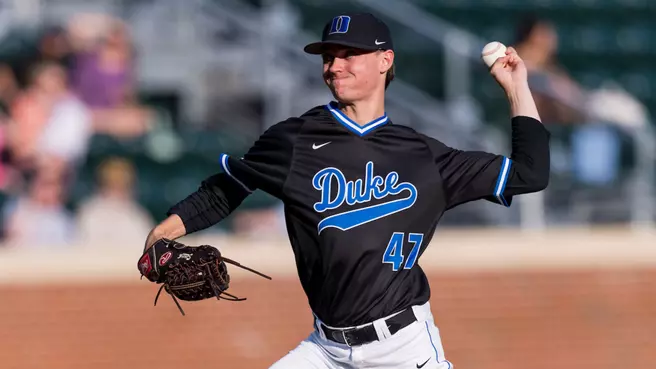
By Jim Sumner, GoDuke the Magazine
Duke made the 2016 NCAA Baseball Tournament, ending a postseason drought that dated back to 1961.Duke made the 2016 NCAA Baseball Tournament, ending a postseason drought that dated back to 1961.
The Blue Devils lost both of their games in the double-elimination format but expected to end that losing streak the following season.It didn’t work out that way.
“We’ve always known how good we could be,” third baseman/pitcher Jack Labosky says. “We expected to be regional-bound last year but we didn’t live up to expectations, so we know that these expectations can fizzle out by the end. Last year, a few things didn’t go our way. It didn’t pan out the way we wanted.”
Despite a late run in the ACC Tournament, Duke finished 30-28 overall, 12-18 in the ACC.So, was 2016 an aberration? Or was 2017?
Labosky says the latter.
“A of teams take awhile to mesh,” he notes. “Experience will show. You know the capabilities of the guys around you. It’s really important to prove that two years ago wasn’t a fluke. I think this year will show that the team that went to the regionals two years ago will be a regular thing.”
Duke returns almost every position player from last season. Right fielder Griffin Conine had a breakout season in 2017, hitting 13 home runs and driving in 56 runs. Conine followed up with an outstanding summer, playing for the Cotuit Kettleers in the prestigious Cape Cod League, where he was voted the league’s top pro prospect.
Conine projects as a first round pick in the 2018 MLB Draft, perhaps a top 15 pick.
How good is Conine?
“He has some pop,” Labosky says. “He can put it in places the rest of us can’t. He’s the real deal.”
Conine has plenty of help. Left fielder Jimmy Herron batted .326 last season, with 39 RBIs. Catcher Chris Proctor, shortstop Zach Kone, second baseman Max Miller and center fielder Kennie Taylor provide talent and experience up the middle, while Labosky returns at third. Veteran Michael Smiciklas returns as DH, while freshman Joey Loperfido began the season as the new first baseman.
But most of these players were in the lineup last season, when Duke struggled to a sub. 500 conference mark. Duke lost all of its weekend starting pitchers from 2016 and much of the season was spent auditioning replacements.
By the end of the season, Duke had found two solid starters, lefty Mitch Stallings and right-hander Ryan Day. Talented freshman Adam Laskey showed ACC stuff but not ACC command, notching a 6.83 ERA.
That trio began this 2018 season as the weekend starters.
“Mitch Stallings has been doing it for three years,” Duke head coach Chris Pollard says. “Ryan Day did a great job for us and he’s back. Adam Laskey made big strides in the fall.”
The staff is adjusting to a new pitching coach, Dusty Blake, who joined the program last December.
Blake was the head coach Pfeiffer College. Pollard says he’s known and respected Blake for years but also notes, “We wanted to upgrade our analytics and Dusty was perfect for that.”
Analytics?
“You find better ways of doing what you’re already doing,” Blake explains. “Analytics gives us feedback data on some of the things that may seem subjective when we see them on the field, whether it’s extension release point, induced vertical break, velocity obviously.”
Sound like an automaton? Think again.
“We find that the more we can get access to that kind of data, the more we can prepare each individual player based on where he is in each specific area. We can maximize his time, rather than have a broad-spectrum plan for everybody,” Blake says.
Stallings and Labosky are impressed.
“He knows his stuff,” Labosky says. “He knows how to analyze a pitcher, knows the science of pitching, but he’s not going to cookie-cut someone based on analytics.”
Stallings cites Blake’s hard work in the film room catching up on what he missed last fall.
“The amount of work he’s put in has been exceptional. He wants guys to buy in. He wants you to understand a drill and he wants feedback on whether something is working for you. He truly prepares each guy."
Duke is trying to maximize pitching efficiency, getting batters out of the box as quickly as possible.
“Strike one is the best pitch in the game,” Blake says.
Stallings is a believer. “Early in my career, I hunted strikeouts too much,” he admits. “The goal now is to get the batter out of the box in three pitches or less 70 percent of the time. Don’t be afraid to pitch to contact.”
A senior from Atlanta, Stallings is a key to communicating these goals to younger pitchers.
“I’ve never been a super-loud guy” he says. “I’m more of a lead-by-example person. I offer my assistance on a personal level, share my experiences, what works, what doesn’t work.”
Blake isn’t the only exciting addition to the pitching corps. Graduate student Ethan DeCaster transferred in from Creighton. He’s a closer.“
He pitches from a funky arm angle,” Stallings says. “It’s like the pitch comes from behind him. Batters can’t figure it out.”
But improvement from sophomores Laskey, Matt Mervis and Graeme Stinson figures to be as important as the veterans, the latter two candidates for mid-week starting assignments.
“Our goal is to get them to improve on a regular basis,” Blake says. “We’re measuring strike percentage, missing in the right area. They have shown improvement. Games are the test. You shouldn’t use the test to learn the test. You need to use every day in between — spin command, both sides of the plate, up and down, in and out.”
DeCaster made his Duke debut against Vanderbilt in the opening series of the 2018 season, throwing 2.1 scoreless innings in a 5-4 win.
And about that Vanderbilt series. Duke jumped into the deep end of the pool, opening with a three-game series at Vanderbilt, a perennial national power only four years removed from winning the College World Series.
“Vanderbilt is the template for where we want to be,” Pollard says, “for the way they combine academics and athletics.”
The Commodores exposed some holes. Laskey, Day and Stallings all had solid starting efforts. Pollard was especially pleased with Day’s six-inning, two-run stint in game two of the series, Duke’s lone win, giving some clues as to what Duke wants from its starters.
“It was a terrific start,” Pollard says. “I really liked the way he interchanged his cut fastball and his slider. The fastball had sink on it and he was very aggressive pitching in.”
With the exception of DeCaster’s sterling effort in that second game, Duke’s bullpen struggled, letting the first and third games get away in one-sided losses. Some shaky fielding didn’t help. Pollard still thinks the bullpen has more good arms than ever before and expects significant improvement from the relievers as the season progresses.
“Josh Nifong and Bryce Jarvis and Matt Dockman are three freshmen who threw well for us this fall and are in a position to grab some innings.”
The goal remains the same.
“We have to adjust to expectations,” Pollard says. “Part of our preparation is getting physically ready but also making sure we’re mentally prepared for the expectations. We’ve got some guys who have proven they can do it. We expect to make the tournament this season, every season.”


