Upcoming Event: Track & Field versus NCAA Outdoor Championships on June 10, 2026

Track & Field
vs NCAA Outdoor Championships


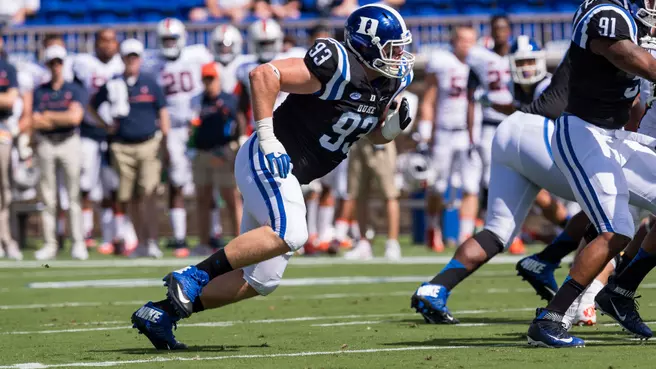
If there was one question mark hanging over the Duke defense heading into the 2016 season, it was the pass rush.
The Blue Devils had one of the weakest pass rushes in the ACC last season — just 17 sacks in 13 games. That ranked 13th out of 14 teams in the ACC and 114th nationally. That weakness put an inordinate amount of pressure on the secondary, which was asked to defend receivers far longer than normal.
The prospects for 2016 weren’t much better, especially with last year’s two sack leaders (Jeremy Cash and Carlos Wray) graduating.
So it comes as some surprise that the 2016 Duke pass rush has been one of the best in the country. After nine games, Duke had recorded 27 sacks, tied for 13th best nationally.
How did that happen?
“I think we’ve been very creative and I think (new defensive line coach) Ben Albert has made a difference,” Duke head coach David Cutcliffe said. “And I think we’ve got some people with the skill to do it.”
Safety Corbin McCarthy saw it coming together last spring.
“I think Coach Albert came in and did a terrific job of getting the D-line ready,” the senior defensive back said. “This spring, he was hammering in on what they had to do with their technique. I saw that first hand. Coach (Jim) Knowles, again, is dialing up blitzes that are working for us. DeVon (Edwards) had three sacks in the first three games. I had two-and-a-half in the first five. We’ve got a lot of people."
Albert came to Duke from Boston College, where he helped shape a defense that led the nation in total defense a year ago. He’s obviously had a huge impact on his young defensive line.
“Schematically, we’re doing very, very well and we have the guys willing to put in the work to make those plays.”
“I think it’s more of a mentality thing,” defensive tackle A.J. Wolf said. “What Coach Albert has brought is the mindset that we are going to go after the quarterback on every play. No matter what the down, be ready to rush. I know we didn’t have good sack numbers last year, but if you look at our sacks on first down a year ago, those were really terrible. Now we rush every down.
“He’s given us a little more freedom to roam, but basically, the schemes haven’t changed … it’s been a mentality thing — always being ready to rush.”
Wolf, who was in on one sack in his first three seasons at Duke, already had 5.5 sacks in nine games this season.
But many of Duke’s top rushers are linebackers and defensive backs. In fact, safety DeVon Edwards — who played in just three games before he was hurt in the opening minutes of the Notre Dame win — still ranks fourth on the team with 3.0 sacks, just behind McCarthy, who has 3.5 sacks in nine games.
That’s what Coach Cutcliffe means when he talks about creativity.
“To get into the creativity when you can get DBs — Corbin and DeVon — being so effective as pass rushers has been really important,” he said. “It’s not an accident that you see A.J. showing up and Marquies (Price) showing up, Brandon Boyce showing up. Those guys have some speed, quickness, strength that helps you defeat one-on-one blocks. That’s what we haven’t had in the past. We’re defeating one-on-one blocks more often in the pass rush.”
McCarthy, who plays the same strike safety position as 2015 sack leader Jeremy Cash, loves the chance to bring the heat.
“I love blitzing, Coach Knowles knows that,” he said. “If I could blitz every play, I would. But it’s up to him.”
Knowles, who has served as defensive coordinator since 2009, designs the blitz packages that have made McCarthy and linebackers Ben Humphreys and Joe Giles-Harris such an important part of the pass rush.
For Humphreys, the improved pass rush is the product of many things.
“That’s all practice. It’s all technique. Everyone’s better,” he said. “The D-line is better in their individual techniques because of Coach Albert and what he’s brought from Boston College, his philosophy and his passion for the game. They play differently than they have in the past. The pass rush on the defensive line and having an experienced secondary allows Coach Knowles to bring pressure from different places and mess with offensive coordinators’ minds.”
Humphreys gets pumped up when he is called on to blitz.
“I’m looking to go make a play,” he said. “I know when he calls a blitz, he’s looking for somebody to go make a play. Someone’s going to be unblocked and when you are unblocked, you have to go make a play. When a blitz is called, coverages are going to be different and somebody’s going to be open if you give them enough time. You have to get there and go 110 percent though the line and go make a play.”
Wolf suggested that the blitz calls make his job easier.
“We try to attack the offensive sets,” he said. “It’s not rocket science. It’s a lot about being in the right spot at the right time. I think what we’re doing a really good job of this year — the reason for more sacks — is containing the pocket, because in the past, we’d have one guy come free on a good move, but the pocket would break down and the quarterback would scramble out. I’ve got a few of my sacks this year, getting in the backfield, but then having another defensive lineman not give up an escape lane. We’ve done a good job of that this year.”
Wolf is the most experienced player on the front line. Duke does have good depth at tackle, but the team’s defensive ends are very inexperienced. True sophomore Marquies Price is the only player on the depth chart at that position with any real experience.
That should be a problem, since defensive end is usually the position that generates most of the pass rush. But while Duke’s ends have combined for just 3.5 of the team’s 27 sacks, that’s not all they do.
“Some of the plays I’m thinking of, the ends are the ones that held the pocket,” Wolf said. “Despite them not having that many sacks collectively, they’re still doing a good job. Coach Albert preaches all the time that it’s a four-man pass rush. It’s not one guy making a good move and getting a sack.”
In the future, Duke’s youngsters ought to make the rush even better. So far this season, true freshmen Terrell Lucas, James Hornbuckle and Chidi Okonya have seen action at end. Along with redshirt freshman tackle Trevor McSwain and true sophomore Brandon Boyce (who might be the most gifted natural pass rushers among the tackles), Duke’s line has the potential for considerable growth.
So there are a multitude of reasons for the improved pass rush — individual player development, Coach Albert’s work on the defensive line, Coach Knowles’ success with the blitz schemes. All have played a part in Duke’s improvement from 17 sacks in 13 games last season to 27 sacks in nine games this season.
“That’s something to be prideful about,” McCarthy said. “It’s good. It just goes to show how good Coach Albert is. How good Coach Knowles is. Just all of our coaches. And how hard all our players worked on that. It was definitely something we needed to work on in the offseason. We focused on it and now it’s coming to fruition.”
Of course, the numbers might fluctuate as the season goes on. The 13-6 victory over Army offered an illustration of how numbers are often warped by conditions. The run-oriented Cadets only threw 11 times in the wind and rain of Hurricane Matthew. Duke didn’t get a sack, although the Blue Devils were credited with three QB hurries — a good number for 11 pass attempts.
McCarthy got one of the hurries. He thought at the time that he had another sack.
“I thought I had a sack as I pulled him down,” he said. “I didn’t know that he was able to throw it away. That hurt my feelings.”
But the play came on a fourth down gamble near the Duke end zone. McCarthy might not have gotten the sack, but his pressure proved to be a significant play in the game.
It’s the kind of play that Duke didn’t make very often last season, but one that the Devils make routinely in 2016.
#GoDuke


