Upcoming Event: Women's Soccer versus Wake Forest on August 5, 2026 at 7:30 p.m.
/
7:30 p.m.

Women's Soccer
vs Wake Forest


.png&width=24&height=24&type=webp)


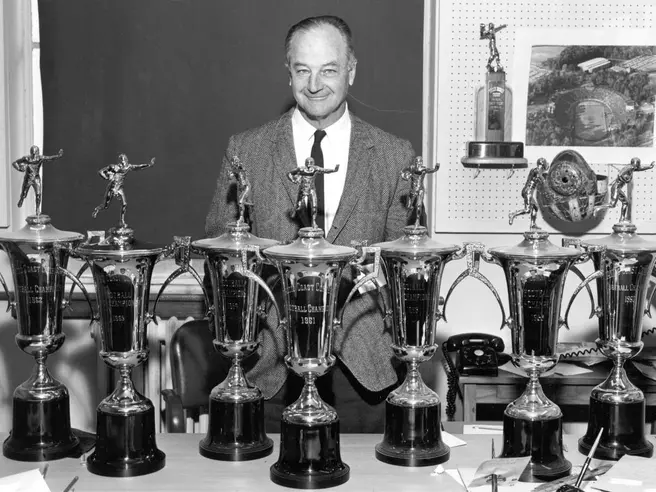
DURHAM, N.C. - When David Cutcliffe talks about changing the football culture at Duke, he’s first alluding to the need to instill a winning attitude in a group of players who have won just two games in the last three years. But the first-year Blue Devil coach also understands that there’s a larger aspect to the idea of changing the culture at Duke.
“There’s a much larger dimension and a bigger challenge involved,” Cutcliffe said. “We have our players every day. We’ve been working on that with them since last January and I think we’ve made progress in that regard.”
The harder task is changing the mindset of those outside the program.
“The thing we have to do is to get people enthused ... to get people in the stands ... to sell the stadium out,” he said. “I said this everywhere I went ? there’s been too much finger-pointing when it comes to Duke football. I think we all have to take responsibility. I think that everybody has a part in this. Our administration has been very supportive in this and has declared that they want to change the culture of football at Duke.
“We’re challenging ourselves. But I’m not going to be afraid to challenge other people. We’re serious about changing this football program.”
Cutcliffe has his work cut out for him. Over the last 40 years, football has played a smaller and smaller role in the campus life at Duke. As the once successful Blue Devil program started to fade on the field in the late 1960s, interest in football faded with it. Basketball replaced football as the school’s signature sport. Attendance dwindled at a slow, steady rate and all the colorful accompaniments that make football so special faded too ? tailgating became limited to a small group (or, in the case of the students, a social function that was divorced from the game); the once mighty Duke University Marching Band shrunk to a handful of devoted musicians; the homecoming parade ? and float-building -- disappeared.
That’s part of the football culture that Cutcliffe must restore.
“Change doesn’t happen overnight,” junior defensive tackle Vince Oghobaase said. “What Coach Cutcliffe has done is go out and get the community involved, get students involved. I think all over the university, Coach Cutcliffe has made the students and the staff buy into Duke football. He’s all over Durham, trying to get people involved and putting Duke football back on the map.”
Cutcliffe acknowledges that the easiest way to set Duke football is to win ? but until that happens, he’s doing what he can.
“I’m pleading, but all I can do is ask,” he said. “We have a responsibility to campus life that we take seriously in football. It’s respect.”
Old-timers remember when Duke football was respected. Wallace Wade, Eddie Cameron and Bill Murray made Duke football was big-time. Between 1936 and 1965, Duke played in five major bowl games, finished in the Associated Press final top 10 five times and finished in the second 10 another 11 times. Just to put those accomplishments into perspective, that’s more major bowls and more final top 10 rankings than Duke’s three Big Four rivals have accumulated between them.
When Murray resigned after the 1965 season, Duke was unquestionably the strongest football program in the ACC, having won or shared seven of the first 13 conference titles awarded, while finishing second in the league three times and third twice. Wade Stadium was surrounded by rows of semi-permanent bleachers and the top games wound draw between 45,000-50,000 fans.
When Eddie Cameron, the Blue Devils’ athletic director at the time, learned that Murray planned to step down, he acted behind the scenes to make sure that Duke’s program would remain at a high level. He dispatched Wade, who was retired on his farm in nearby Bahama, N.C., to New York City to talk to Bud Wilkinson about the job.
Wilkinson, who won 14 conference titles and three national championships in 16 years at Oklahoma, was just 47 years old when he retired to run for the U.S. Senate. After he lost that race in 1964, the future Hall of Fame coach signed on with ABC-TV as a color commentator for college football. He had a connection to Duke ? his son, Jay, was an All-American halfback in 1963 under Murray. Reportedly, Wilkinson let Wade know that he would be interested in a job offer from Duke.
It was not forthcoming. New university president Douglas Knight wanted to remake the Durham school into more of an Ivy League institution. He prevailed to Cameron to pursue and hire Tom Harp, who had compiled a 19-23-3 record in four years at Cornell. And when Harp was released after the 1970 season, Duke turned down the chance to pursue young West Virginia coach Bobby Bowden (who claims that the Duke job in 1970 was the only job he ever applied for).
But it would be unfair to blame Harp or his successor Mike McGee, who got the job instead of Bowden, for the gradual, but steady decline of Duke football. Both were victims of an administration and faculty that had come to see athletic success as somehow antithetical to the school’s academic reputation. In December of 1969, a five-man committee appointed by the Duke Academic Council issued a report recommending that Duke de-emphasize athletics, eliminate athletic scholarships (except for need) and withdraw from the ACC “as soon as contractual and other arrangements permit.”
While the Board of Trustees voted to reject that proposal, little was done to give the football team much chance for success. Facilities were allowed to run down, coaching salaries were the smallest in the ACC and recruiting budgets were limited. Duke high academic standards became even more on a handicap in 1972 after the ACC abandoned its 800 SAT rule and adopted the NCAA’s minimal admissions standards ? standards that allowed Duke’s ACC opponents access to a huge pool of talent that the Blue Devils couldn’t touch.
In hindsight, McGee’s 37-44-4 eight-year record looks better than it was judged at the time. And, in hindsight, can anybody believe that Red Wilson was fired after consecutive 6-5 seasons in 1981 and 1982?
The slow, gradual decline of Duke football can be measured by the winning percentages of the coaches who succeeded Murray:
Obviously, the three-year Spurrier Era represents the lone exception to the long Duke decline. While Spurrier’s undoubted offensive genius had a lot to due with Duke’s success in the late 1980s, he was helped by a brief period of institutional support engineered by former athletic director Tom Butters and some good ground-work lade by Sloan and his staff.
Unfortunately, Duke couldn’t build on Spurrier’s success. In fact, the program took a sharp downturn after Goldsmith’s remarkable 8-4 season in 1994. What had become a mediocre program before Spurrier, became one of the worst programs in college football. Starting in 1995, Duke is 22-125 (15.0 percent).
It’s become a vicious circle. Duke’s lack of success has killed interest in the program. The lack of interest in the program made success more difficult to achieve.
That’s the culture that Cutcliffe must change if he’s going to revive the once-great Blue Devil football program.
Is it possible?
Well, two of Duke’s first three 2008 opponents offer evidence that the cycle of football failure can be broken.
Navy was once, like Duke, one of college basketball’s great powers. The Middles endured some tough years in the late 1960s and early 1970s, but when George Welsh took over the Navy program in 1973, he restored some of the program’s luster and led the Naval Academy to five winning seasons and three bowl games in nine years. But after Welsh left in 1982, the program again fell on hard times. Five straight coaches came and went with losing records as the Middles compiled a 72-148 record in a 20-season span.
Navy football was in sad shape when Paul Johnson took over the program in 2002. The Naval Academy was coming off the worst two-year span in school history (1-20). Johnson’s first team finished 2-10, including a 43-17 loss to a 2-10 Duke team.
Navy’s facilities were outdated and, of course, the academy faced serious recruiting handicaps compared to most major college programs. Yet, Johnson won eight games in his second season and 10 in his third. He led the Midshipmen to five straight bowl games and never ? after that first season ? won less than eight games.
Duke’s second opponent in 2008 offers an even better blueprint for the Blue Devils to follow.
Between Alex Agase’s 7-4 record in 1971 and Gary Barnett’s 10-2 Big Ten co-champions in 1995, no Northwestern team won more than four games in a season. The Wildcats were 46-203-3 ? that’s 18.8 percent ? over a 23-year period. During one seven-year stretch from mid-season 1975 to midway through the 1982, Northwestern was 3-70-1 with a 34-game losing streak.
John Pont, who won a Big Ten title at Indiana, was a part of that failure. So was Dennis Green, who later won 10-plus games in five different NFL seasons.
Barnett had to re-build from the ground up. His first three Northwestern teams won three, two and three games before he suddenly won 10 and 9 games (and Big Ten championships) in his fourth and fifth seasons. After 23 straight losing seasons, Northwestern has won six or more games in seven of the last 13 seasons.
Northwestern and Navy prove it can be done.
Cutcliffe is betting that he can break Duke’s losing cycle both because of his own previous success at Ole Miss and because he has something that no other Blue Devil coach in 40 years has enjoyed ? the full support of the school’s administration.
“They are about total commitment,” Cutcliffe said back at his introductory press conference last December. “As they were evaluating me, obviously I’m evaluating them. I know where their heart is. I know where their intellect is. They are totally committed to what we’re doing.”
Cutcliffe said that before he agreed to come, he wanted to know what Duke’s plan for success was.
“My job is to have a plan,” he said. “What is the administration’s plan to make Duke football better?”
He learned about the long range Strategic Plan for Duke football ? a study of schools that have successfully blended football success with academic success and a blueprint for doing the same at Duke.
“They very quickly went into what they were going to do from a commitment standpoint, whether it was personnel, facilities ? there is a plan in place here,” Cutcliffe said. “I like looking at this ... you look at what Mike Krzyzewski has done here; look at the other sports here. It all comes together when you put that strategic plan in place.”
New athletic director Kevin White came to Duke from Notre Dame to help implement that plan.
“I think pretty unique for [the Trustees] go out on a limb and say ?We think intercollegiate athletics are pretty darn important and this is what the future needs to look like,’” White recently said.
Cutcliffe has a pretty good idea of what the future needs to look like. He’s already gone a long way towards selling that vision to the players he inherited.
“He came in with a level of confidence that we hadn’t seen before,” Oghobaase said. “That gave us confidence.”
Cutcliffe’s players are convinced that there has already been a change in the football culture at Duke. As they prepare for the 2008 season opener Saturday night against James Madison, they are determined to show the rest of the Duke community what Duke football is going to look like in the future.
“People want us to succeed,” senior linebacker Michael Tauiliili said. “We’re going to have to do what we have to do in order to change the culture. We’re going to have to start producing and put Ws on the charts. That will change the culture.”
That makes sense ? it was losing that changed Duke’s football culture for the worse ... winning will almost certainly reverse the process. And there’s at least some historical evidence to support that assumption.
In 1987, when Duke completed a 5-6 season in Spurrier’s first year, the home attendance averaged 23,300 fans. A year later, it started slow, but as the team reeled off five straight wins en route to a 7-3-1 finish, the turnout soared to an average of almost 30,000 fans for the final three home games. And after another slow start in 1989, when the team started 1-3, the turnout exploded late ? averaging over 35,000 fans (over Wade’s capacity) for the final three home games.
The same thing happened in 1994, when Goldsmith’s first team unexpectedly won seven straight to open the season. The opener drew just 20,831 fans. The next three home games averaged just over 30,000 fans ... the final two home games averaged 37,000 fans (again, over capacity).
“I feel like all that will come along if we win games,” senior wide receiver Eron Riley said. “I think there will be enough enthusiasm and charisma here that it will be like the basketball team.”
There are indications that Cutcliffe’s sales efforts ? and the optimism and enthusiasm his arrival has generated ? will pay some immediate dividends for the opener. A large crowd, perhaps even something close to a full house, will be on hand to see the opening of the new era for Duke football.
Isn’t that a lot of pressure on Cutcliffe and his team to perform at a higher level than what Blue Devil fans have gotten used to?
“Thank goodness there are expectations,” the Duke coach said. “I like that. I know the importance of going out and playing well and people coming back and people believing. But, shoot, the biggest challenge to begin with is just to generate the interest and having some real expectations. I’ve never been afraid of expectations. I’ve always believed if you don’t go in expecting to do well, you generally will not.
“We welcome that challenge ? people are expecting more.”
When Cutcliffe talks about his team, he’s fond of saying, “We’re much, MUCH better. But we’re not near where we need to be.” That probably describes his efforts to change Duke’s football culture. It’s already much better than its been in decades. But it still has to get a lot better to reach Cutcliffe’s goal.


