Upcoming Event: Baseball versus Liberty on April 14, 2026 at 6 p.m.

Baseball
vs Liberty


By John Roth, Blue Devil Weekly
DURHAM, N.C. - The oldest facility on Duke’s West Campus is overdue for an extreme makeover. The question is, when will it happen?
Wallace Wade Stadium, originally known as Duke Stadium, first opened for business in 1929, while the rest of West Campus was still under construction. It has been refurbished several times since, but as its 80th birthday approaches, it’s become increasingly clear that the structure now needs more than fresh paint and an annual power washing.
Director of athletics Joe Alleva commissioned RATIO Architects of Indianapolis to develop a plan for upgrading the stadium. The Board of Trustees has not yet approved the project, nor has fund-raising officially begun. But a model and renderings are on display in the football office, leading coach Ted Roof to remark that it’s obviously past the “let’s gather some information stage.”
“It’s a very necessary project for us to continue to build our football program,” he says.
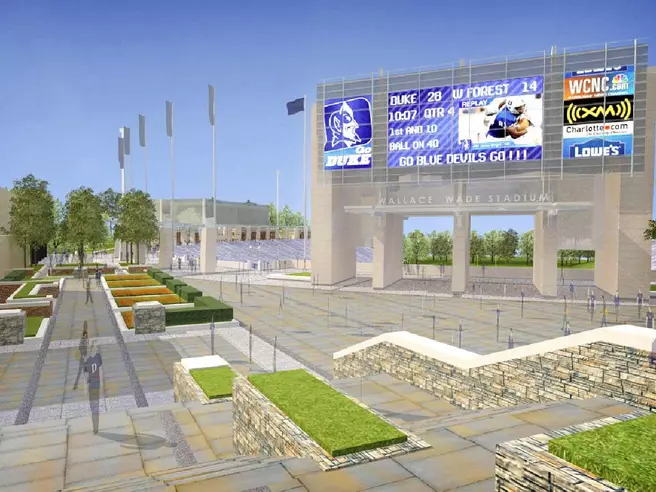
A primary feature of the stadium enhancement plan is a new concourse with modern restrooms, concessions stands and reserved areas for Iron Dukes. Club level seats, luxury suites and a new president’s box structure on the east side, mirroring the Finch-Yeager Building, also are incorporated into the plan.
One of the most striking changes would be the redesigned north gate entrance near the Yoh Football Center. It would include a new plaza and fan zone, ticket pavilion, message board, scoreboard and video system.
When combined with the landscaping and plaza areas outside the Krzyzewski Center for Excellence, which is now under construction, the space between Cameron Indoor Stadium and Wallace Wade Stadium would take on an entirely different look.
Alleva expects the project will be done in phases.
“The first phase that needs to be done is the restrooms, because they are terrible,” he says. “The whole concourse needs to be dressed up, because it’s a mess. There are a lot of aesthetic things that need to be done to make it look good.
“One of the main things we want to do is make the stadium more fan-friendly, so people who come here have a good experience whether we win or lose the game.”
Alleva would like to see the upgrades take place over the next four to five years, sooner if possible. He suspects it may cost $75 million or more.
“It’s huge,” says Roof, “because facilities equal commitment. It’s no different than the chemistry school or the engineering department. You want to have the best facilities so you can attract the best talent.
“It’s also something that’s going to enhance the game-day experience for our fans. It all goes hand in hand ? it’s not the chicken or the egg. As the game-day experience is enhanced, and certainly the product on the field is a part of that, then what that does for the overall environment, the overall program, the revenue that is generated, it has a very broad impact.”

Technically, Wade Stadium is not the oldest football stadium in the ACC, as Georgia Tech’s Grant Field (1913) and UNC’s Kenan Stadium (1927) have been at their present locations longer. But both of those venues have undergone massive growth over the years. And technically, Wade is not the smallest stadium in the ACC at 33,941 seats, because Wake Forest’s Grove Stadium has a listed capacity of about 2,500 fewer seats.
But few could deny that the home of the 1942 Rose Bowl has deteriorated to the point where it is now the most outdated structure in the ACC, and more of a liability than an asset in recruiting as well as fan amenities.
So Alleva will be taking plans for the makeover to the trustees’ building and grounds committee this year. He already has the backing of university president Richard Brodhead and executive vice president Tallman Trask. Some silent fundraising will follow, then a formal campaign, if necessary.
“It’s not going to be easy, but I think it’s imperative that we do it,” he says.


