
Upcoming Event: Men's Golf versus NCAA Regional on May 18, 2026

Men's Golf
vs NCAA Regional
6/16/2009 12:15:00 PM | Men's Golf
DURHAM, N.C. ? As soon as Tom Lefebvre, a 2005 Duke graduate, entered the Marine Corp, they began hammering into his head the importance of supporting arms and decision-making skills until these skills become as second nature as tying your shoes or hitting a golf ball.
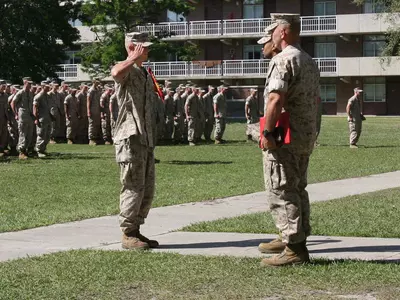
Lefebvre, a letterman on the golf team at Duke from 2003-05, was recently awarded a Bronze Star for his actions in Afghanistan.
On May 3, First Lieutenant Lefebvre was positioning his section in over-watch of a critical bridge in Garmsir District, Helmand Province, Afghanistan, from 24 April 2008 to 8 June 2008 in support of Operation Azada Wosa, when his vehicles came under heavy enemy rocket- propelled grenade and small arms fire.
That's when instincts from day one took over in Lieutenant Lefebvre and the other 41 members in his unit.
“It really wasn't anything spectacular, or it didn't seem like it,” Lefebvre said. “It was kind of just doing what you are taught to do.”
Lefebvre tells an understated version of the events that transpired.
We reached the city and discovered there were quite a few Taliban there, more than we originally thought. We ran into the majority of the Taliban defense. We were supporting a rifle company. We were in armored trucks. We got ambushed. We are taught to gain fire superiority and that's what we did. You start calling in indirect fire like artillery, mortars and bombs from planes, which is called close air support. To be able to do those things you need to be able to see your enemy, which means there is an element of danger.
“It really was just like muscle memory reaction, like stepping up to a golf ball and hitting it,” Lefebvre said.
He has said since getting back to the states he has felt more pressure at times during tournaments in college golf than he ever did in combat.
“The Marine Corps ingrains stuff into you so much that getting shot at is a lot easier sometimes than making a five-footer.”
What Lefebvre leaves out when he tells the story is that eight enemy 82-millimeter mortar rounds landed within meters of his vehicles.
With the unit pinned down from the Taliban's fire, Lefebvre dismounted his vehicle and exposed himself to the enemy to obtain coordinates to his enemy's position.
Once he indentified his enemy's location, Lefebvre directed a simultaneous artillery and mortar mission before changing his attention to observing for close air support.
His efforts were invaluable to his unit defeating the Taliban threat in the area, with his efforts reflecting the highest traditions of the Marine Corps and resulting in the First Lieutenant being award a Bronze Star for heroism and valor in a ceremony at Camp Lejeune, N.C.
The Bronze Star is given to those who have demonstrated significant heroic actions and leadership in combat and is the fourth-highest behind the Silver Star, The Navy Cross and the Medal of Honor.
“But by no means was I the only one in danger,” Lefebvre said. “I definitely had some great support from my Marines - especially my machine gunners - who all got similar awards to what I got because they did an absolute amazing job.”
His father, Paul Lefebvre, was a Major General in Marine Corps, so Tom has been around Marines his entire life and because of that he has always thought he should serve some time.
It was his freshman year when the Sept. 11 attacks occurred which would make joining the Marine Corps a pretty simple decision. He joined Marine Corps ROTC program while at Duke.
Lefebvre is no in New York with his wife, Chelsea, who he met during his junior year at Duke while the two were in choir together, growing a beard and waiting for July 1st, the official end of his Marine Corps commissioning.
He is going to be taking post-baccalaureate classes at Columbia and then attend medical school in a couple years, while his wife is beginning her residency in Optimology at New York Medical College.
Lefebvre would like to go into orthopedic surgery through the Navy's medicine program.
But for now he is content getting back on the golf course a little bit with his father.
“My father loves to play, so whenever I am with him he takes me out to play,” Lefebvre said. “I haven't had as many chances to play since I have been back. The weather hasn't been that good, but I may try for the U.S. Amateur qualifier later this summer.”
“See how that goes.”


%20(1).png&width=24&height=24&type=webp)


