Upcoming Event: Track & Field versus NCAA East Regionals on May 27, 2026

Track & Field
vs NCAA East Regionals


%20(1).png&width=24&height=24&type=webp)

7/23/2008 12:00:00 AM | Football, Athletics
DURHAM, N.C. ? Kevin White has been on the job as Duke's director of athletics for a little over a month now, and most of that time has been spent, as he says, in sponge mode ? “in meeting after meeting after meeting” ? trying to absorb as much information as he can about his new institution.
But he's already made one significant decision that replicates something he did in his first days at his old institution, Notre Dame, or as he tends to call it, “my previous setting.”
When White arrived at Notre Dame over eight years ago, he commissioned a national sports architectural firm to create a master plan for athletics facilities that provided a comprehensive long-term blueprint for the department's structural needs. That led to the opening, in 2005, of a 96,000-square foot, $22 million complex to house the Fighting Irish football team and to provide enhanced training space for all other Notre Dame athletes.
The master plan also called for a refurbishment for the Joyce Center arena, where the Fighting Irish play basketball, and the development of several new stadiums ? a softball complex that just opened this spring, a soccer stadium for which ground was broken in April, plus lacrosse, tennis and track facilities still to come. In total, about $125 million in improvements to the school's athletics physical plant.
“Everything we determined we needed became part of the plan, and it's interesting to see most of it in place eight years later,” White said. “I think we need to go through exactly the same exercise here at Duke.”
To that end, White has wasted no time in initiating action. He promoted Mike Cragg to senior associate athletics director, with the specific responsibility of overseeing facilities and getting that master plan developed. Cragg has been working as the basketball program's primary administrator and the director of its Legacy Fund, and he will continue in those roles. But he was also instrumental in the recent construction of the multipurpose Krzyzewski Center adjacent to Cameron Indoor Stadium, an experience that should serve him well with the master plan project.
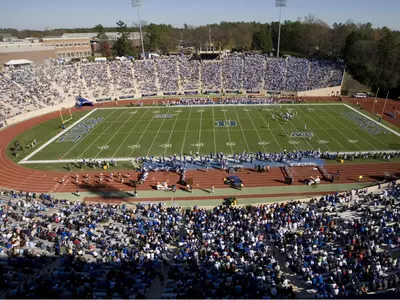
Even before an architect is hired to produce the master plan, White understands that one of Duke's most dire needs is to do something about Wallace Wade Stadium, the home of the football team. Despite its rich history and picturesque setting, it clearly is the most outdated football stadium in the ACC and a recruiting detriment because of its deterioration, lack of atmosphere and meager attendance figures.
White's predecessor, Joe Alleva, hired an architect last year to design a stadium upgrade. RATIO Architects of Indianapolis developed a new look for the soon-to-be 80-year-old stadium, and Alleva had hoped to begin phasing in some of the improvements this year with the addition of modern restrooms, concession stands and a new scoreboard tower atop the north end zone. But most of the initial enhancements were delayed by a city zoning squabble.
When asked what needed to be done first, White resisted the temptation to play “pedestrian architect” and said, “I don't know where to start, I really don't. I think we need to get some experts in here and give us a sense of what it could be and at what different price point breaks, and take a good hard look at it.”
But he readily conceded that the stadium's needs are many, suggesting that the whole environment needed to be re-cultured.
“We need to do an awful lot in Wallace Wade,” White said. “This facility is antiquated at best, and we just have got to come in here and do a pretty significant makeover. Not a facelift, but a makeover.”
White also is already on board with the need to improve the football team's practice facilities in addition to the game-day setting. The current field turf practice surface is not even 100 yards, so that needs to be elongated. And both new coach David Cutcliffe and the university's Strategic Plan for Athletics have called for the addition of an indoor practice facility/fieldhouse in the short term.
Football facilities are a top priority for White for several reasons, not the least of which is financial. He knows that the university has invested heavily in trying to elevate the program's status, and a fan-friendly, prospect-attractive stadium is an essential part of the equation.
White cited an NCAA study of two years ago that said only six of the 119 Division I-A football schools enjoyed positive cash flow. Duke is among the 113 that are “financially challenged,” and it's obvious that one of the biggest opportunities to increase revenue is at Wade Stadium ? by fielding a more competitive football team that puts people in the seats, creates the possibility of luxury box and club suite income, and courts more corporate support.
Most Duke officials and administrators already have a grasp on the department's major needs from a facilities standpoint. Many of them were identified in the recent Strategic Plan. White has read the plan more than once and has quickly developed an appreciation for his new setting. He considers a makeover for the baseball stadium as another immediate essential, asserting that Duke will be a contender in that sport.
But the sooner he has that master facilities plan for the next 7-10 years in place, the better. White brings a reputation for fund-raising with him, and he well knows that an important part of that process is the presentation of a concrete vision for the future to potential benefactors. Cutcliffe has a very similar need in being able to showoff that vision to potential recruits.
“When we have supporters lined up to help us with all these projects, it would be really important to be able to show people exactly what it is we're going to do and present a timetable,” White said.
That's the way many capital improvement projects are done, in college athletics and elsewhere. It worked well in White's previous setting at Notre Dame and it's clearly an early priority in his new setting at Duke.
Worth Noting...
White has asked former Duke AD Tom Butters to accept a position as director of athletics emeritus. Butters, a Duke Hall of Famer, retired 10 years ago...
White will make a few other structural changes within the department by adding a couple of new senior administrators to oversee key areas...
At his first luncheon with local media members, White said hiring high quality ethnic minorities would be a significant priority. Duke has never had an African American head coach in any sport...
The new AD said that in all of his initial meetings with coaches, staff members and campus administrators, he has heard a lot of people profess a great affection for the school. He's detected another common characteristic as well: “The people I've spoken to aren't interested in just being average,” he said. “They want to be really good. And to be really good in everything, we're going to need to find resources to make that happen.”