Upcoming Event: Football versus Tulane on September 5, 2026 at TBA

Football
vs Tulane


2/5/2008 12:00:00 AM | Football
DURHAM, N.C. ? It wasn't easy for Gerald Harrison to leave the University of Tennessee to join David Cutcliffe's administrative staff at Duke. Not only was he leaving his alma mater, but the South Carolina native was giving up an important staff position at one of the nation's most successful football programs to join a Blue Devil program that has struggled in recent years.
“It was a little bit of a shock,” Harrison said of the transition. “I took this job sight unseen. I did not come visit first. I believe in the guy I'm working for that much.
“I remember that Saturday night when I first got here and he told me, ?You're going to be surprised by what you see.' I came [and saw the Yoh Football Center] and it's a wonderful building. Obviously there was a commitment when they built this building. You meet everybody from the secretaries all the way up to the top and you know there's a passion for it.”
Harrison, who was recently named Assistant Director of Athletics/Football Development at Duke, understands that a successful program goes beyond coaches and even beyond players to the support staff that includes administrators, trainers, secretaries and even equipment managers.
Especially equipment managers ? which was Harrison's first football job as a student at Tennessee.
“I've been blessed with having the opportunity to work at every level,” he said. “Once you go from student assistant equipment manager, you've done it all.”
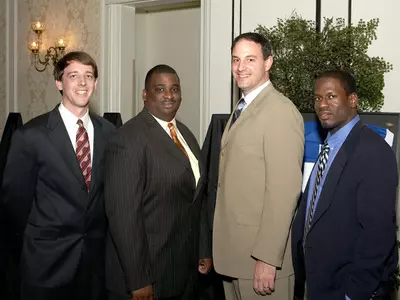
Harrison is one of the new administrators hired by Cutcliffe to continue his reconstruction of the Duke football program. Three of the new staffers are new to Duke ? Harrison from Tennessee; Ole Miss product Noel Durfey, who is the new Football Strength & Conditioning Coach working under veteran staff member Sonny Falcone; and Ole Miss product Kent McLeod, named Director of Football Relations. Two of the new hires are veterans of the Blue Devil staff ? Director of Football Operations Tony Sales and Assistant Director of Football Relations Terrell Smith.
“You've got [three] guys who can come in and add a fresh new perspective on things, then you've got two old guys that can tell them things that have worked here in the past and things that don't work,” Smith said.
The interesting aspect of the new staff hires is that four of the five have experience as administrative recruiting coordinators. Technically, that's the job McLeod will fill at Duke ? just as he did at Ole Miss.
“You've got your recruiting coordinator [which in Duke's case is assistant coach Zac Roper],” McLeod explained. “But every school now has an in-house guy who handles recruiting. The difference is that your recruiting coordinator has to be one of the nine coaches. He has to have an area, then he also has to coach. All the administrative work goes on somebody in the office, that's why these positions have been created.”
Not only did McLeod hold that job at Ole Miss ? under both Cutcliffe and his successor, Ed Orgeron ? but Harrison filled the same job at Tennessee.
“Kent and I were rival peers,” Harrison said. “He was doing that role at Ole Miss and I was doing it at Tennessee.”
And Sales started at Duke as “Director of High School Relations” which involved many of the same responsibilities. Smith, a former All-ACC defensive back for Duke, has also been heavily involved with recruiting.
“Recruiting is the lifeblood of what you do,” Harrison said. “If we don't build for the future and get recruits who want to come to Duke, it doesn't matter what coaching staff you bring in. When you look at what Coach Cutcliffe has brought together as a staff ? especially on the administrative side ? you've got guys who bring different things. But when you look at it, we've all done the same things. Tony Sales was a director of High School Relations, which means he dealt in recruiting. I dealt in recruiting. Kent dealt in recruiting. So we understand what it takes to get great players.”
It's going to start with McLeod, who will work closely with Zac Roper, the recruiting coordinator, to design and oversee an effort that involves everybody on the staff ? both coaches and administrators.
“What I'll be doing is make sure we're compliant,” McLeod said. “I make sure we're doing everything correctly as far as forms and official visits. I'll set up official visit schedules. When coaches go on the road, we'll plan out the week of travel to make sure nobody is getting stretched. I'll help divide up the recruiting areas ? we'll probably do that in the next week. Then will come football camps, I'll help with that. Make sure the mailouts are going out. Make sure we're getting film on the top prospects. That we're getting recruiting services that our coaches need to evaluate players.
“It's basically a year around job because when you're not working on '08 guys, you're working on '09. And when you're not working '09, you're working '10.”
It's a job that McLeod feels qualified to handle after his experience at Ole Miss. He actually started working in the football office there as an undergraduate Math major, under coach Tommy Tuberville.
“I was there when Coach Cut came in,” he said. “I was finishing my degree. I was going to do something in math. But when I got through, he asked me if I'd be interested in a job. So he hired me. And when they had the change and Coach [Orgeron] came in, so I worked for him the last three years. Then when there was a change [after last season], Coach Nutt came in and I was about to work for Coach Nutt.
“I'd been at the same place, but I've met a lot of people and seen a lot of different ways to recruit. I've definitely learned a lot.”
McLeod has seen the recruiting process change over the last decade.
“Before the Internet started, basically coaches had an area,” he explained. “They would go out in the spring ? three or four weeks out. They would ride around in that area, hit the schools, find the players, get the films and they would come back and start evaluating them ... this was in May.
“Now, you better know where you're going in May. It's not, ?Well, I have Atlanta and I'm going to drive around to 30 schools and find me some players.' If you don't know where you're going, you're going to be in trouble. You have to know where you're going to get the most out of your spring.”
McLeod understands that recruiting at Duke is different ? that the school's strict academic requirements will present a challenge.
“It's not easy, but it can be done,” he said.
At Ole Miss, McLeod saw Cutcliffe and his staff ? many of them now Duke assistants ? excel at finding overlooked prospects.
He pointed out that Cutcliffe's recruiting classes at Ole Miss were never ranked very highly, yet produced enough good players to win at least seven games every year but one and to win the SEC West title with a 10-3 record in 2003.
“We recruited a lot better than people think,” McLeod said. “What we didn't do ? we didn't sign top 15 classes. So people think, ?Well you're not getting any players.'
“But when you get a Patrick Willis, a two-star player nobody wants and he ends up being NFL rookie of the year ... I think people forget, that's where it goes back to rankings don't really mean a lot.
“There was kid after kid who went to the NFL. There was Marcus Johnson who got drafted in the second round ? nobody wanted him. We had Chris Spencer, who was highly recruited and got drafted in the first round. Charlie Anderson, nobody recruited and he's still playing in the league. Von Hutchins, nobody recruited, he's still playing in the NFL. Trumaine McBride, who got drafted in the seventh round, started 7-8 games for the Bears.
McLeod didn't mention Stacy Andrews, Ben Claxton, Mike Espy, Jayme Mitchell or a guy named Eli Manning ? all future NFL players recruited at Ole Miss during Cutcliffe's tenure.
Smith and Sales will also contribute their ideas.
Smith, who earned All-ACC honors as a Duke defensive back in 2003, brings first-half experience about the school's program ? its strengths and its weaknesses.
“Duke is a unique place,” Smith said. “It's not like some of the places some of these coaches have been. It's a learning process ... it's not a science. It's not something we've figured out, but I think I've got a grasp on it.”
Durfey will bring a new perspective to Duke's weight training and conditioning program. He played baseball at Lincoln Memorial University and later earned a graduate degree at Tennessee. He worked for the Vols ? as well as stints at Brigham Young and James Madison ? before joining Cutcliffe's staff at Ole Miss in 2001. He remained in Oxford after Cutcliffe's departure, for the last three years serving as the school's Coordinator of Strength and Conditioning.
Like Harrison and McLeod, he left a good job to come to Duke.
Why?
“Coach Cutcliffe ? the opportunity to work with Coach,” Durfey said. “He's one of the best people I've ever been around. When the opportunity came to rejoin him, I couldn't pass it up.”
Durfey's hire is a significant sign of Duke's increased commitment to the football program. He's not replacing anyone on the old staff ? his is a new position that will add an experienced strength coach to the holdover team of Sonny Falcone, Chris Combs, Jeff Howser and William Stephens, who also works closely with the men's basketball team.
And the newcomer is impressed by Duke's modern, state-of-the-art weight room in the Yoh Center.
“We had a nice weight room at Ole Miss, but the football team had to share it with the track team,” he said, noting that Duke's facility is for football-only.
He also has a clear idea of what he wants to accomplish in the off-season.
“Total conditioning,” he said. “The best way to get in shape is to stay in shape. We'll run all year around. Lifting wise, I'm very nuts and bolts. We'll do a lot of pulling, a lot of squatting and pressing.”
Smith went through Duke's weight-training program as a defensive back between 2000, when the football team's weight room was in the Murray Building and 2003, when he became one of the first generation of players to benefit from the Yoh Center.
Following his playing days at Duke, Smith looked for a job in sports administration.
“I always knew I wanted to get into administration and one day be an athletic director,” he said.
“When I graduated, [former Duke lineman] Louis Clyburn knew I wanted to get into athletics in some shape or form, so he asked me to come down to Lenoir Rhyne College. He said, ?I know you don't want to coach, but you can coach and also do some administrative roles here.' At a small school like that, you've got to wear many hats. Down there, I got to dip a bit into compliance, academics ... I even did laundry and painted fields. So it was an interesting experience.”
Ted Roof brought Smith back to Duke as a graduate assistant coach. But it was always with the understanding that his former standout would take an administrative job when it opened up. Smith still harbors a lot of respect for his former boss, who was dismissed after last season. He believes that Roof and his staff laid the groundwork for what Cutcliffe and the current staff is going to accomplish.
“A lot of great coaches have come through here and we have a lot of great coaches on the staff now,” he said. “There's always been a commitment here to Duke football, but I feel that commitment has been reaffirmed, taken to a new degree.”
Sales, an N.C. State graduate who also started his career as a graduate assistant coach for Mike O'Cain in Raleigh, is starting his ninth season at Duke. He can see the same bright future.
“This is a new era and things are going to change,” he said. “They're going to change for the good. When Coach Cutcliffe told me he was going to keep me, he said, ?I'm keeping you ... not just because you've been here. I think you're the right person for the job.'”
As Director of Football Operations, Sales handles much of the detail work behind the program. For instance, he's the team's travel agent.
“People see only the Saturday stuff,” Sales said. “But getting to the games and stuff, I handle all the team travel ? whether that's home or away. Setting up the meals, setting up the rooms at the hotels. For away games, setting up a charter flight. Busses to the airport. Busses there. Postgame snacks and all the things that go into the team's travels.”
Not so long ago, travel arrangements were handled by the team's trainers. In fact, when Sales first game to Duke in 1999, he acted as a travel assistant to football trainer Hap Zarzour.
“That's been a big change over the last 10 or so years,” he said. “When I came, I was the travel advance person for Hap. I would go a day before the team and meet with the hotel people and make sure everything was the way we wanted it. After doing that a couple of years ... Hap was like, ?Switch it over.'”
Sales handles far more than just travel.
“I set up the housing ... I'm the liaison to various departments within the athletic department ... I work on compliance issues ... plus, I'm looking ahead for team travel and doing site visits to places we haven't been. There's always something. Every day is different. It's just a smorgasbord of different things.”
Sales and Smith have helped ease the recruiting transition for the new coaches and for McLeod. The new staff will have basically three weeks of real recruiting time before signing day.
“When you go to school and don't have anybody you can go to and say, ?Who's the contact for this or that?' it can be tough,” McLeod said. “Having Terrell who played here and Tony who has been here eight and a half years ... to have those resources is invaluable. Even the first recruiting weekend ? I'm in charge of it, but Tony is helping me book all the hotels. He knows the right person to call. He knows the right person to get us in the restaurant. If you don't have that, you're lost. It will be a good mix here.”
That's what Coach Cutcliffe is trying to establish at Duke, a smooth-running machine ? a blend of coaches and administrators; a blend of newcomers and Blue Devil veterans.
Making it all work is part of Harrison's wide-ranging job description.
“My role is to bring together Coach Cutcliffe's overall mission ? his goals for this program,” Harrison said. “That covers everything from managing the equipment and the training room to the Strategic Plan for Football. That includes future schedules ...a little bit of everything. I call it ?other jobs that are assigned.'
“It is my job to make sure his vision is carried out through the program.”
Harrison, whose father was a prep coach in South Carolina for 30 years and now works on the staff at South Carolina State, is ? like Smith ? doing exactly what he set out to do when he chose a career in athletic administration.
“I played football in high school and had an opportunity to go into several 1-AA type programs,” he said. “Once I got to Tennessee, I knew I wanted to be an administrator. My father was a coach and I was always around it and I saw that part of it. But I was always interested in how to make it go. That's another thing about Coach Cutcliffe. He understood it took everything. It wasn't just the coaches ... you have to have administrators that understand and believe in the same thing.”
Harrison believes that understanding is in place. Along with the renewed commitment from the university, he can see no reason why Duke can't be successful on the gridiron.
“There's definitely been a commitment from [Athletics Director Joe Alleva] and the university to improve not only Duke football, but the image of Duke football,” he said. “We are blessed to be at a university with great academic standards. We have a great athletic department. You look at the success of the basketball program and every other sport here. There is a commitment that's been made to get football on the same level.
“I think the Strategic Plan does acknowledge that it's going to take time. But you'll see subtle changes right away, whether it's the design of something in the stadium or the graphics package or the way we look, the way we carry ourselves.”
“I think we've got some great things coming. When people visit, they'll see changes. A lot of it won't be public. A lot of it, we've got to work on in house. A lot of it, we've got to work on the attitudes of our players and help them understand that we're going to win. They've got to believe it.”
Harrison is looking forward to the challenge, which will be so different than what he faced at Tennessee.
“At Tennessee, you're expected to win,” he said. “We're coming to a program where people want you to do the best you can. They want to win. But if you have the energy and the passion and show them you're working toward a goal, they'll respect that. I'm excited about that. I was excited at that first team meeting. Coach Cutcliffe was talking about winning games and bowl games ? just to see the players' faces, that's what makes you as an administrator want to get up and do your job the best you can.”


