Upcoming Event: Football versus Tulane on September 5, 2026 at TBA

Football
vs Tulane


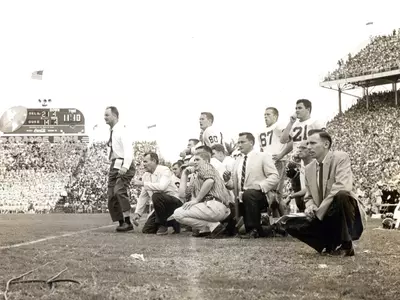
10/5/2007 12:00:00 AM | Football
DURHAM, N.C. ? Fifty years ago, Duke boasted the best football program in the ACC ? and one of the best in the country.
It's a measure of the program's stature that a brilliant 1957 season, which saw the Blue Devils represent the ACC in the Orange Bowl and finish the season with a No. 16 national ranking, is viewed by many of that team's veterans as a frustrating year.
“It was a great year, but it could have been a lot better,” Hal McElhaney, the '57 team's captain, said recently.
“We were so close,” Wray Carlton, the team's offensive star, added. “If we could have played the last three games like the first three, we'd have been fine. We had a very good year, but we could have been so much better.”
Approximately 50 members of the 1957 Duke football team will return to Durham this weekend and will be honored Saturday at halftime of the Duke-Wake Forest game at Wallace Wade Stadium. They'll be recognized as one of six Duke football teams to earn a major bowl bid and for being one of 16 Blue Devil squads to finish ranked in the final AP poll.
They'll also try to reawaken memories of their coach ? the late Bill Murray, whose 15-year tenure in Durham produced one Southern Conference and seven ACC championships, three major bowl bids and a dazzling record of 93-51-9.
“Coach Murray was a man of ultimate integrity,” 1957 veteran Mike McGee said. “I had the great good fortune to play for him and coach for him. He was like a second father to me.”
A strict, old-fashioned father.
“If you passed him on the campus, you walked around to the other side of the quad so you wouldn't have to walk by him,” McElhaney said. “Some call it loyalty. Some call it fear. It was intermixed. The guy was a very strict disciplinarian ? very firm, but very fair. If you got into trouble, you hustled your butt in to see him. It would go rough on you. It would go a little less rough if you went to him instead of making him come to you.
“He expected the best, whether you were a freshman trying to win a freshman game or a third stringer trying to work on one of the specialty teams. You just busted your hump. He never yelled at me in my career ... never once raised his voice. I heard him raise it with some other guys. But he treated us individually. I was kind of a shy, introverted and he made it a point not to embarrass me in front of the team.”
When McElhaney had some personal problems during his freshman season, he discovered another side of his coach.
“I had some problems that he worked me through,” McElhaney said. “He was more than a coach. More than a father figure. He was a doctor and a counselor.”
On the football field, Murray was a conservative ball-control coach, who believed in defense and the running game ? in that order.
“Murray was an old leather-helmet type like Woody Hayes,” Carlton said. “He didn't like to throw the ball or kick field goals ... he didn't like any of that fancy stuff.”
McElhaney also brought up the comparison to Hayes.
“Three yards and a cloud of dust ? he and Woody Hayes were two peas in a pod,” McElhaney said. “They were good friends too. In fact, we played them my sophomore year and upset them up in Columbus. People ask me, which game excited you most ? that game had to be at the top of the list.”
That 1955 victory over Ohio State, the defending national champion, was just one of the signature victories for Murray's teams in that era. His teams won three straight from Tennessee, rallied from a 21-0 halftime deficit to win at Florida and gave Duke its only victory over Notre Dame.
McElhaney was a redshirt freshman during the 1954 season when Duke beat the Vols, swept the ACC, then smashed Nebraska in the 1955 Orange Bowl.
“Six of us redshirted that year -- that handful of kids were probably the nucleus of that [1958] Orange Bowl team,” he said. “We went to the Orange Bowl in ?55, but that was our redshirt year, so none of us played. We were in uniform on the sidelines and Coach Murray always kept us on our toes by saying, ?Hey, if so-and-so gets hurt, you're going to play.' He was just blowing smoke.”
McElhaney and his five redshirted classmates did get to play the next season. In fact, that Ohio State upset would be the moment when McElhaney moved up to the first team, a spot he would hold for two and a half years.
He played fullback and linebacker in that era of one-platoon football. He was never an exceptional ball-carrier, but the ACC coaches twice awarded McElhaney the Jacobs Blocking Trophy as the league's best blocker. And he was even more important as the team's top linebacker.
But the 1957 Blue Devils boasted a galaxy of stars.
“We were expected to have a pretty good team,” Carlton said. “We finished the previous year strong and had a lot coming back.”
A lot of the talent was concentrated on the line, which boasted tackles Tom Topping and guard Roy Hord, who would both earn first-team All-America honors that season. Guard Melwood “Buzz” Guy would play four seasons in the NFL. Tackle John Kersey was drafted by the Eagles (but never played pro football). McGee, a part-time starter as a sophomore in 1957, would win the Outland Trophy in 1959. In addition, end Bill Thompson ? whose role was more of a lineman than a pass receiver ? won second-team All-ACC honors and was drafted by the Steelers.
“We had a big team ... for the time, we were huge,” McElhaney said. “John Kersey was 6-5, 265 ... Buzz Guy was 265. I played at 215 pounds. Carlton was over 200 pounds.”
None of the players on the team were listed at anywhere near those weight levels.
“Coach Murray was obsessed about weight,” McElhaney said. “We'd weigh before practice and after practice. You might weigh 220 before practice and 215 after practice ... then you'd be listed at 198.”
Whatever the listed weight, Duke was bigger than just about everybody it faced in 1957.
“Coach Murray wanted size,” McElhaney said. “He wanted three things ... a big heart, defensive ability and size. We had fullbacks who were better runners than I was, but Coach Murray liked me because I played defense and I blocked. He always picked the better defensive player first.”
Carlton, later a two-time All-AFL running back for the Buffalo Bills, and McElhaney gave Murray a pair of big, bruising backs. George Dutrow, the other halfback, was a smaller, more elusive-type runner. The quarterback was Bob Broadhead, who threw just 62 times in the 1957 season for 392 yards.
That's not a reflection on Broadhead's passing ability ? the quarterback he succeeded threw for just 371 yards in 1956. And Sonny Jurgensen went on to become an NFL Hall of Famer as a passing QB.
***
Duke opened the 1957 season ranked No. 10 in the AP's preseason poll ? matching the 1953 team for the school's highest preseason ranking up to that time (and still the second-highest in Duke history, topped only by the 1962 team, which opened at No. 8).
The Blue Devils got off to an auspicious start, smashing highly regarded South Carolina 26-14 in Columbia. It was a particularly sweet victory over a Gamecock team that had upset Duke 7-0 in the 1956 opener ? still, to that point, the Devils only ACC loss since the league was formed and a loss that had cost Murray his fourth straight ACC title.
Duke followed with a 40-0 rout of Virginia (which had opened the season the week before with a stunning tie with powerful West Virginia) and a 14-0 victory over Maryland, which had been its biggest conference rival in the early days of the ACC.
“Our first three games, we were awesome,” Carlton said.
One small problem did show up in those early games. Duke's placekickers missed four of the team's first nine extra point tries, plus the team's only field goal attempt of the season. Murray called on Carlton to add placekicking to his chores as a running back and linebacker.
“I kind of got roped into kicking when we missed two extra points at South Carolina, then missed our first two kicks at Virginia,” Carlton said. “Murray turned to me and said, ?[assistant coach] Ace Parker says you can kick ... get out there and show me.' Then I started kicking off too.”
Carlton's placekicking would play a pivotal role in Duke's success ? and in one notable disappointment ? during the season.
The three early victories lifted Duke to No. 5 in the national polls and turned the team's Oct. 12 trip to Rice into a game of national significance.
“We were undefeated, they were undefeated,” McElhaney recalled. “They had two tandem quarterbacks who played in the NFL ? Frank Ryan [who led Cleveland to an NFL title] and King Hill. They played them both. Every series, you'd see a different quarterback. Their running back, Ray Chilton, played in the NFL. [End] Buddy Dial, played for the Steelers. And they had a bunch of linemen who played in the NFL.”
Rice would end the season ranked No. 8 nationally and would play in the Cotton Bowl. But the Owls couldn't handle the Blue Devils.
“It was a night game in Houston ? but it was still 99 degrees and hotter than Hades,” McElhaney recalled. “We come out of the huddle after the kickoff and ran what we called a drive series, where they fake to the fullback and hand off [to the halfback]. Well, Carlton went 68 yards on the opening play of the game. He kicked the extra point and there's not 15 seconds off the clock and we have a 7-0 lead.
“From then on, we hung on for dear life. We were backed up to our goalline the entire night. They finally put one in the end zone. So it's 7-6, but we blocked the extra point.”
McElhaney made the block, but much of the credit goes to Kersey.
“There was a picture in the Duke Yearbook showing McElhaney blocking that extra point and it showed me on my ass,” Kersey said. “I had just pulled the center out of the way so Mack could have a path to the kicker.”
McElhaney explained that Murray taught his linemen to grab the center and guard and pull them apart.
“What he taught us to do ? pull guards to create a seam,” McElhaney said. “Was that legal? Well, Coach Murray thought it was and we got away with it. We blocked a lot of kicks.”
But the blocked extra point ? which made the difference in Duke's 7-6 victory ? proved to be a costly triumph. Kersey wrenched his knee on the play and was hobbled for the rest of the season. Soon afterwards, McElhaney was clipped and suffered an ankle injury that knocked him out of one game and left him less-than-full-speed for weeks.
“We all got beat up in that game,” Kersey said. “My roommate [backup halfback] Eddie Rushton, also got hurt. When we woke up the next day, we had to lean on each other to get out to the bus.”
The accumulation of injuries didn't matter much the next week as Duke routed a very weak Wake Forest team to improve to 5-0 and to climb to No. 4 in the national rankings. But those injuries may have played a big role a week later, when the Blue Devils traveled to N.C. State and suffered the first disappointment of the season.
Duke led the Wolfpack 14-0 late in the second quarter, but N.C. State scored on a long pass to Dick Christy just before halftime and added a short touchdown pass to Christy in the third quarter. Wolfpack halfback Dick Hunter hit both extra points, which in hindsight, proved to be a key accomplishment, since he missed his next seven attempts in a row after the Duke game.
Duke dominated play and ended up with a huge lead in total yardage (353 yards to 179 yards), but couldn't break the 14-14 tie.
“Maybe we were overconfident, I don't know,” Carlton said. “We beat them 42-0 the year before and had just no problems with them. Personally, I was not expecting a tough game.”
McElhaney gives an outmanned Wolfpack team a lot of credit for hanging tough.
“I commended them,” he said. “I got to know Dick Hunter later. Christy and Hunter ... they were kind of like a rag-tag team. They weren't very big, but they came at you tooth and nail and really took it to us. We squandered about five chances to score.”
One of those chances came with about four minutes left, when Duke drove all the way to the Wolfpack one-yard-line. Even after a penalty forced the Devils back to the six, Murray gambled on fourth down rather than attempt a potential game-winning field goal.
“Coach Murray didn't believe in field goals,” Carlton said.
Murray didn't like to throw either, but with seconds left and Duke on its own 40 yard line, he did call for a pass to Carlton.
“We called timeout and Ace Parker told me to split out and run deep as fast as I could,” Carlton said. “Brodhead hit me with a pass and I almost got away. They brought me down at the 15. It was about a 50-yard pass, but we didn't have time for another play.”
The tie felt like a loss to the Blue Devils.
“That kind of turned the season around,” Carlton said.
Duke followed the tie with State by traveling to Atlanta and suffering a 13-0 loss to a Georgia Tech team that would finish .500.
“It wasn't that close ? they flattened us,” Kersey said. “I don't know what happened. [Assistant] Coach Bob Bossons had just come from Georgia Tech and he told me the guy I was going against was a creampuff. Well, he left cleat-marks on my chest all afternoon.”
But the lopsided loss at Georgia Tech would be Duke's lone bad outing all season. The embarrassing defeat was followed by another scintillating performance against No. 7 Navy in front of 31,000 fans at Baltimore's Memorial Auditorium.
The powerful Middles, led by All-American quarterback Tom Forrestal and All-American tackle Bob Reifsnyder, were en route to a 9-1-1 season that would end with a victory over Rice in the Cotton Bowl and a final No. 5 national ranking.
However, on this cold, windy day in Baltimore, Duke and Navy battled on even terms. The Middles took an early 6-0 lead, but Duke scored the tying touchdown in the second quarter. Carlton can still remember lining up to kick the extra point.
“It was a tough day,” he said. “It was kind of cold and the wind was really swirling around Memorial Stadium. I thought I made it. I still think I made it. What happened was I kicked it inside the stake, then the wind got it and carried it wide. In those days, we had those short goal posts and I kicked it above the highest part of the goal post.”
The officials ruled his kick no good and Duke had to settle for a 6-6 tie with the Midshipman ? amazingly, that was one of four Duke-Navy ties in a five-game stretch in the mid-1950s.
The Navy game, while frustrating, had a very different feel than the earlier tie with N.C. State. Against the Wolfpack, the Duke players thought they were the much better team and were bitterly disappointed to settle for a tie. The Duke-Navy game was a battle of heavyweights and while the Devils might have pulled it out with a different call on Carlton's extra point kick, the tie reflected the relative performance of two great teams.
Duke, given a week off to rest (and heal!) came back strong the next time out and won a tight, 7-6 duel with No. 14 Clemson. The Blue Devil defense stopped the Tigers five times inside the Duke 30 in the second half.
“That was a lot like the Rice game,” McElhaney said.
The victory set up the Devils to clinch the ACC title ? and the league's automatic bid to the Orange Bowl ? with a victory at home over North Carolina.
The Tar Heels were 5-3 under coach Jim Tatum, who had won a national championship at Maryland and was just starting to get the UNC program back on track after a long dry spell in the post-Choo Choo Justice years. Still, Duke had won seven straight in the series under Murray and was the heavy favorite at home.
More than 40,000 fans braved frigid temperatures and a light drizzle (heavy rains were predicted, but held off until after the game) to see the game open as expected ? Duke jumped to a 13-0 lead in the second quarter and seemed to be dominating play.
But North Carolina got a break when Dutrow intercepted a Jack Cummings pass at the Duke four and when the Devils couldn't move, a short punt set up a 39-yard UNC touchdown drive to make the score 13-7 at the half.
Two Duke fumbles set up a pair of third quarter touchdowns for the Tar Heels, allowing the visitors to build a 21-13 lead. Duke drove to the UNC 14 with five minutes left, but when that drive stalled on downs, UNC was able to hang on for the unexpected victory ? even though Duke had more first downs and more yards in total offense.
“That Carolina game ... I still wake up with nightmares,” McElhaney said. “I wake up with a night sweat, saying ?Don't let them beat us!' That was a tough loss.”
That loss was to cost Duke the 1957 ACC championship. Going into that weekend, both Duke and N.C. State were undefeated in the league, but Duke played one more conference game, so a victory over the Tar Heels would have left the Devils at 6-0-1?better than anything N.C. State could do.
But the Pack, playing a later game in Columbia, learned of Duke's loss and it helped inspire them to a dramatic 29-26 victory over South Carolina.
At 5-0-1 and all alone in first place in the conference, the ?Pack should have represented the ACC in the Orange Bowl. But N.C. State had been found guilty of its second major basketball recruiting violation in a three-year span and was on an all-sports probation. Because of Everett Case's violations, the Wolfpack football team was not allowed to play in a bowl game.
The ACC's executive committee met in Durham the day after the Duke-UNC game and voted to send second-place Duke to Miami instead of the Pack.
“The critics say we backed into the Orange Bowl,” McElhaney said. “I guess there's a little truth to that.”
But Carlton still insists that Duke deserved the bid.
“I thought we had the best team,” he said. “I thought we were the better representative.”
So Duke ? 6-2-2 on the season and ranked No. 16 in the nation ? accepted the bid to play No. 2 Oklahoma in the Orange Bowl on Jan. 1, 1958.
***
It was not revealed at the time, but the Blue Devil players came very close to rejecting the Orange Bowl bid.
“When we voted whether or not to accept the bid, the vote was very close,” Carlton said. “Some guys didn't want to go.”
The resistance to the Miami trip may have come from players who recalled the grueling pre-bowl workouts three years earlier. Murray was not a coach to equate a bowl trip with “fun.”
“We had five days off after the season,” McElhaney said. “Then we had to report back. We were back here practicing, with two-a-days, and nobody else was on campus. It turned into drudgery ? it was like another spring practice.
“We got down to Miami [on Dec. 26] and it was a week of the same ? more two-a-days. We'd pick up the paper in the morning and there would be a big story about ?Today, the Oklahoma players played volleyball on the beach' then we'd head off for practice.”
It didn't help that the players viewed their team hotel ? located far from the beach ? as a dump.
“There sure was some grumbling about the facilities,” Kersey recalled. “The “Rony Plaza” came to be a catch phrase for something dirty or crummy.”
Murray used the same focused approach before the 1955 Orange Bowl, which resulted in a 34-7 rout of Nebraska, and before the 1961 Cotton Bowl, a 7-6 victory over Arkansas.
But all the hard work didn't pay off against Oklahoma.
“That game was an absolute nightmare,” Carlton said. “In those days, Oklahoma would run in three teams to wear you down. I guess Coach Murray thought we would play their game and match their substitutions. It didn't work out. It was just a horror show.”
Every player who made that trip insisted that the final 48-21 score did not reflect the relative strength of the two teams.
“A lot of people who weren't around don't realize it was a 20-14 game early in the fourth quarter,” McElhaney pointed out. “People think we got routed ... well, we didn't.”
Indeed, Duke had 321 yards total offense to 301 for the Sooners and more first downs (16 to 12). Six of Oklahoma's seven touchdown drives were the direct result of Duke mistakes. The first Sooner touchdown came on a 94-yard interception return. The last Oklahoma score came on a 30-yard interception return. In between, the Sooners took advantage of a bad snap on a punt and another punt that was blocked to score easy touchdowns. Two Duke fumbles led to two more short scoring drives.
“We still moved the ball on them,” Carlton said. “I remember Coach [Bud] Wilkinson saying afterwards that he'd never had a game where so much was given to them and they did so little with it.”
Kersey also recalls running the ball down Oklahoma's throat ? despite his personal distraction.
“I had to get a shot of penicillin right before the game,” he said. “I had this cut on my head with all these lines running out of it. I got the shot and I remember playing with a sore butt. I remember running all over Oklahoma. They just took advantage of some things.”
When the game ended, the Duke players were finally allowed to relax.
“They had a party for us at the country club after the game,” Kersey said. “A few of us were partying with [TV star] Dale Robertson. I'm not sure in what capacity he was there, but I remember closing down the club with him.”
The team was slated to return to Durham the next morning.
“We got held up by bad weather coming back from Miami and we got home late,” Kersey said. “I then had to drive home [to Bluefield, W.Va.] to attend a wedding the next night, but I had been up two nights in a row and I fell asleep and missed the wedding. I got to the church and nobody was there!”
***
The seniors on Duke's 1957 Orange Bowl team finished their career with a 13-2-1 record in ACC play. At that point, Murray was 21-2-1 as an ACC coach.
His program would step back slightly in the next two years ? to a mere 5-5 in ACC play in 1958 and 1959. But the key players on his great 1960 Cotton Bowl team ? players such as All-Americans Tee Moorman and Dwight Bumgarner -- were freshmen or redshirts in 1957. Duke would win ACC titles in 1960, 1961 and 1962, while winning 16 of 18 ACC games.
In hindsight, it's easy to dismiss the 1957 team as just another one of Murray's powerhouse teams. Its final 6-3-2 record is not eye-popping. But it should be remembered that the Orange Bowl team played three teams that finished in the top 10 of the final AP poll and went 1-1-1 against No. 2 Oklahoma, No. 5 Navy and No. 8 Rice. Five of the team's other eight games came against teams that spent time in the top 20 and just two games (Wake Forest and Virginia) came against teams that finished with a losing record.
It's true that with a little better fortune, the 1957 Blue Devils might have accomplished more, but what they did accomplish looks pretty darn impressive 50 years later.
NOTES: Duke's Orange Bowl team will also be honored, along with the members of Oklahoma's 1957 team, on Jan. 3, 2008 in Miami by the Orange Bowl, which every year honors its 50th anniversary teams.
-- One of the backup tackles on the 1957 team was Jim Swofford of North Wilkesboro, N.C., whose younger brother John Swofford is now the commissioner of the ACC.
-- It's coincidental that Duke replaced N.C. State in the Orange Bowl, since in 1955, when Everett Case's ACC championship basketball team was blocked from the NCAAs by the school's first recruiting violation, the Pack's place was also taken by Duke.
The Blue Devils lost 74-73 to Villanova in Madison Square Garden in Duke's first NCAA appearance ever.
-- Duke played before an estimated 378,918 fans in the 1957 season, which was listed at that time as a record season attendance.
The Orange Bowl crowd of 76,318 was the largest, but the Devils also played in front of 52,000 against Rice in Houston, and three crowds estimated at 40,000 ? at South Carolina, at Georgia Tech and against UNC in Durham.
The smallest crowd was the turnout of 21,000 at N.C. State, but even that small number was significantly above the listed capacity (20,000) of tiny Riddick Stadium.
-- Duke's current president, Richard Brodhead, shares the same last name as the starting quarterback of the 1957 football team.
Are they related?
“He was only on campus a couple of months when I asked him this question,” McElhaney said. “He looked me in the eye and said, ?You're the 18th person to ask me that question. Yes,' he said, ?we're distant cousins twice removed.”
“He went on to tell a story about how they both come from the same Dutch family. ?Our ancestors came over and landed at Philadelphia. Some of them went East and some went West.' ”
-- All the players who made the trip to Miami for the 1958 Orange Bowls were given gifts.
“Rings weren't in vogue ... we got watches,” McElhaney said. “I got two of them ? one for 1955 and one for 1958. I gave the first one to my brother and I kept the other. Now mine is broke and his is still running.”


