Upcoming Event: Football versus Tulane on September 5, 2026 at 3:30 p.m.

Football
vs Tulane


10/3/2006 12:00:00 AM | Football
by Jim Sumner, Blue Devil Weekly
DURHAM, N.C. - It's a long way from the small town of Weldon, N.C., to the offices of the National Football League, but it's a journey that Cedric Jones has made with considerable success.
Jones was born in Norfolk but moved to New York City at a young age. He moved to Weldon when he was 12. Moving from the Big Apple to Weldon sounds like culture shock of the highest order but Jones had a pair of grandparents in Elizabeth City and another pair in Moyock and had spent good parts of every summer in northeastern North Carolina.
The oldest of five children, Jones got into sports in a big way once he moved to Weldon. He played baseball, basketball, and football. Jones came to Duke in the tenth grade for a Youth Day football game and was impressed. The interest became mutual when the Duke staff saw Jones playing basketball. Duke was scouting an opposing player but came away impressed with Jones' athleticism. After some inquiries, Mike McGee was assured that not only did Jones play football, he played it at a high level.
He also was an outstanding student. Jones looked at in-state schools like UNC and North Carolina State, along with national powers like Ohio State. He flirted with Stanford but it was too far away. But in the end, “Duke kept popping up,” says Jones. “I was always comparing schools to Duke and Duke kept coming out on top. The academics were great, it was nearby and I came in with a class that was sure it was going to turn around Duke football.”
McGee recruited Jones as an athlete, not sure how to best use him. After a few weeks of practice, Jones received a summons to McGee's office. “He told me I was a wide receiver.”
It turned out to be a good match. Jones caught 14 passes as a freshman in 1978, two for touchdowns. But it was a tumultuous season. After starting 3-1, Duke began losing games and losing them by huge margins. Pressure mounted for a change. Jones says “the freshmen were told to stay out of it and we did. It got messy.” McGee was forced out after a 4-7 season and replaced by Red Wilson.
Wilson hired Steve Spurrier as his offensive coordinator. “Spurrier taught me more than you can imagine about the passing game,” Jones says. “He knew it all and he could teach it all.”
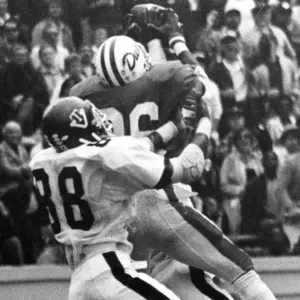
The arrival of Ben Bennett for Jones' junior year was a dramatic upgrade at the quarterback position. “Ben had that swagger that all good quarterbacks have,” he says. Jones caught 18 passes in 1979, 25 the following season. He was also a standout kickoff returner, averaging 27.1 yards per return in 1979, including a 97-yard touchdown against Wake Forest. Jones also caught an 80-yard touchdown pass from Craig Browning that same game and surpassed the 100-yard mark in receiving yards three times in the 1980 season.
Spurrier advised Jones that a big senior season could put him in the NFL. Jones did just that. Duke had struggled to a pair of two-win seasons during Jones' sophomore and junior seasons but was poised for something bigger in 1981. Those goals were threatened when Bennett hurt his shoulder in an opening-game loss to Ohio State. After losing to South Carolina to fall 0-2, Duke went to Charlottesville desperately in need of a win. Jones combined with backup quarterback Ron Sally to give them that victory.
The pair combined for a 30-yard scoring strike to give Duke a 12-7 halftime lead. Duke fell behind 24-15 early in the fourth period. Sally and Jones teamed up for a 52-yard bomb which set up a 25-yard Sally to Ron Frederick touchdown pass. Duke got the ball back trailing 24-22 and Jones got behind the Virginia secondary for a 58-yard completion with 1:38 left. Two plays later, Mike Grayson scored from the two and Duke had the 29-24 win. Jones ended the game with 167 receiving yards.
Duke followed this win with victories over East Carolina and West Virginia and a loss to eventual national champion Clemson, putting the record at 3-3 heading to College Park. Jones had a career game against the Terrapins, catching six passes for 183 yards. Bennett hit Jones with a 43-yarder on the game's second play, and Jones ended the drive with a touchdown catch. He had a 47-yarder set up another touchdown.
Duke trailed 24-14 when Bennett and Jones hooked up for a 23-yard touchdown with 5:11 left. Duke got the ball back and Bennett, who ended the game with 397 passing yards, drove Duke to the Maryland 26. Usually reliable Duke kicker Scott McKinney missed the field goal ? his third miss of the game ? and Maryland held on for a 24-21 win. Jones still regards this “as my toughest loss at Duke. This was our ticket to a bowl game and we came so close.”
Duke recovered from the loss with wins over Georgia Tech, Wake Forest and North Carolina State but lost handily in the season finale to North Carolina to finish 6-5. Nowadays 6-5 puts a team in a bowl game, but not in 1981.
Jones finished the season with 52 catches for 832 yards and 10 touchdowns, leading the team with 60 points. He was named first-team All-ACC and second-team AP All-America. He ended his Duke career with 99 catches, a 17.5 yard per catch average, and 21 receiving touchdowns. Jones still ranks third in school history in touchdown receptions, seventh in receiving yards.
Jones did well at several NFL combines and at the Senior Bowl, solidifying his draft status. New England selected him as the first pick in the third round. “There were only two or three teams that I didn't want to draft me,” laughs Jones, “and New England was one of them.”
Jones' reluctance didn't last long. A history major at Duke and a self-described history buff, Jones came to love New England's history and culture. He played sparingly in 1982, the strike year, but caught 20 passes in 1983, and 19 in 1984. New England went from terrible to competitive to championship caliber in short order.
Jones started his career as a deep threat but was forced to diversify when the Patriots made Irving Fryar the first pick of the 1984 draft. “I was smart enough to know they weren't going to pay him that kind of money to be a possession receiver,” says Jones.
Jones became a cerebral, sure-handed receiver, able to fill in anywhere, in any passing formation. Raymond Berry became head coach in 1984. Jones places Berry “right with Spurrier as a coach and as an expert on the passing game. An incredible coach.”
The 1985 season stands out. After a 2-3 start, New England roared from behind to finish 11-5 and make the playoffs as a wild card team. They became the first NFL team to win three playoff games on the road, defeating the Jets 26-14, the Raiders 27-20, and their perennial nemesis the Miami Dolphins 31-14, ending an 18-game losing streak at the Orange Bowl “It was an incredible experience. We got every loose ball, made some breaks, took advantage of our opponent's mistakes. I still get goose bumps thinking about it.”
The run ended in Super Bowl XX when the Bears dominated New England 46-10, “the only time I was ever nervous in an athletic event.” Jones had one catch for 19 yards.
New England finished 11-5 again in 1986 but lost its playoff opener 22-17 to Denver. Jones had his best season in 1989 with 48 catches for 670 yards and six touchdowns. He retired following the 1990 season with 191 catches and 16 touchdowns. No former Duke player has caught that many passes in the pros. “I could have played longer but I was still healthy and figured it was good to walk away that way.”
Jones spent a few years in Raleigh working in estate planning before returning north to take a position with the NFL in 1993. He is now in his fourth year as Senior Director of Youth Football for the NFL, administering a $150 million youth football fund and overseeing programs like the popular Punt, Pass, and Kick competition. The job enables him to leave his New York office to see youth competition around the world.
Jones remains close to his alma mater. His younger brother Walter was a wide receiver at Duke from 1988-91. Cedric served for six years on the Duke Alumni Association Board of Directors. Oldest son Cori is at Halifax Community College studying to be an actor and model, while twin sons Cameron and Colin play football at Mercersburg Academy in Pennsylvania and are being recruited nationally. Jones just became a father for the fourth time with the birth of Conner Jones. His second wife Suzy is a Northwestern grad and Jones hopes Duke can play the Wildcats soon in order to regain the family bragging rights.
Nephew Tielor Robinson, who lived with the Jones family in Connecticut while he prepped at Greenwich High School, transferred from Army to Duke and lines up as Duke's starting fullback this fall. Jones helped facilitate the transfer and feels strongly that Ted Roof “is the right guy for Duke. He knows Duke and he knows the ACC. Give him the time and the resources and he's going to win and he's going to do it the right way.”
Kind of like Cedric Jones.


