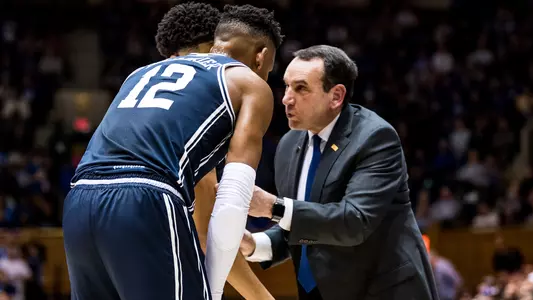
From Go Duke The Magazine (by Barry Jacobs) -- Mike Krzyzewski has been known to playfully challenge the word choice of a questioner during postgame press conferences. This is more likely to occur following victories, and there have been plenty of those. Not that the questions matter nearly as much as answers that offer insights into the coach's richly textured, intricately analyzed basketball world.
So it was that, after defeating Winthrop in late November, Krzyzewski unobtrusively shared a fundamental tenet of his thinking, an imperative that shapes his approach to teaching and coaching the game. Still smarting from a stunning home loss to Stephen F. Austin, a rare case of a Duke squad taking an overmatched opponent lightly, the coach noted the setback was "horrible" and "not easy" to overcome.
"At the end of my career, whenever it is — you may be the one who asks me this — is, who was your toughest opponent? And I will tell you right now: human nature," Krzyzewski said. He hastened to offer reassurance he wasn't contemplating retirement just then. But, he added, "That's the coach's toughest opponent to handle, human nature."
The comment inevitably raised the question of what exactly Krzyzewski meant by this "human nature" thing.
The task of confronting and surmounting human nature has haunted Duke locker rooms for decades and, less often, surfaced in Krzyzewski's public comments. Listeners quickly deduce that, in citing human nature, Krzyzewski refers to a galaxy of motivations and justifications, or if you prefer excuses and rationalizations, that can lull a player or team into feeling and acting satisfied.
That touch of complacency, like a subtle rust spot, may be manifest in a slow start or a wandering mind, an air of entitlement when facing what seems a lesser foe, even giving in to fatigue because it's easier than fighting through.
Deep in the season, in reviewing a close victory at Boston College against a team Duke beat by 39 points barely a month earlier, Krzyzewski noted how expectations can shift dangerously in return engagements. The Blue Devils, objectively better than the Eagles, seemed to presume superiority rather than feel the need to demonstrate it. They nearly lost as a result.
Then there was a blowout loss at N.C. State in mid-February, Duke's only double-digit defeat in almost exactly a year. "We were not competitive tonight," Krzyzewski said. "In order to beat them tonight, we had to be extremely competitive. Sometimes when you've eaten a lot you aren't as hungry."
The notion there are formidable internal barriers to right action is not unique to athletics or to Krzyzewski, and is hardly a modern interpretation. Consider the remark of a character in
A Fool's Errand, a masterful 1879 book by Albion Tourgee on Reconstruction, racial prejudice and the Ku Klux Klan.
"There's no more use of asking questions of human nature than of an owl," wrote Tourgee, a former North Carolina judge who originally published his historical novel anonymously in an era when terror often greeted challenges to white supremacy in the South. "What and why are things that don't concern human nature. It don't care no more for reason than a mule does for persuasion. Human nature is a stubborn, obstinate, unreasonable brute; but it always has its own way with all of us."
Notions of human nature aren't monolithic, however.
"It's always tempting to imagine that there's this thing called human nature that can explain how people act," said Orin Starn, a Duke professor of cultural anthropology and history. But, he observed, "Different cultures have different ways of thinking about what comes next in relationship to the now."
Working with villagers in Latin America, Starn finds an emphasis on "living in the moment and for the moment." That attitude is decidedly alien to ours. "We live in a culture where we're always looking ahead," he said. "One of the reasons we're an anxious, tending-to-depression culture is that we're always worrying about what may lie ahead."
Yet remaining in the present, or remaining firmly focused on the path just ahead, is key to prosperity in Krzyzewski's formulation. "He's always next play," explained Duke assistant coach and former Duke player
Chris Carrawell. "That's to me, I've taken a lot from him, but the next play is the biggest."
Carrawell recalled his own experience in the NBA Draft as illustrative of the pitfalls of failing to take in stride what comes along.
Carrawell was the 2000 ACC Player of the Year as a senior, a unanimous first team All-ACC selection, a consensus All-American. Yet he didn't get chosen by San Antonio until pick No. 41 in the second round of the '00 draft.
"I could never get over it," Carrawell said. Discouraged and insulted, he let circumstances ground his playing career. "I didn't move on from that," he admitted. "I didn't beat human nature."
He's since achieved a keener grasp on how to carry forward that fight, influenced by close proximity to Krzyzewski. At least for Carrawell, who sees how perpetually focused his mentor is, that struggle against urges to relax, to lean toward self-satisfaction rather than sustained effort, is embodied in the notion of moving to the next play.
"Human nature is to sit back, to rest on your laurels," the 43-year-old explained. "Everybody wants the pat on the back. Everybody wants to be told they're doing well. You get the pat on the back, then what?"
Carrawell identified two examples, one recent and one well before his Duke career, of a Krzyzewski team transcending the gratifying impact of hard-fought victory despite every temptation to loosen the internal reins.
The '20 team came back two days after a double last-gasp overtime win at Chapel Hill in February to defeat a gifted, top-10 Florida State club that had lost once in its previous 14 outings. And in 1991 the Blue Devils rallied to top undefeated UNLV in the Final Four in a huge upset, then turned around two days later to handle Kansas to win Krzyzewski's first NCAA title.
Tales of that '91 Final Four are still trotted out for Duke players to illustrate a fraught escape from the gravitational pull of settling to soar instead. "He has a career full of experience of beating human nature," Carrawell said.
#GoDuke


.png&width=24&height=24&type=webp)