Duke basketball is strikingly different in several respects this year beyond the inevitable post-partum blues now that
Zion Williamson has left the building.
Where in recent seasons talk of freshman stars dominated the Cameron conversation, the watchword in 2019-20 is team balance, of a roster with interchangeable strengths at every position, rich with a blend of athleticism and length, newness and experience. Like a basketball Noah's Ark, there's some of most everything, including juniors and seniors who actually saw significant playing time last season.
"Everyone feels like they've got a shot to play, and they do," says
Mike Krzyzewski, going on to vow a more aggressive defensive approach.
What's also different at Duke is that the individual garnering the bulk of early media attention is a modest sophomore,
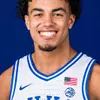
Tre Jones, who shifts from consummate complementary player to focal point. "Tre's good, and he's going to be as key of a person as we have, and our leader," Krzyzewski says.
The soft-spoken Jones, 20 this coming January 8 as Duke plays at Georgia Tech, had a remarkable freshman debut. His superior play came despite being handicapped by shoulder and hip injuries, and overshadowed by more spectacular classmates.
Frontcourt players Williamson and R.J. Barrett, Duke's leaders in point production, were singularly adept at creating their own shots rather than rely on passes to put them in optimal scoring position. Yet Jones still directed the offense to optimal effect, pacing the '19 squad with an assist every 6.4 minutes played even as he minimized mental mistakes and withstood whatever defensive pressure opponents exerted. His 3.62 assists for every turnover was best in the ACC, and best by a modern Duke player. (Turnovers and assists weren't recorded officially until the 1970s.)
His role will be the same in '20. "He's going to make the engine run here," Krzyzewski says confidently.
Jones, listed this year as an inch taller at 6-foot-3, also was and remains Duke's defensive linchpin. Williamson led the Blue Devils in steals and blocked shots last season, but it was Jones' relentless on-ball pressure that set the pace, disrupting opponents' attacks, forcing hesitation, errant passes and other ill-advised decisions.
Key is intensive video study of individual tendencies, gearing reactions accordingly, and unwavering focus, discipline in sliding one's feet, and physically impeding the ball-handler within the rules. "It's definitely a mentality, being able to learn different aspects of the game and pressure your opponents," Jones says.
Last year teammate
Javin DeLaurier called Jones "the heart" of the squad. Krzyzewski approvingly ranks him among the best ball-pressure defenders of his 40-year Duke coaching tenure.
Rather than rely on natural playmakers, the Devils often depended recently for ball pressure and ball-handling on well-rounded combo guards, among them seasonal assist leaders Daniel Ewing (2005),
Jon Scheyer (2009, 2010),
Nolan Smith (2011) and Grayson Allen (2016, 2017). But in Jones Duke has a pure point, one with an ability to seamlessly project his coach's will on the court.
That mental bond has been missing "for a while now," Krzyzewski acknowledges. "He's the guy that helps us make great decisions. Last year playing with R.J. and Zion especially, you had to give them the ball. You didn't have to necessarily give them the ball so that they'd be ready to score, they needed the ball so they could not only score but move the defense. With this team, Tre's responsibility in that regard goes up."
That Jones is so adept as the Devils' floor general is a reflection not only of individual aptitude and hard work but of his background, a product of a family with participatory passion for the game. His mother, Debbie Jones, played for a state championship high school team, and for a time in junior college. Rob Jones, his father, played Division II ball. Jadee Jones, an older half-brother, played at Furman before transferring to a D-II school.
And of course there was brother Tyus Jones, the point guard who led the Blue Devils in assists and steals in 2015 and was the Most Outstanding Player of the Final Four as Duke won the national championship.
Paired with senior Quinn Cook in the backcourt, Tyus regularly supplied clutch plays during his single Duke season before turning pro. He averaged 11.8 points, hit a shade under 38 percent of his threes, and got to the line four times per game, making 88.9 percent of his tries.
Tyus led the champs in assists, with one every 6.1 minutes, and in steals (one per 22.4). Only Cook played more minutes. Tyus currently is with the NBA's Memphis Grizzlies.
Tre harbors similar pro aspirations, and clearly would chafe at the prospect of being outshone by the sibling three-and-a-half years his elder. "If we're playing video games, board games, a backyard game, we're extremely competitive with each other," Tre says, insisting their battles routinely end in draws.
Yet the younger brother was sufficiently savvy to recognize that, unlike Tyus, he was not ready to jump immediately from Duke freshman to the professional ranks. So he didn't even test his NBA worth following the 2019 season, choosing instead to get his right hip and a hernia surgically repaired, then work himself back into playing shape. "I'd say he's about eight pounds lighter, he's quicker, more athletic," Krzyzewski says.
Now the goateed guard from Apple Valley, Minn., has marching orders to step up both vocally and as an offensive threat. In '19 Jones averaged 9.4 points and hit 26.2 percent from 3-point range. On a team that failed to hit a breakeven percentage from long distance (like the majority of ACC squads), Jones tried more than a pair of 3-pointers in less than a third of Duke's games.
Only once all year — in a narrow Sweet 16 win over Virginia Tech — did Jones make more than two 3-pointers in a game, hitting 5-of-7 in a season-high 22-point effort. "Tre was magnificent, not good, in running our team," Krzyzewski said afterward. "And not just in scoring, but eight assists, no turnovers. Good D. And he ran the team to get the ball to R.J. and Zion in the second half."
Another area of projected improvement for Jones in 2020 is in driving to the basket, either in transition before defenses are set or in the halfcourt when he can penetrate to make a layup, or cause the opposition to react, then kick to teammates poised to shoot on the perimeter.
At the least such assertiveness would get Jones to the line more often; he hit 75.8 percent on free throws but tried just two per outing as a freshman. He'll also have the ball more frequently in end-game situations, drawing more fouls.
Teammate
Justin Robinson, among Jones' many admirers, plays a subtle personal game with the playmaker in practice, trying to take his measure as the smaller man attempts to get layups by him. "Age-wise he's young. But I would say even last year, he was one of the older guys," says the 6-10 grad student. "He knows what to do. I trust him."
#GoDuke