DURHAM, N.C. –
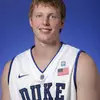
Ryan Kelly was not born with a basketball in his hands.
Not quite.
But it didn't take long for the future Duke forward to get his hands on the spheroid that would dominate his life.
“When I was learning to walk, like most kids I had to hold onto something like a table or my mom's hand,” Kelly said. “I couldn't walk by myself. My parents handed me a little basketball and they have a picture of me, the first time I ever walked on my own was with me holding a basketball.”
Kelly's affinity for the sport is inherited. His father, Chris Kelly played basketball at Yale. The 6-foot-7 forward earned second-team All-Ivy honors as senior in 1984 (joining Harvard's Bob Ferry, the older brother of Duke's Danny Ferry, on the all-star team). After earning a degree in economics, Chris Kelly played professionally in France.
When he returned to the United States and began teaching, the elder Kelly coached basketball at an all-boy's school in upstate New York (about 90 minutes north of New York City). His star pupil was future Kentucky standout Heshimu Evans, who had 14 points and 11 rebounds in the 'Cats narrow victory over Duke in the 1998 South Regional finals in St. Petersburg, Fla.
Kelly also ran a summer basketball camp, where his son was one of his prize pupils.
“The thing I remember most is every summer my Dad ran a camp,”
Ryan Kelly said. “I'm originally from New York and he ran a camp up there. All summer I'd be going to camp and we'd be doing a lot of those Maravich Series drills, a lot of ballhandling things. Since I was doing that for such a long time and from such a young age, it really helped me.”
The Kelly family moved to North Carolina when Ryan's mother got the job as principal of the lower school at Ravenscroft Academy. His father gave up coaching – at least as a professional concern.
“My father decided that he wanted to coach his kids,” Kelly said. “He just coached me, my brother and my sister.”
Upon his arrival in the area, Kelly acquired a new influence – his future coach at Ravenscroft Academy – former Duke guard Kevin Billerman.
“I had Ryan as a sixth grader – I coached a little kids AAU team,” Billerman said. “I started him as a freshman [at Ravenscroft]. His Dad taught him the fundamentals of shooting very well. I think we taught him footwork and helped his understanding of the game.”
Kelly was always the tallest guy in his class, starting with his first organized ball as a third-grader in New York. He always played in the middle, despite his lack of bulk.
“If you had seen him as a 6-8, 167-pound sophomore, you'd have thought, 'I don't know if this guy's got a chance to play at a school like Duke',” Billerman said. “You'd have seen a great skill set, but a lack of physicality.”
But Kelly worked hard to get bigger and stronger. He watched his diet and began to work out in the weight room at an early age.
“I started in the spring of my eighth grade year,” he said. “That's when I first started going in regularly before school. That forced my mother to get up early and come in with me – they wouldn't let me go in alone.”
The hard work began to pay off ... gradually. Billerman said that recognition from recruiters came slowly to his prize pupil.
“Between his freshman and sophomore year, we were at a tournament in Guilford (N.C.), when a UNC Wilmington coach told me they were offering him a scholarship,” Billerman said. “They couldn't talk to him, but they were offering him. He was a skinny 6-7 post player who could shoot at the time.”
Kelly didn't jump at his first offer.
“Coach Billerman had always told me that I could be really good – and I believed him,” Kelly said. “Since I was a freshman in high school, playing varsity, he always told me that I could be the best. Really, after my sophomore year, I went out and played on the AAU circuit a lot more and I realized I could play with anybody.”
More and more coaches were coming to that realization.
“The Kellys wanted him to go to a good academic school,” Billerman said. “At first they were looking at William & Mary, Richmond, American, George Washington and maybe the Ivies. I told them if he kept progressing he could do better than that. After his sophomore year, right at the end of the [summer] season, he had a good tournament in Phoenix. Davidson was on top them – and they would stay in it to the end.”
But Billerman was convinced that Kelly was good enough to play at even a higher level than even Bob McKillop's Wildcats offered. The problem is that because Kelly largely played in the middle for both his high school and AAU teams, few coaches were aware of the range of his skills.
“During his junior year, he was now 6-8, maybe 6-8 ½ and I knew he was good enough [to play at the highest level],” Billerman said. “I called North Carolina, Duke and Wake Forest – State was already involved – just to let those guys know that I had a kid they might want to take a look at. Duke came over a couple of times. Roy [Williams] came over one morning. [Wake coach Dino Gaudio] came over. They saw the same thing – I put him through a workout where he not only showed his post skills, but he also showed many of his perimeter skills that they didn't get to see watching Ravenscroft play.”
Duke assistant coach
Chris Collins said that Kelly blossomed from a low-major to a mid-major to a major-major prospect before the eyes of the Big Four coaches.
“It was exciting to watch him grow,” Collins said. “I don't think there was any kid throughout college basketball who improved like he did. If you saw him as a 10th grader versus his senior year ... wow! There's no reason to believe he's not going to continue to get better.”
In the end, all of the Big Four schools – as well as Davidson, Georgetown, Vanderbilt and Notre Dame – were involved. Kelly had come out of nowhere to become one of the nation's premier prospects. Grown to 6-foot-10, 220-pounds, he was rated the country's No. 14 player in the prep Class of 2009 by the RSCI (which averages the rankings of various recruiting services). He won a spot on the McDonald's All-America team.
Duke's chances of landing the budding star took a brief hit when
Mason Plumlee – a player of similar size and similar inside-outside skills – committed to the Blue Devils.
“With Duke, when Mason committed, the communication kind of broke down on our part and Duke's part,” Billerman said. “We didn't know if they were still recruiting him after signing another 6-10 player and they didn't know if Ryan was interested in being part of a class with another 6-10 player. Mike [Krzyzewski] and I talked on the phone and got things going again. I assured him that Ryan likes to play with great players and getting Mason was no problem.”
Kelly's decision, which came just before signing day in November of 2008, became a very hot topic on Tobacco Road. Many rivals thought that Duke had an edge with a former Blue Devil handling his recruitment.
“I think a lot of Carolina, State and Wake fans thought, 'Billerman is there, Duke has the inside track',” Billerman said. “That was not the case. I tried to be as honest and impartial as I could be. When I talked to him about Duke, I told him that it was one of the top five programs in the country with one of the top four coaches in basketball history and was a place where he could get a great education. But when I talked to him about Carolina, I said almost the same thing – a top program, a great coach and a great place to get an education.”
In the end, Kelly insists that he and his family made the choice without any influence from Coach Billerman.
“I always heard stories about Duke from him and he obviously loved the place, but I don't think he pushed me in any way,” Kelly said. “I don't think anybody pushed me in any direction. My parents are now very happy that I'm close to home, but it wasn't even a thought at the time – it was finding the right place for me.”
He decided that place was Duke.
“Basically what it came down to was here [Duke], North Carolina, Wake Forest, Vanderbilt, Notre Dame and Georgetown,” Kelly said. “I sat down with my parents and Coach Billerman and just worked it out. We were looking at everything and trying to do pros and cons. But in the end, it just came down to a gut feeling. I felt most comfortable here. One of the things I liked the most was whenever I came over to play, I felt like there was no special treatment for a recruit: 'We're going to go after you just as hard as anybody else.' That just gave the feeling that I could be the best player at Duke. Obviously, Coach K is an unbelievable coach. And the mix of academics and athletics are unbelievable.”
So what kind of player is Duke getting in
Ryan Kelly?
“He's really a good player,” Duke's Krzyzewski said. “And he's very smart – a very smart player. I think he'll help us right away. He can really shoot the ball. He can score. And he gets it. He can understand any game plan, any play. He'll be a really good player for our team.”
Billerman pointed out that Kelly won the 3-point shooting contest before the McDonald's Game last spring, but actually played most of his prep career inside – giving him the ability to score both in the perimeter and in the post.
“Ryan can really shoot the ball,” the Ravenscroft coach said. “A lot of people don't understand how well he shoots off the dribble, how good he is at relocating for the jump shot. And he's long. He can block shots and he can score inside ... he can really score inside. He's got a wide array of inside moves, all the head and shoulder stuff, a jump hook, a bank shot ... he just needs to get stronger to hold his position and rebound.”
Kelly understands that he needs to get stronger.
“I think that is a fair assessment,” he said. “A lot of that has to do with my body naturally growing. I'm a skinny person naturally. I'm working as hard as I can in the weight room to add lean muscle mass. I'm never going to be the strongest guy out there. I'm never going to be the biggest. But at my size, I have to be able to take advantage of the skills I have.”
Billerman suggested that the strength would come with normal maturation. In fact, Kelly got up to 222-pounds last summer before a brief illness knocked him back a bit. For that reason, Coach Krzyzewski used Kelly exclusively as a perimeter player during the allowed offseason workout sessions.
“During preseason, we had him exclusively playing on the perimeter in all the drills,” Krzyzewski said. “We felt it would help his foot movement – get him wider and quicker. He's actually progressed now to where we're using him both places.”
Kelly said that during his recruitment, Coach K talked to him about the many inside-outside forwards who had excellent careers at Duke – players such as Danny Ferry, Shane Battier,
Mike Dunleavy and current junior
Kyle Singler.
“Duke has certainly used that kind of player to be successful,” Kelly said.
During the summer, Krzyzewski suggested that Kelly resembled a European style big man more than an American player. That could be the result of his father's experience playing pro basketball in Europe.
“That's just how my Dad and Coach Billerman knew I could be the best player, that would make me a top player,” Kelly said. “There are not many players who play like that. With my God-given talents, that would best display them. I'm not the most athletic guy, but I try to make up for that in different ways.”
Kelly will try to use his variety of skills to try and carve out a significant role on the 2009-10 Duke team. He's competing with a deep crop of frontcourt candidates with a variety of skills, including fellow freshman
Mason Plumlee. The two are rooming together now, along with freshman guard
Andre Dawkins. That's a big change from high school, when the two prep All-Americans were competing for supremacy in the North Carolina prep ranks.
“I think we complement each other very well,” Kelly said. “He beat me in the state championship – he got me good there – since then, I think we've gotten to bond together. We've been together all summer and so far this fall. We really connect. I think he's an excellent passer from the post. He's always in attack mode.”
And what role does Kelly see for himself?
“I'm going to do whatever is asked of me, but one thing I think I can do is create matchups that help our team,” Kelly said. “I can play a couple of positions at my size that can create those matchups. And I think my ability to shoot at my size can certainly help our team.”
It's a role that the young forward has literally been preparing for ever since he learned to walk.