Upcoming Event: Football versus Tulane on September 5, 2026 at 3:30 p.m.

Football
vs Tulane


10/8/2008 12:00:00 AM | Football
DURHAM, N.C. ? Duke's basketball team has retired 13 jersey numbers, honoring the greatest players in Blue Devil history.
Yet, the Duke football team ? with an equally rich heritage ? has never retired a number. That means that the numbers worn by such greats as Ace Parker, George McAfee, Jay Wilkinson, Bob Matheson, Ernie Jackson and Clarkston Hines are still in use today.
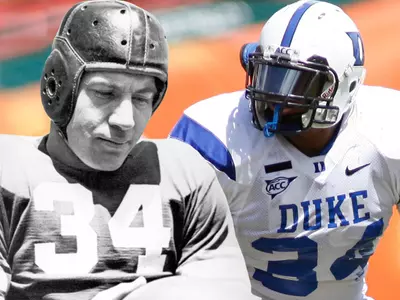
Take No. 34 ? the number that tailback Clarence “Ace” Parker wore in 1936, when he was winning consensus All-America honors for Coach Wallace Wade. That number currently belongs to senior linebacker Michael Tauiliili, who may be having an All-American season for the Blue Devils this year.
Interestingly, Tauiliili wears No. 34 to honor a running back ? but not Parker.
“I've had that number since little league ? it belonged to Walter Payton,” Tauiliili said. “I always wanted to play running back and I played running back and linebacker when I was younger.”
Tauiliili asked for No. 34 when he arrived at Duke in the summer of 2005. It was available ? but another incoming freshman wanted it too.
“Paul Thornton and I both requested it,” Tauiliili recalled. “We are both from Houston and we both wore 34 in high school. We were both in the Texas vs. Louisiana all-star game and I remember he got 34 and I got 33. Then we found out I got 34 here.”
The No. 33 wouldn't have been bad for a Duke linebacker ? it's the number that future all-pro Mike Curtis wore in Durham. Another future all-pro linebacker wore No. 28 at Duke, although Bob Matheson became more famous for the No. 53 he wore during his prime with the Miami Dolphins ? in fact, the Dolphin defense was labeled the “5-3” defense because of the unique role that No. 53 played in the scheme.
When Duke first started using numbered jerseys in the early 1930s, numbers were haphazardly assigned. All-American George McAfee wore No. 22, which seems an appropriate designation for a single-wing tailback, but Elmore “Honey Boy” Hackney, who played tailback in the interim between Parker and McAfee, wore No. 66. Dan “Tiger” Hill, the captain of the 1938 Iron Dukes played center and wore No. 35.
By the 1950s, the numbering system stabilized and became very structured ? quarterbacks and kickers wore numbers between 1-19; fullbacks wore numbers in the 30s; halfbacks wore numbers in the 20s and 40s; ends wore numbers in the 80s; centers wore numbers in the 50s; guards were in the 60s and tackles in the 70s.
Today, the numbering system is looser ? as evidenced by the No. 3 worn by junior defensive tackle Vince Oghobaase.
“When I committed to Duke, I just had the urge to get a single digit,” Oghobaase said. “When I asked Coach [Ted] Roof, he checked and said 3 or 7 or, I think, 8 were available. I said, ?I'll take No. 3'.”
The big defensive lineman wore No. 77 at Alief Hastings High School in Houston. So why change it?
“No real reason, I just want to be different,” he said.
Not everybody gets the number they want.
“When you are being brought in as an incoming freshman, they give you a sheet to put down your first option and then if that's not available to put down, you put down other numbers,” senior offensive tackle Fred Roland said. “Coming in, I was expecting to get No. 75. But they gave it to a teammate, who is no longer here. They gave me No. 70 and I was fine with it. I remember that one of my alternates was 70, so I guess somewhere in the back of my mind, I was thinking that it would be a decent number to wear.”
Zack Asack also wound up with No. 13 ? the number once worn by All-American cornerback Ernie Jackson ? by chance.
“Growing up, every sport I played since I was seven years old, I had the number 4 ? for everything,” Asack said. “When I came to Duke, they gave me No. 13 and at first I was like ?13?' You look around the NFL and there are not many quarterbacks with No. 13. In a way, I was like, ?You know, this is kind of unique. Maybe I can make something out of this.' Now 13 is my number ? and I like it.”
Asack was not the only player to ask for the No. 4 in the summer of 2005. Wide receiver Eron Riley requested that single-digit, but ended up with No. 15 ? the number worn by All-American Jay Wilkinson ? instead.
The No. 4 went to running back Clifford Harris, who will be completing his eligibility this fall. Asack, who has another year at Duke, could switch to his favorite number for his senior year.
“I think about that, ?Hmmm, what would it be like if I go to 4?' But I think people know me as No. 13, so I'm going to stick with that. I like it.”
Some players do change numbers. Ernie Jackson actually wore No. 43 in his first year at Duke before switching to his familiar 13. Outland Trophy winner Mike McGee wore No. 82 as a freshman end before switching to guard and donning No. 68.
Placekicker Joe Surgan switched from the No. 26 he wore in his first three seasons at Duke to No. 81 for his senior season.
“It was the only number available,” Surgan explained, when asked the significance of his new number. “They had promised a bunch of freshmen numbers. When I came in [as a freshman] I asked for a number less than 10. I asked for a number less than 20, so they gave me 26.”
Things didn't work out so well for Surgan wearing that number. He came into this season looking for a fresh start.
“They asked me if I wanted a number change,” he said. “They asked what number I wanted to change to and I said, ?How about anything less than 10 or anything less than 20?.' They gave me No. 81.
“So I guess that's where I stand on the team. I'll take that.”
Junior linebacker Vincent Rey was lucky enough to get the number he wanted. His No. 31 jersey has a special significance.
“It's kind of a long story,” he warned. “I'm from New York City. Back at home, I had to take public transportation to school. We didn't have cars. I took a bus and a train back home ? every day. The bus we got on was the Q31. So I told my friends when I got home I'd try to get No. 31.”
His choice is interesting because he wore No. 56 in high school. Former Giants' star Lawrence Taylor made that number popular with linebackers, especially for linebackers in the New York area.
Current Duke quarterback Thaddeus Lewis also has a numerical link to a famous NFL quarterback. Sonny Jurgensen wore No. 18 at Duke, but earned NFL Hall of Fame honors wearing No. 9 for the Washington Redskins.
But Lewis' No. 9 has nothing to do with Jurgensen.
“I was No. 1 in high school,” the junior signal-caller said. “I always wanted No. 1 when I came to college but I couldn't get it.”
That's because Jabari Marshall, one class ahead of Lewis, owned the No. 1.
“My second choice was No. 8,” Lewis said. “I was going to be No. 8 [the same number that record-setting passer Anthony Dilweg wore at Duke], but they gave 8 to [running back Tim] Ball because he was 8 in high school. I just took what was available. Coach called me one day and said, ?No. 7 or No. 9?'
“I picked No. 9 and stuck with it.”
Lewis just laughed when asked if he ever tried to ?buy' one of his preferred numbers from a teammate.
“I heard about that in the NFL ... not so much in college,” he said. “I'm a college student and don't have a lot of money, so I knew I couldn't buy my number. I probably could have taken him out on food points or something, but that's about it.”
And how important is it in the long run? Tracking numbers is interesting, but does it really make a difference in a player's career?
Maybe Fred Roland put it best.
“I didn't want to get too caught up in the numbers,” he said. “I feel like the man makes the number ... the number doesn't make the man.”