Upcoming Event: Track & Field at Mt. SAC Relays on April 15, 2026

Track & Field
at Mt. SAC Relays


10/27/2008 12:00:00 AM | Athletics
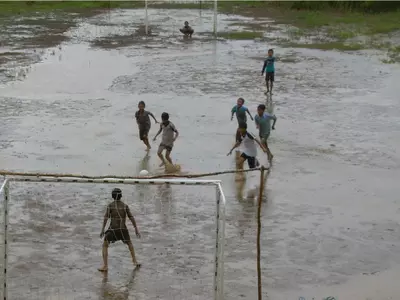
DURHAM, N.C. ? Eight rain-soaked Southeastern Vietnamese children play soccer. Their goals are not regulation size. They don't wear $200 soccer boots. Instead, they run barefoot through the mud and water that has built up on their dirt field. Their clothes are mud-covered and dripping with rain and sweat.
Some may complain. Others may quit. But the kids playing soccer on this field in Vietnam refuse to do either. They don't know anything else. They play because they love the sport ? even without top of the line facilities and equipment.
They play because students from Duke and North Carolina are trying to bridge the gap between sports and academics, the United States and Vietnam, and Duke and UNC through the Coach for College Program, which was founded by Parker Goyer, a 2007 Duke University graduate and varsity women's tennis player.
"It evolved over a few years," Goyer said. "I first knew about Vietnam through a club at Duke called Global Grasp. My senior year, I raised some money to do a study in Vietnam for a new civic engagement program. When I went to Vietnam it solidified the idea of focusing on sports because I saw a lack of sports infrastructure there and also a lack of role models and educational structure for youth. When I came back I had an opportunity to do a fellowship with the Robertson Scholarship Program and developed a program to both address the problem for the youth, and then also for student athletes who often don't get to study abroad and don't get to do a lot of community service.”
The Coach for College Program was held for two sessions over the past summer with 10 Duke and 10 UNC student-athletes, five from each school per session, teaching Vietnamese students the fundamentals of sports and teamwork in and out of the classroom. The first camp ran from July 7 to July 25 and the second session went from July 28 to Aug. 15.
"The reason why we do Duke and UNC is to create a very unique experience to work with people you would not normally work with, like rivals," said Casey Hales, associate director of operations and development. "Like going to work with Vietnamese and just connections that are made through working with people you would not normally work with."
The 10 Duke student-athletes that participated in the program were Andrew Antila, men's soccer; Ned Crotty, men's lacrosse; David Eitel, men's fencing; Amanda Granson, women's tennis; Greg Meyers, football; Ben Bubnovich, men's track and field; Cassi Carley, women's lacrosse; Andrea Crane, women's soccer; Reka Zsilinszka, women's tennis and Hales, football.
Goyer and Hales recently met with Duke University President Dr. Richard Brodhead, Vice President and Director of Athletics Dr. Kevin White and North Carolina's Chancellor Dr. Holden Thorp to discuss the future of the program. All three unequivocally gave the pair their full support of the program and the potential it has to grow to succeed over the coming years.
When Goyer began developing the program she knew little about Vietnam before she made a trip over to the country months before this summer's pilot program began. She ended up learning a great deal about the culture, the people and the fascinating history of the country. She realized that this could be a program that really could work there because they showed a strong passion for sports, but lacked the infrastructure, instruction and equipment for sports that we take for granted in the U.S.
The most organized sporting event they have over in rural Vietnam is the afternoon pickup soccer game because it requires the least equipment to play, just a soccer ball and a makeshift goal.
"They are also very eager to improve their education system and a lot of the kids want to go far in education, but they do not necessarily have the resources to do that," Goyer said. "On top of that they're very eager to partner with Americans at this point in time."
Goyer felt that if she could pull off the pilot program in Vietnam, with all the government bureaucracy she had to deal with, then it would be much easier in upcoming years to expand the program to other parts of the world.
Goyer worked with a nonprofit organization called Peacework based in Blacksburg, Va., which helps to alleviate conditions of poverty and promote peace through partnerships and development around the world. With the help of Peacework, Goyer was able to forge a university partnership in Vietnam with Can Tho University and Dr. Ni, a professor at the university, to help manage on the ground logistics.
The final step was submitting a formal proposal to the local Vietnamese Government officials, which was accepted, and Goyer was on a downhill climb to bring the pilot program together.
Goyer earned her undergraduate degree at Duke in psychology with a focus on neuroscience, and is currently at Harvard working on obtaining an EdD from the Graduate School of Education program. She spends more than 20 hours a week working on expanding the Coach for College Program for next summer.
With Goyer being away from Durham the task of working on the program from Duke falls on the shoulders of Hales, an ?07 grad and former long snapper on the football team, who works from Durham building the program's national recognition and long term potential.
"Our commitment as a program is to positively impact the communities that we go to while at the same time give an experience to student-athletes and show how this program can really teach us a lot as well," Hales said. "We went over there and we are teaching the fundamentals of sport and the fundamentals of education... We learned so much in the process. Going to another country, representing Duke and UNC and most importantly the United States, it was a once in a life-time experience."
For the 200 students (grades 6-9) of Hoa An Secondary School in Vietnam that participated in the program, learning about organized sports and fundamentals through team work and in class participation was a completely new experience.
"They have never experienced learning like this before. The teachers they are used to are very strict, students only take notes, they don't raise their hands, they don't participate in class," Hales said. "They have never done this before. That is why this is a big deal for the kids."
An all-sports court was built at the Hoa An site that can be used to play basketball, volleyball, badminton, tennis and soccer, allowing the student-athletes the chance to leave behind a sports infrastructure for future generations.
In addition to playing five sports, the kids worked inside the classroom learning about the connection between sports and English, health, education, physics and leadership.
"We are teaching the life lessons learned though sports, not only on the field but in the classroom," Hales said. "We were able to get the kids excited about learning while also letting them know why it is important to go to college and achieve a higher education."
Each session had five different teams of kids with a Duke and UNC student-athlete serving as coach, plus two Vietnamese college students and a high school student to help with the language barrier and work with the kids.
"There were friendships being formed in the community for the first time because of the program," Hales said. "These kids live in the same community and go to the same school, but it took sports and it took the teambuilding activities in the program to really bring them together and to build these lifelong friendships.”
An initiative this global in size required a tremendous amount of funding to begin to build the sports infrastructure in Southern Vietnam.
Goyer was able to accumulate around $230,000 for the pilot program. Last year Duke gave $130,000 with $60,000 coming from the dean of undergraduate education, $60,000 from the provost and $10,000 from the athletic department. $68,000 came from the chancellor of UNC and the Rams' Club. The rest came from donors who were impressed with the ideals of the program. Nike also donated 100 pairs of shoes to be given to the Vietnamese kids.
"The kids showed up every day barefoot, running on concrete, no shoes," Hales said. "Giving a pair of Nike's to them was a big deal, a really big deal."
This year Goyer is receiving $175,000 from the U.S. Department of State after she received approval for a state department grant sponsoring international sports programs. In addition, Duke is handing out another $75,000 in support of the program.
This upcoming summer the program will host programs at two different sites in Vietnam. They will once again go to the Hoa An School as well as host another session in the Ben Tre Province.
"Working with a communist government is very difficult, they are very particular in what they allow in their community. The ideas behind the program were brand new to them." Hales said. "Fortunately we got all of their approvals, a number of the government spoke at the Ceremony to dedicate the sports court for the school. They really appreciated the American student-athletes in the community and made us feel welcome, that is why we are going back to Vietnam for summer 2009."
While the original program was a highly innovative and diverse idea, the founder of the program is working to expand its reach to more student-athletes and more locations across the globe.
Goyer and Hales are currently in talks with Virginia and Virginia Tech, Oklahoma and Texas, and USC and UCLA about becoming involved in the program that brings rival schools together.
Goyer believes they can get one other program up and running this summer, with the most likely being Virginia and Virginia Tech. If the necessary funding can be acquired in time the two schools will likely work in the Ben Tre Province site.
"My goal is to involve universities across the U.S. starting with NCAA Division I rivals," Goyer said. "I have been talking with people at Virginia Tech that want to do a program with UVA and then Oklahoma and Texas, schools like that."
Hales said Oklahoma and Texas have shown interest in the program, but the two schools will need to show the dedication and time that the organizers at Duke and UNC have put into the program to make it a success.
"We are trying to make this an elite national program for student-athletes, which gives them a unique experience they might not otherwise be able to have because it is difficult as an athlete to study abroad," Hales said. "This is a program that bridges cultures, rival universities, and most importantly athletics and academics, all for the purpose of helping kids achieve a higher education using skills learned from sports. The Coach for College Program represents everything student-athletes stand for, especially at Duke.”
They are also hoping to get more national sponsors.
"We are building the resources right now to make this a program that companies want to contribute to," Hales said. "We are targeting some of the bigger sports related corporations who have an interest in social responsibility.”
Behind all the donations, funding and government approvals is the true essence of the program, the Vietnamese children. For people in Vietnam, the program was such a unique experience to witness firsthand that children, who were too young to participate, would crowd around outside to watch the program and view the lesson being taught inside.
"Near the end of the program, Dr. Ni, a Vietnamese Professor who has worked in the region for 25-years, told us that we were doing a great thing in the community," Hales said. "He said ?You are helping our kids and you are getting them excited to go to school. They want to be around people like you.' It was an amazing experience to reach these kids through the universal language of sports and education. It was a life changing experience.”
In May, Goyer spoke at the NCAA leadership conference and heard excellent feedback from athletes across the country with more than 100 signing petitions to bring the program to their school.
"There is a lot of interest out there," Goyer said. "I just have to decide how fast I want to try and expand to these other universities."
"One of my outcomes for the athletes was to have them realize how many resources they have, both in their childhood and now going to Duke and UNC," Goyer added. "Also, I wanted them to see that they have these skills and they can use another arena besides sports to make a difference."


