Completed Event: Men's Basketball versus #7 UConn on March 29, 2026 , Loss , 72, to, 73
/
Final

Men's Basketball
72
vs #7 UConn
73
10/3/2007 12:00:00 AM | Men's Basketball
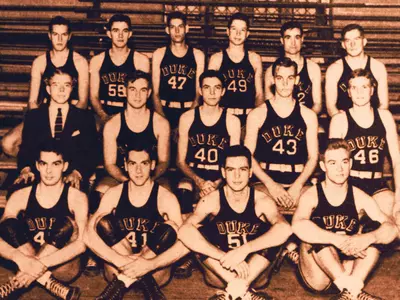
DURHAM, N.C. -- Duke's first basketball championship came as a big surprise to Eddie Cameron.
The 35-year-old coach, starting his 10th season at the helm of the Blue Devil program, never thought his unheralded 1937-38 team would be the one to give him the title that had remained just beyond his grasp for so long.
But a bunch of guys nicknamed “Mouse” and “Suitcase” and “Sparky” would take Cameron on a wild season-long ride that culminated with a magical weekend in March ? three days that saw Duke University claim its first basketball championship in front of the largest crowds ever to see college basketball played in the South up to that time.
As the 70th anniversary of that championship season arrives, it's appropriate to look back and wonder whether the 1938 “Never a Dull Moment Boys” were carried along by the explosion of basketball interest on Tobacco Road or whether they helped ignite that explosion with their energy and their unpredictability.
Either way, their anniversary deserves to be celebrated as the first tangible accomplishment for a Duke program that has become one of the nation's best.
A SEASON OF LOW EXPECTATIONS
In a very real sense, the 1937-38 basketball season was the beginning of the modern game.
Prior to that season, games would stop after every made basket. Play would resume with a jump ball at mid-court ? there were dozens of center-jumps in every game. During the summer after the 1937 season, the NCAA changed the rules to eliminate the center-jump. Under the new plan, when a team scored a basket, the opponent would get possession on the baseline ? just as happens today. Play would be continuous and jump balls would be limited to the start of each half and after tieups during play (the alternating jump ball arrow was still a half-century in the future).
The new rule created a lot of excitement and speculation before the 1937-38 season. However, most of the attention in the Southern Conference was directed at the two “dynasties” that had been vying for conference supremacy in the most recent seasons. North Carolina and Washington & Lee had split the four previous Southern Conference championships, meeting each other in the finals of the conference tournament for three straight seasons. The Generals boasted the best big man in the league ? senior Bob Spessard ? and writers wondered whether the new rule would lessen his impact on the game.
Even so, the preseason favorite ? both in the Southern Conference and in the “Big Five” (a term used by the press to describe the five league members in North Carolina) ? were the UNC White Phantoms (only rarely called the Tar Heels in those days). Coach Walter Skidmore's backcourt of captain Earl Ruth and Foy Grubb was particularly admired, while his frontline anchored by two-sport star Andy Bershak, undersized forward Pete Mullis and towering Bill Dilworth was expected to be dominant. N.C. State's “Red Terrors” were supposed to provide the greatest in-star challenge to UNC with center Connie Mac Berry and forward Bill Mann forming the best one-two scoring punch in the league.
There was some debate as to the prospects for the other three Southern Conference schools on Tobacco Road. Wake Forest boasted a great offensive player in Jim Waller, a first-team all-conference pick the year before. Davidson's veteran team had gone 1-5 against the other four in-state teams in 1937, but that one win had come against the powerful White Phantoms.
Duke, on the other hand, had gone 0-3 against its rival from Chapel Hill in 1937 and had lost three starters, including its best player, captain Kenneth Podger, to graduation. There was some optimistic talk surrounding slender junior forward Ed “Suitcase” Swindell, a Durham High product with a smooth set shot, and a lot of speculation about Langhorn Hobgood, another local product who stood a towering 6-7, but had yet to show the skills to get in the Blue Devil lineup.
However, not even Duke publicist Ted Mann could muster up much enthusiasm for Duke's chances.
“The Blue Devils do not have prospects of being improved over last year's [15-8] outfit,” Mann wrote in a December news release.
The true state of Duke's prospects only became clear after the season, when Raleigh sports writer Anthony J. McKelvin revealed: “The irony of this Duke triumph is that ere this season started even the usual never-complaining Cameron was downhearted whenever anyone talked about basketball prospects.”
Cameron, who also coached the backfield for Wallace Wade's football team, had to do double duty through the end of November. It wasn't until Duke completed its 1937 football season on Nov. 27 with a 10-0 loss to mighty Pittsburgh ? the Panthers were not only the 1937 national champions, but later voted college football's team of the decade by Sports Illustrated ? that Cameron was able to focus on his hardwood duties. And it was only then that junior fullback Bob O'Mara and senior end Fred Edwards could join the basketball team and take their places on the frontline.
O'Mara was a star on the gridiron ? a burly 6-2, 200-pounder who would earn All-Southern Conference honors the next fall as a key member of Wade's undefeated, untied and unscored-upon Rose Bowl team. Edwards, a husky 6-2, 185-pounder, played end on the football field after losing his starting center job to future All-American Dan “Tiger” Hill.
Neither football player was well-established on the basketball court going into the 1937-38 season. O'Mara, a native of Ashland, Ky., had been a part-time starter for Cameron's 15-8 team as a sophomore in 1937 and was more highly regarded for his defensive skills than for his non-existent offensive game. “Mouse” Edwards, who hailed from Bloomsburg, Pa., was an energetic player who had been the top sub on the previous year's team.
“They were all a daffy bunch,” recalled Add Penfield, a Duke student working in Mann's office at that time. “And Mouse Edwards was the daffiest of all.”
Edwards was elected co-captain in the fall of 1937, along with senior John Hoffman, a 6-1 guard from Fort Wayne, Ind., who was already in law school. A backup his first two seasons, Hoffman, a slender defensive expert, was fighting to win a starting job for the first time. His backcourt competition came from James “Brother” Thomas, a 6-foot sophomore guard from nearby Durham High School, who had led the 1937 freshman team in scoring, and Russ “Sparky” Bergman, a chunky 5-8 guard from Madison, N.J., who was more comfortable on the baseball diamond, where he started for Coach Jack Coombs at shortstop alongside second baseman Lawrence “Crash” Davis.
The closest thing to an established player on the roster was Swindell, a very slender 5-11 junior forward who had played with Thomas and Hobgood at Durham High School. The player known as “Suitcase” had started on the 1937 team as a sophomore, finishing second to Podger in the scoring column. Swindell's set shot was much admired ? he was regarded as a streaky shooter, but one with a classically beautiful form.
“He had a skinny little body,” Bill Parsons, a reserve on the 1937-38 team recalled. “He was not much of anything, except he could shoot better than any of us.”
Penfield said Swindell's nickname was derived from the player's frail frame.
“He always looked like he was about to fall apart,” Penfield recalled. “He was long and loose-jointed.”
It's easy to see in hindsight why Cameron was so pessimistic as he approached the season. His sights must have been set on the talent-laden freshman team, which was coached by Herschel Caldwell, another football assistant. Future standouts such as center Chuck Holley, guard Cy Valasek and gifted forward Glenn Price were still a year away from the varsity
THE GOOD AND THE BAD
The unusual and inconsistent nature of the 1937-38 Duke team would begin to manifest itself during a four-game mid-December road trip.
The Blue Devils, not surprisingly, opened the season with 52-31 loss to the powerful semi-pro McCrary Eagles in Asheboro. For some long-lost reason, the game was not included on the team's record, even though during that era all of the Big Five Southern Conference teams played ? and usually counted ? games against the mill-sponsored teams.
The first official game of the season was a narrow 36-33 victory at High Point in a game that was delayed more than an hour because of icy roads. Cameron was happy with his team's performance, especially since Edwards and O'Mara had just joined the team after taking a short break after football. They had only practiced with their teammates for a couple of days.
But two nights later in Columbia, S.C., Cameron's team would begin to reveal its inconsistent nature that would define the season. Duke was dreadful in a 32-26 loss to a very weak South Carolina team. It would be the Gamecocks' only Southern Conference victory in 14 tries.
Just when Cameron must have assumed that his worst fears about his team were about to be realized, Duke arrived in Gainesville, Fla., and scored back-to-back victories over Florida. Soon after New Year's Day, the Blue Devils made their home debut against Mississippi State in front of a near capacity crowd of about 3,000 fans at Card Gymnasium.
“Practically a full house was on hand to take a look at the new streamlined game,” an anonymous reporter wrote in the AP coverage of the game. “While last night's contest was slow at times, they saw the possibility of plenty of excitement in future engagements.”
Duke lost its home opener on a last second field goal by Mississippi State's Milton Steele. While the game was sloppily played by both sides, the close finish was viewed as a good showing against one of the South's basketball powers. But whatever optimism was generated against Mississippi State was squandered in a truly horrendous 40-22 loss to Davidson in a game played in Winston-Salem.
In the days before a two-week exam break, Cameron's erratic club continued to alternate strong showings ? as in a home victory over Wake Forest -- with poor ones -- such as a lopsided road loss to Navy. Duke reached the break with a 6-5 record, including a 3-3 mark in Southern Conference play.
“Duke remains a question mark,” Fred Haney, the columnist for the Durham Morning Herald wrote. “It is true that Coach Eddie Cameron does not have the material to make a real team ... Duke's biggest trouble is keeping from being eliminated from the conference tournament before it settles down.”
Only eight of the 15 teams in the Southern Conference would qualify for the league's postseason tournament. Duke had never before missed the cut in its nine years in the league. But it seemed a very real possibility midway through the 1937-38 season.
“This year's Blue Devils are unpredictable and inexplicable,” Mann wrote in an official release. “It is a team that is making its own brand of history at the institution. This team does not go halfway ? they are either scalding hot or freezing cold. They have put on shows that have had the spectators marveling, booing or laughing.”
As Duke took its long mid-season break, North Carolina's sports writers struggled to hang a nickname on Cameron's erratic team. In the Durham Sun, the Blue Devils became “the Unpredictables.” McKelvin labeled them the “Five-ring circus”. But it was Duke's Mann who hung the moniker that would stick ? calling them “The Never a Dull Moment Boys.”
Mann suggested the name to writers just before the team resumed play on Jan. 30 after exams. He and Penfield batted ideas around during the exam break. It took a little while to catch on ? variations such as “The Not a Dull Minute Blue Devils” were tried out before the newspapers began to use Mann's version consistently.
One thing that may have helped promote the nickname was the team's continued bizarrely inconsistent play. Duke closed the pre-exam portion of the schedule with a five-point loss to Maryland, then opened the post-exam schedule with a 10-point victory over the Terps. That set a pattern that would be repeated all season ? Duke played a pair of regular season games against seven teams and split against five of them (Florida and Wake Forest being the sole exceptions).
The Maryland victory was followed by a stunning 40-28 upset of N.C. State in Raleigh, in which Edwards began to emerge as a lightning rod for both praise and criticism. He became the forefather to such players as Christian Laettner, Steve Wojciechowski or J.J. Redick ? the Duke player opposing fans most loved to hate.
“Mouse” ? the reason for his nickname is lost to time -- was the focal point of Cameron's offense ? a high-post big man who distributed the ball much as Princeton's center would do in Pete Carril's famous offense.
“Edwards plays his own type of basketball and there is never a game passes that he does not have the fans in stitches,” McKelvin wrote.
The Raleigh reporter was also impressed by Duke's Feb. 2 upset of previously once-beaten N.C. State ? a 12-point win that was actually much more lopsided than the final score.
“The supposedly sorry Duke University basketball team offered anything but sorry basketball in defeating favored N.C. State,” McKelvin wrote.
The Tobacco Road fans were starting to come out to see the Blue Devils and the other Triangle teams in numbers that had never been seen before. Demand for tickets grew so large that the tiny gyms that had been used for decades were suddenly inadequate,
“The only drawback to North Carolina basketball this season is the lack of space in which to properly handle interested customers,” Haney wrote in the Durham Morning Herald. “Interest in the popular sport has increased at an amazing pace during the last few years and has caught all of the schools unprepared. The University of North Carolina is now constructing a gymnasium designed to seat 6,000 people at basketball games, but the building won't be ready this season and as a result, people are going to be forced to crowd into the Tin Can to see the White Phantoms. When the new gym is completed, fans will be able to enjoy basketball more, but don't think Carolina will have any extra space, even with 6,000 seats available because the major attractions will attract more people than that.”
The new UNC facility under construction would be named Woollen Gym and, as Haney suggested, it would be out-of-date before it was finished. Still, it gave North Carolina an edge on rivals Duke, Wake Forest and N.C. State. Although Cameron is believed to have started planning for a new arena as far back as 1935, the school had not authorized anything and the only plans completed at that time were Cameron's possibly mythical matchbook sketch.
“The situation at Duke, State and Wake Forest ... is serious,” Haney wrote. “We have never seen interest here greater than it is right now and it's a shame that Durham does not have a gymnasium large enough to accommodate the crowds. Perhaps within the next few years, ways and means will be found for erecting a structure large enough to take care of the customers.”
Duke and North Carolina would make Haney's case on Feb. 12, when the two teams met in the Tin Can on the UNC campus. An all-time record crowd of more than 4,000 had jammed the facility to see the White Phantoms humble NYU the previous week, but an even larger crowd showed up to see UNC beat Duke 34-24, passing Davidson for the top spot in the Southern Conference standings.
It was not a good showing by Cameron's team, but the Never a Dull Moment Boys lived up to their nickname two nights later when they took the train to Lexington, Va., and routed Washington & Lee, the defending Southern Conference champions, 48-39. O'Mara did a terrific job against Spessard in the middle and Hoffman, emerging as the team's defensive star, shut down the Generals' star guard Earl “Kit” Carson.
But the Blue Devils had become almost predictable in their unpredictability and they followed the Washington & Lee win on the road with a homecourt loss to N.C. State.
“The unpredictable Duke team, which is playing slightly better than .500 ball this season, has turned in some of the best and worst exhibitions of any member of the Southern Conference,” McKelvin wrote in the Raleigh newspaper.
McKelvin may have been thinking about an odd exchange that he had with Duke's Mann just before the Blue Devils' homecourt loss to N.C. State. The Raleigh writer complained that a “mat” photo of the Duke team supplied by Mann had printed poorly. He sent Mann a telegram to request eight tickets for the N.C. State game, then added: WHAT WAS THE IDEA OF A SQUAD PICTURE WITHOUT EYES, NOSES OR MOUTHS OF PLAYERS ... McKEVLIN
Mann provided the requested tickets. In the same envelope, he included McKelvin's telegram. Written on the back were the words: “My friend, those Never a Dull Moment Boys are ghostly ? they aren't human ... guess you notice I checked the N&O files of the tourney last year and had this cut made exactly the right size for the N&O to use in Sunday's paper ? as a picture of champions ? after tourney ... Ted”
JOCKEYING FOR POSITION
A Southern Conference championship must have seemed far-fetched after the loss to N.C. State, but at least Cameron didn't have to worry about making the tournament. Duke's record was a mediocre 10-9, but was 7-5 in conference play, well above the cutoff for the eight-team tournament qualification.
Duke's position got even stronger when the Devils edged Wake Forest, 41-40, at Gore Gym, then finished the regular season by snapping a five-game losing streak to North Carolina in front of what was described as the largest crowd ever to pack Card Gym. The game started late (8:45 p.m.) due to a Methodist function on campus that Friday night, but more than 4,500 fans jammed into Card to see the Never a Dull Moment Boys upset the mighty White Phantoms for the first time since 1936.
“The Dukes play is as chameleonic as the weather,” Hugo Germino wrote in the Durham Sun.
The two closing wins allowed Cameron's club to finish the regular season at 12-9 (9-5 in the conference). North Carolina topped the Southern Conference standings at 13-2, followed by N.C. State at 10-3, The Citadel at 7-3 and surprising Clemson at 9-4.
The standings revealed a problem that the Southern Conference would wrestle with ? and never really solve -- until seven schools broke off to form the ACC in 1953. The league was so big and so varied that teams couldn't play every conference opponent and didn't even play the same number of conference games.
Under the rules used in 1938, the top four teams in conference winning percentage were supposed to be seeded 1-though-4, while the next four teams would go in a hat and the first-round tournament matchups would be drawn.
There was speculation that the Southern Conference tournament committee, which met in Lynchburg in the last week of February, might adjust the standings to take into account the wide disparity in schedule strength. The big concern was The Citadel, which had achieved its 7-3 league record by playing the minimum number of conference games allowed and picked up six of its seven wins against lightweights such as South Carolina (1-13 in the league), Furman (2-7) and VMI (2-7). The Citadel had played just two games against the so-called Big Five, losing badly to both Wake Forest and N.C. State.
There was some thought that the committee ? chaired by Duke's Cameron -- would give Washington & Lee, which finished 7-5 in the conference, a top seed and replace The Citadel in the tournament with Wake Forest, which finished 7-8 against the strongest schedule possible.
Instead, the committee stuck strictly to the standings. Cameron explained that before the breakup of the old Southern Conference in 1932 (when the schools that would become the SEC pulled out) the tournament selection process had been marred by politics and to avoid that danger, the committee voted to rank teams solely by their conference standings.
That meant that the top four seeds were awarded (in order) to UNC, N.C. State, The Citadel and Clemson. Richmond (8-4), Duke (9-5), Maryland (6-4) and Washington & Lee (7-5) were the other four teams extended bids to the tournament.
The blind draw for first-round matchups created a sensation when UNC and Washington & Lee were paired ? the two teams that had met in the championship game in the three previous seasons. Duke drew second-seeded N.C. State, which was rated another spectacular matchup. Maryland was perceived to have “won” the draw, when Burton Shipley's “Old Liners” were matched against third-seed The Citadel, which almost every observer agreed didn't belong in the tournament. Fourth-seeded Clemson was expected to have a tough time with a Richmond team that had twice upset Washington & Lee and, like UNC, had knocked off a powerhouse NYU team.
The first-round matchups generated considerable pre-tournament buzz.
“North Carolina and Washington & Lee and N.C. State vs. Duke in the preliminaries!-!-!,” Haney wrote in the Durham Morning Herald, spacing out the three exclamation points to emphasize his excitement. “That makes a new high in the first-round play in the Southern Conference Tournament. You can imagine teams of the caliber of Duke and Washington & Lee being ?warm-ups”. The Generals, defending champions, and the Blue Devils, a team that can only be described as ?dizzy', are a pair of clubs that could do justice to the finals of a basketball tournament anywhere.”
Indeed, Duke ? which had beaten every Southern Conference team it had faced at least once during the season ? was judged to be a dangerous first-round opponent for the second-seeded Red Terrors. But no one rated Cameron's Blue Devils as a real threat to win the tournament. After all, Duke had not won more than two games in a row at any point in the season. How could they be projected to win three straight games over three nights in the tournament?
THREE DAYS IN MARCH
The Southern Conference Tournament had been played at Raleigh's Memorial Auditorium since 1933, when the league left Atlanta after the schools that became the SEC split off into their own conference.
The old facility was hard-pressed to handle the explosion of interest in Southern Conference basketball. Officials tried to keep up with demand ? in the days before the 1938 tournament opened, the Auditorium's management managed to jam in an extra 1,700 seats, raising capacity to 4,672. When the league offered 500 “season” tickets (for all four sessions) at $3.50 each, they were gobbled up in hours. The semifinals and finals were sold out before the tip-off of the first game and pre-tournament ticket sales for the two first-day sessions topped 4,000.
The 17th annual (as it was styled at the time) Southern Conference Tournament opened at 3 p.m., Thursday, Mar. 3. Clemson, which didn't play on Tobacco Road during the regular season and had not qualified for the 1937 tournament, unveiled dazzling center Banks McFadden to the amazement of the assembled fans. The two-sport star ? to this day, McFadden is the only player at an ACC school to win consensus All-America honors in both football and basketball ? poured in 17 points to help the Tigers edge the Spiders, 35-32.
But that was just the warmup for the UNC-Washington & Lee game that most of the crowd of more than 4,000 had come to see. The majority of them were UNC fans, who watched in dismay as the Generals dismantled the top-seeded White Phantoms. Spessard and Carson combined for 29 points in W&L's surprisingly easy 48-33 victory.
An even larger crowd ? estimated at over 4,300 ? turned out to watch the evening session. The only surprise in the first game was that The Citadel, backed by a large contingent of uniformed cadets, put up such a good fight before falling to Maryland, 45-43. That dramatic game seemed to rev the crowd up for the Duke-N.C. State matchup.
First round: Duke 44, N.C. State 33
A couple of minutes in, Duke's Mouse Edwards and N.C. State's Shelby Jones got into a wrestling match over a loose ball. Referee Paul Merton called a double foul and gave both players a long talking to. Moments later, Jones got in it with Duke's Bergman and referee George Proctor stopped the game to call another double foul and to give another warning speech.
Somehow, the crowd blamed Edwards for the early tussles and showered him with boos for the rest of the game.
The game went Duke's way from the first moments. O'Mara scored the first basket against Berry inside and the Devils would never trail. The Red Terrors did manage to tie the game at 14 on a basket by guard P.G. Hill, but Swindell put Duke back on top with a free throw and the Blue Devils outscored N.C. State 8-1 to close the half and take a 22-15 lead. When Cameron's boys opened the second half with a 14-1 spurt, the game was all but over.
Edwards, dubbed “the ringmaster of Duke's five-ring circus” by McKelvin, led the Blue Devils with 11 points, while Swindell and O'Mara added nine each.
“The Durham team's victory was achieved principally as the excellent result of co-captain Fred Edwards, who turned in the finest exhibition of his career,” Haney wrote in the Durham newspaper.
Nobody noted at the time that the victory was the third in a row for a Duke team that had not previously won more than two straight. To make it four straight, the Blue Devils would have to beat a Maryland team that they had split with during the regular season.
Although Duke was the last Triangle-area team left in the tournament, the interest in the event kept increasing. The audience for Friday night's semifinal session astonished the assembled sports writers. The first Thursday afternoon session had been proclaimed as the largest crowd in tournament history, only to be topped a few hours later by an even larger crowd for the night session. But neither could match the turnout for the Friday night semifinals. Every seat in Memorial Auditorium was filled and yet the fans continued to jam themselves inside. The crowd ? estimated as more than 5,000 -- was proclaimed as the largest ever to see a basketball game in North Carolina and probably (the writers at the time weren't sure) in the South.
The overflow crowd was treated to a surprise in the first semifinal as Clemson's McFadden continued his superb play to lead the Tigers to a 38-33 victory over Washington & Lee. The powerful big man scored 14 points against Spessard to help eliminate the defending champions.
Semifinals: Duke 35, Maryland 32
In the nightcap, Duke faced its toughest game of the tournament, battling the “Old Liners” into the final minute before the issue was decided. Maryland actually led by three points with just under two minutes left, when Edwards hit a long set shot to cut the lead to one. Maryland missed a free throw after a foul by Bergman and at the other end Hoffman ? normally more of a defender than a scorer ? swished a long set shot to give Duke a 31-30 lead.
Moments later, Swindell ? normally an offensive star ? turned defender and swiped a Maryland pass and got it to Bergman in the corner. The tiny guard connected to give Duke a three-point lead with just over a minute to play.
Shipley called a timeout and set up a play that failed, but Edwards turned the ball over and Coleman Headley threw in a long shot for the Old Liners. Duke's lead was 33-32 with maybe 45 seconds to play (it was hard for the writers to exactly gauge the time left in that era before digital clocks). Before Maryland could foul, Edwards surprised his opponents ? and his teammates. Instead of stalling the ball, he sliced through the defense and scored the clinching basket with less than 30 seconds left.
Edwards was the only Blue Devil player in double figures with 12 points. The normally high-scoring Swindell managed just five points, while Bergman hit three field goals for six points.
The victory put Duke in the title game for the fifth time. Cameron, who had also guided the four previous finalists, was still looking for his first championship. His very first Duke team beat Alabama, North Carolina and Georgia to reach the 1929 finals in Atlanta, but the Devils lost badly to N.C. State in the championship game. Cameron's teams also lost lopsided title games to Alabama in 1930 and South Carolina in 1933. Only in 1934 did the Devils come close ? losing a 30-29 heartbreaker to Washington & Lee in Raleigh.
It must have been a long Saturday for the Never a Dull Moment Boys, waiting for their 8 p.m. appointment with the Clemson Tigers. Several of the players gathered in the lobby of the Hotel Carolina late that afternoon to listen to a national radio broadcast of the “Hundred Grand” horse race from Santa Anita in California. They heard a bit of history as Stagehand edged favored Seabiscuit, with veteran jockey “Little Georgie” Woolf up in place of the injured Red Pollard, by a nose.
At that point, Edwards ordered the team's five starters back to their rooms to dress, then to lay down and rest in their uniforms until it was time to leave for the Auditorium. Three of the team's subs -- John Minor, Evan “Abe” Hendrickson (the brother of future N.C. State football coach Horace Hendrickson) and Spencer Robb serenaded their teammates with what was described as “Mountain Music.”
Finals: Duke 40, Clemson 30
If anything, the crowd for Saturday night's title game was larger than the semifinal audience. Outside the arena, scalpers were getting $3.50 a ticket (the same price as a pre-tournament book of tickets) and in a photo cutline published in the News and Observer the next morning, the crowd was described as the largest to ever seen an indoor sporting event in the state's history.
The Never a Dull Moment Boys took the drama out of the championship game early, seizing a lead 90 seconds after the tip and never relinquishing it. Cameron came up with an innovative defensive scheme to contain McFadden. O'Mara played behind his fellow gridiron star, while Hoffman kept dropping down from his guard spot to deny the entry pass to Clemson's big inside weapon.
McFadden managed just one field goal in the game's first 37 minutes and there was no one else to take up the slack. Referee Merton reported one first-half incident that was used to illustrate Duke's defensive dominance.
“That little 44 (Bergman) was waiting for me to hand him the ball out of bounds,” Merton told McKevlin. “The score was 14-8 in favor of Duke. He looked over to 49 (Hoffman) and said, ?How the devil did those fellows get any points?”
Duke had the game well in hand at the halftime break, leading 20-11, when an incident occurred that virtually assured that there would not be a Clemson comeback.
Cameron was standing in the hallway outside his team's tiny locker room when a reporter showed him the all-tournament team, which was picked early so that it could be released to the morning newspapers. The Duke coach was astonished to see that not a single member of his team made the first all-tourney team.
Cameron took the list inside to show his players. The following dialogue, reported in the next morning newspapers, is almost certainly nothing more than a loose approximation of what went on behind closed doors:
Cameron: “Well, none of you fellows made the all-tournament team. You can't win anything except the championship. So you need to win that if you're going to get anything out of this tournament.”
Mouse Edwards: “Hmmph, that doesn't make us look good. But it makes you look mighty good, Coach, for we're going to win the championship ? and it will make the coach look plenty good to win without any players good enough for the all-tourney team!”
Amazingly, Washington & Lee ? eliminated in the semifinals ? put Spessard and Carson on the all-tourney team. Clemson's McFadden and guard Ed Kitchen also made the first team, along with George Knepley of Maryland.
Edwards and Bergman made the second team. Swindell, who ended up as the tourney's No. 2 scorer, was relegated to honorable mention. The team was picked by the league's coaches and the three officials who worked the tournament.
“The only regret I have is that the coaches and officials didn't see fit to put any of our players ? and particularly Fred Edwards ? on sufficient all-tournament selections to give at least one of them a spot on the all-tournament first team,” Cameron complained after the game.
At the time, Duke used the snub as motivation, coming out and outscoring the Tigers 10-4 in the opening minutes of the second half to open a 30-15 lead with barely seven minutes to play. From that point, maybe in an unconscious tribute to their season-long inconsistency, Cameron's team let up, allowing Clemson to close the gap down the stretch. It didn't matter ? the lead never shrank below 10 points.
The News and Observer did indeed ? as Ted Mann predicted ? run the team picture that he had provided in its Sunday morning championship edition. McKelvin wrote: “The Duke University basketball team, which had less pre-season potentialities than any recent Blue Devil court outfit, last night brought the Durham school its first Southern Conference basketball championship ... In winning the title battle, the Blue Devils asserted domination throughout.”
Swindell led the scoring in the title game with 14 points, followed by Edwards with 12 and Bergman with eight. McFadden scored seven meaningless points in the final three minutes and led the Tigers with 13.
Cameron found it hard to talk about the unexpected triumph.
“What can I say, other than I'm proud of these boys,” he told reporters. “Did you ever see a bunch of boys who could -- and would -- fight harder than they? They fought and fought all the way and I don't have to say that I'm proud of them ? why everyone's proud of such a fine bunch of boys.”
There was no NCAA Tournament in those days (the national event would debut in 1939), so Duke's season ended with the victory over Clemson. The team's overall 15-9 record wasn't quite as good as the 1937 team had achieved ? and was, in fact, the worst since the 1932 Duke team finished 14-11.
But that Southern Conference title made it a special year.
“There's no way to say the Blue Devils were the best team in conference circles this season, because they were not,” Durham's Haney wrote. “But there wasn't a more determined, harder fighting aggregation in the league. In his 10 years as Duke's coach, Cameron has had better players, but it remained for the 1938 edition, which barely squeezed into the tournament, to bring home the bacon.”
There were no parades or pep rallies for Duke's first basketball champs. But the players were feted at the team banquet, held that spring at the Hope Valley Country Club. The posh crowd was treated to one last moment of unpredictability from the Never a Dull Moment Boys.
“They called Mouse up to make a little talk,” Penfield recalled. “And somebody asked him what Coach Cameron told them to get them inspired for the tournament. He answered, ?All he told us was to get plenty of rest, eat three square meals a day and keep our bowels open.'”
THE LEGACY
Duke first championship would mark a turning point for the Blue Devil program. Confronted by the growing public interest in basketball ? an interest that was to some degree sparked by the excitement that the Never a Dull Moment Boys generated ? Cameron finally got approval for a new basketball facility, which would be paid for largely out of the profits from the 1939 Rose Bowl trip.
When Duke Indoor Stadium opened in January of 1940, it was the third largest basketball facility in the country and the largest in the South. It helped Cameron ? and his successor Gerry Gerard ? turn Duke in the Southern Conference's greatest power (at least until Everett Case's arrival at N.C. State after the 1946 season). The school that had never won anything before 1938, won five conference championships in the next nine years and played in the title game 12 times in the final 16 years of the old Southern Conference (before the seven strongest programs in the league broke off to form the ACC).
In the years since the 1938 “Never a Dull Moment Boys earned their unexpected title, Duke has won 21 conference championships, 14 NCAA regional titles and three national championships.
It's probably going too far to suggest that the 1938 team is responsible for all the success that was to come. But the Never a Dull Moment Boys were the first in line for that championship parade and 70 years later, ought to be remembered, not only as Duke's first championship team, but also as the most unusual team to ever bring the Blue Devils a title.
Notes:
-- The two Duke-UNC games in 1938 and the entire Southern Conference Tournament were broadcast on WDNC radio in Durham. The color commentator on the broadcast was Gerry Gerard, who would success Cameron as Duke's head basketball coach after the 1942 season. Gerard, who had been the backup to Red Grange at Illinois, was hired by Wallace Wade in 1931 to direct Duke's intramural sports program. Both Bill Parsons and Chuck Holley confirmed that Gerard often helped Cameron at practice, a significant advantage in an era when most schools employed just one basketball coach.
-- Interesting that Duke followed its first championship season with the only losing season in the Cameron era. Swindell played well as a senior, but O'Mara's senior season was marred by academic demands created by Duke's Rose Bowl trip. The school allowed only a limited number of class cuts at that time and O'Mara used up his during the Pasadena trip. Therefore, he not only joined the basketball team late (in mid-January), he was not allowed to make any road trips with the team. The heralded 1938 freshman class struggled as sophomores, but lived up to their billing a year later, leading Duke to 19 wins and the Southern Conference title game. As seniors in 1941, Holley and company spearheaded Duke's second Southern Conference championship team.
-- Although the 1938 Southern Conference Tournament was advertised at the time as the league's “17th annual” event, it was later changed to the 15th annual Southern Conference Tournament. The confusion stems from debate over the forerunner to the Southern Conference Tournament ? the Southern Intercollegiate Basketball Tournament, held in Atlanta from 1921 to 1923. That event was open to any southern college and the winner was proclaimed “the champion of Dixie.” The newly formed Southern Conference took over the tournament in 1924 and limited participation to league members. Conference officials had a hard time deciding whether the 1924 tournament was the first or fourth annual tournament. For some bizarre reason, the Southern Conference originally decided to count the second and third Southern Intercollegiate events, but not the first ? thus turning the 1938 event into the 17th tournament. After World War II, the three earlier events were all eliminated from conference records and the count was re-figured, starting with the 1924 tournament.
-- Duke's 21 conference championships (five Southern; 16 ACC) rank second to North Carolina's 24 conference titles (one Southern Intercollegiate, seven Southern; 16 ACC) and just ahead of N.C. State's 17 (seven Southern; 10 ACC) in combined Southern/ACC circles. Nobody else is close ? Wake Forest is fourth with five titles (four ACC; one Southern).