Upcoming Event: Football versus Tulane on September 5, 2026 at 3:30 p.m.

Football
vs Tulane


10/20/2006 12:00:00 AM | Football
by Michael Corey
Special To Blue Devil Weekly
DURHAM, N.C. - He could have matriculated at the University of Georgia.
He could have played in front of a hundred thousand people every weekend, and starred on national television, and been a football star in the most football-crazed part of the country.
And Patrick Mannelly was initially swept up in the craze, committing to the Bulldogs and making his plans for Athens. An ambitious young coach named Ted Roof convinced him to take one more college visit, however, and that one detour has made all the difference.
“You'll take your visits, and the bells will go off in your head,” Mannelly recalls. “And Duke, everything about it ? the students, the campus, obviously the school ? I really enjoyed the students I was around. At Duke, the bells went off in my head.”
That ringing would not have happened without Roof, then the linebackers coach for the Blue Devils, who was somehow able to convince Mannelly to visit the Durham campus. In contrast to the other programs recruiting Mannelly ? Georgia and Boston College among them ? Duke had seemingly little to offer on the football side. And in the days prior to the Yoh Football Center, Duke also lacked the competitive facilities that tend to make such a big impression on the impressionable young men choosing between schools that, after a while, all tend to run together in a constant stream of cushy promises and cushy surroundings.
“To me, I was always more mature,” Mannelly says, “and I thought I just couldn't pass up a Duke education. It floors me that more kids don't choose a Rice, a Duke or a Northwestern. The chances of going to the pros are slim to none, but the chances to get a great education are great. Four years of your life are great times with football, but with a Duke education, that's a lifetime of good times.”
Mannelly, a bulky defensive lineman out of renowned Marist High in Atlanta, quickly reneged on his commitment to Georgia and signed with head coach Barry Wilson and Duke instead. It was a coup for the Blue Devils, landing the 1992 lineman of the year out of the football-rich Atlanta area. Roof ? a Georgia native, as well ? was that good of a recruiter, Mannelly insists.
“It's his whole persona, his personality, the way he talks to you on the phone,” he says. “I felt like he became my friend. The other coaches throw their schpiels and pitches about their school at you, ?Hopefully you can do this and that.' But with Coach Roof, he's just a good person, and it felt like he was my friend. That was a big deal. That opened the door to visit Duke, the way he treated me. And then once I got on campus, Duke was it.”
Such has been the primary challenge for Duke football recruiting the past several decades: How to convince recruits ? particularly elite ones ? to use one of their NCAA-allotted visits on a trip to Durham?
When Roof returned to Duke as its defensive coordinator, and more notably became its head coach in 2003, he took this question, and the challenges it faced, to heart. Consequently, recruiting successes have come for Roof by following the same formula he used with Mannelly.
“I think we have a great university to sell here, not only in the state of North Carolina but all over America,” Roof has said. “When you think of Duke, you think of excellence and respect, so we're going to go after the best young men in the country that can compete on the field for us and compete in the classroom.”
Patrick Mannelly was the epitome of a Duke football target under Roof's philosophy. What was unique for Mannelly, however, was that once he arrived at Duke, he found both individual and team successes on the gridiron.
“My first year I long-snapped as a true freshman,” Mannelly recalls. “Gil Winters was supposed to be the long-snapper, but he got hurt in preseason practice, so I was asked to give up my redshirt to long-snap for the year. I had an older brother that had played at Notre Dame, so I knew the importance of that position.”
It was a position he would never relinquish at Duke, though he flipped from a defensive lineman to an offensive one after his sophomore season, the most successful year the team enjoyed since Steve Spurrier roamed the sidelines. In 1994, the Blue Devils stormed out to a top-25 ranking and a 7-0 record en route to an appearance in the Hall of Fame Bowl, where Duke fell 34-20.
“To be honest with you it was great to see the students, the support they gave us was probably the biggest thing I remember,” Mannelly says. “Being on the team and all that stuff and winning was great, but watching the stands fill up more and more each week, the two words ?Wade Wacko' came out, and the support they gave us when we came home at 7-0 from a road game was amazing. All the students were waiting outside the old football office. It was awesome, and the students enjoyed it because the basketball team that year suffered, so it was fun to be the winning program for once.”
Once and for all, the football program would like to be able to change its fortunes so the 1994 season ? and seasons like it ? no longer appear anomalous, but consistent with the Duke football tradition of excellence, a tradition that peaked in that nationally-televised game but began to peter off in Mannelly's final years at Duke.
Though the Blue Devils had a disappointing season in 1995, Mannelly thrived in his dual role as an offensive lineman and long-snapper, performing well enough to garner preseason All-ACC accolades from various publications prior to his senior year, a billing Mannelly was forced to postpone due to a health problem that forced him to take a medical redshirt.
“It started basically late in the offseason,” Mannelly says. “I just had some hip pain, I didn't think anything of it. It was something that came and went, so I went into the preseason, I knew I had a problem, and it kept getting worse and worse through two-a-days, and as the season got closer the doctors said, ?Let's shut you down.'”
Mannelly tried to resurrect his senior season by playing in the first quarter of a game against Army, but his body simply would not permit him to do so.
“It was just too painful in the first half,” Mannelly remembers.
After the decision had been made to take the medical redshirt, Mannelly had conflicting emotions of disappointment and relief.
“I'm kind of happy, because now we've decided what avenue we're going to take,” Mannelly told The Chronicle at the time. “It's been a tough first few weeks of the season, not knowing what I'm going to be doing every day. Waking up in the morning, going into the training room and seeing how I was going to feel ? that was tough to deal with. Now it is a little bit easier, now that all I have to do is try and heal up for next season.”
And that is precisely what he did. And after a strong senior campaign, Mannelly began considering his options, his ideal one being the pursuit of a career in football. His specialty of long-snapping was his selling point, but as Mannelly knew all too well, establishing a career in such a unique skill was a long-shot at best.
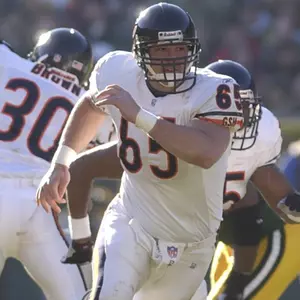
Projected to go in the late rounds or to be snagged as a free agent, Mannelly was delighted to be taken in the sixth round by the Chicago Bears in 1998. During a visit with his new coaches, he was told that the long-snapping position would be his job to lose.
Mannelly has been the Bears' long-snapper ever since. It's a responsibility Mannelly cherishes with pride and humility. Few are so fortunate to thrive as a professional athlete, let alone those who do so with a degree from one of the world's top universities.
“I can remember putting the Bears helmet on for the first time,” Mannelly says. “I took it all in and it really came through. I couldn't believe it was happening.”
Down to a svelte 265 pounds, Mannelly has developed into one of the most reliable long-snappers in the game. Indeed, the Bears set the NFL record for the most consecutive unblocked punts at 920, and games without a blocked punt at 180 ? records that spanned the course of 13 years, a bulk of which occurred under Mannelly's steady hand.
Mannelly has even developed his own website, longsnapper.com, in which various educational tools are provided instructing would-be longsnappers on proper grips and techniques, techniques he first learned while an undergraduate at Duke.
In the offseason, Mannelly and his wife enjoy traveling and playing golf, and enjoying time with their eight-month old baby girl. Mannelly hopes to continue his career with the Bears until he's no longer good enough, or until “they don't want me anymore.” This is his ninth season, and he is signed through 2010.
Such is the evolution of an athlete's career, surging at the onset with offers to play all over the country, being sought by a select few to play professionally, and concluding softly in retirement when the body electric can no longer fire like it used to. But when Mannelly's path in the NFL comes to a close, there will be so many others to follow, for that path taken at Duke has made all the difference.
Recent Duke grad Michael Corey served as sports editor of The Chronicle and also writes a column for GoDuke.com.