
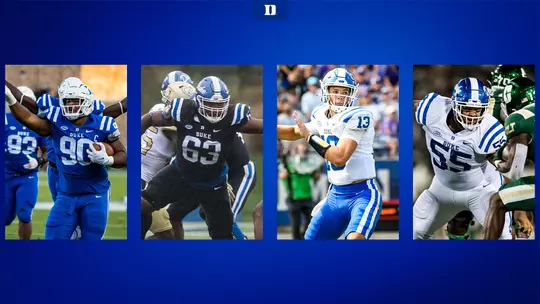
Captains Discuss Leadership, Goals and the Season Ahead
David Shumate, GoDuke The Magazine
These interviews originally appeared in the 2023 Duke Football Yearbook.
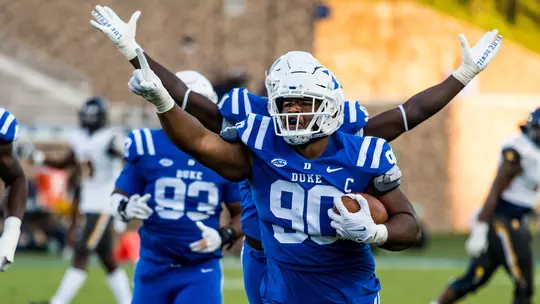
DeWayne Carter
DT • Redshirt Senior • third year captain
David Shumate: I want to get into the bigger picture stuff in just a second, but let's talk about some of the statistics from a year ago. Collectively, I think it was 36 sacks, and individually you had 5.5 of those. It was a huge jump from the previous year; is there another jump to be had this coming season for the group?
DeWayen Carter: Look, I hope so. I think there's some room to grow of course. We're a year better and a year more mature, which I think is the biggest thing. For a lot of guys their first time playing was last year so I'm excited to see what a lot of people do with that year underneath their belt.
DS: There’s been a lot of conversation about how many of you are returning along the defensive line. When you look at yourself, Ja’Mion (Franklin), RJ (Oben), and we could go on down the line with Michael (Reese) and VJ (Anthony) — how does that help the chemistry, the fact that you guys have worked together in some cases for several years now?
DC: So, I'd say we're a close team, we're really close. Like, we hang out with each other 24/7. Our chemistry is second to none. But also, just from a grown man standpoint on the football field — transitioning from high school to college, you have to transition from a boy to a man. It's just a whole ‘nother level you can get to because we are at that peak and that’s because we've had guys who played now two and three years.
DS: When I think of guys who are captains over the years, there are at times guys who are elevated to be leaders and then there are guys that were already leaders long before they were officially named a captain. I think it’s safe to say you're firmly in that second bucket. You've been a leader for this program for awhile. Why do you embrace that regardless of whether you're a captain or not?
DC: Yeah, I think it really comes from my high school days. Coming up my head coach, Jay Sharrett, he was always thinking about the seniors, like nothing else mattered. You did not matter (laughing) unless you were a senior on this team, and when you were a senior, you had a job to do — to lead everybody else. So I kind of adopted that mindset, just being the best teammate I can no matter what the circumstance and then trying to transfer that mindset into college. Especially that freshman year, when you’re the low man on the totem pole trying to figure out what your place is. Now, I just want to help those guys out. I feel like just having that mindset of helping others and just kind of being myself. I feel like that will always pay off.
DS: We're just getting started with camp, the season's just about to get underway, but I think it's fair to say last year a big part of your guys' fuel was having a chip on your shoulder about what people expected of you versus what you guys were able to do. Do you have a sense yet what the fuel is going to be for this group or is that still coming together?
DC: Yeah, obviously, it's still a work in progress…but I feel like I can speak for the general body of the team when we say we still have a chip on our shoulder, and we still have a lot to prove because we left a lot on the table. We had a lot of close losses last year; we were a game away from the ACC Championship game. There was a lot left on the table, so we still got a lot to prove.
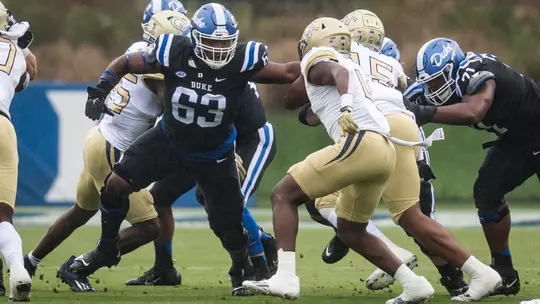
Jacob Monk
OL • Grad Student • second year captain
David Shumate: So, I wrote this down because it's hard to believe — in your career you already have played 3,051 snaps, and you have 45 starts in 46 career games. Does it feel like you have played that much college football?
Jacob Monk: I feel it when I wake up for sure (laughing), but other than that, no man, I feel like a little kid. As soon as I put a helmet on, as soon as I get in the weight room, I feel like a little kid. I love it. I love this stuff.
DS: Part of the story for you is the ability to play multiple positions — guard, center, etc. How much do you like that, as it obviously has a chance to prepare you potentially for opportunities at the next level, but also the versatility that provides for you and the team?
JM: I mean, I love it. I have been able to play everything, and it shows that whenever coach needs something I'm there for him. He can count on me, and I'll just do whatever I can to help this team win.
DS: Everyone knows about the history with your dad and this program. I am curious — when you're playing out there, can you hear him at all or when you come to the sidelines? I know you said he is not shy.
JM: Yeah, I definitely hear him. There's been more than a handful of times that I've turned around and just like waved at him. Like, no, let's calm down, and he'll nod and sit down for a little bit, but he'll stand right back up (laughing).
DS: Being a leader on this team, being a captain for this team, obviously you've been a part of it for awhile now. What does that mean to you? There’s the recognition from your peers, but also a chance to set the tone for the program.
JM: Being a fan of this school since I was a little kid it means the world to me to have been voted captain and I'll just do whatever I can to serve my teammates.
DS: When we look at stats, we look at skill position guys, that's kind of the nature of it. But the way you guys dominated the line of scrimmage on both sides of the ball — you guys finished third in the ACC with 184 yards a game rushing and Riley barely got sacked. How much pride do you guys take in setting that tone up front?
JM: It’s our standard for sure and Riley makes our job a lot easier. But it means a lot to us to go out there and do our job at a really high level.
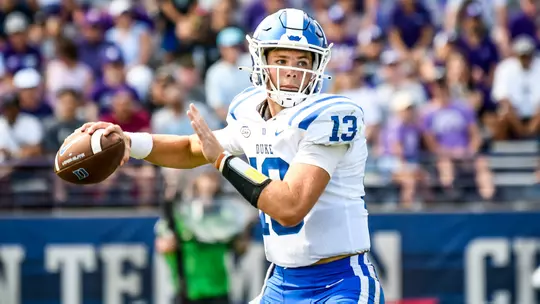
Riley Leonard
QB • Junior
David Shumate: Let’s start with the experience you had this summer at the Manning Passing Academy. I’m curious what that experience was like for you.
Riley Leonard: Yeah, I mean, it was insane for me. The biggest thing I learned was that, well, it reminded me why I play the game of football. To go out there with 1,500 kids and to be with the best quarterbacks in the country, it was just so cool to meet those guys, they're so down to earth. I learned so much about football on and off the field. Peyton, Eli and Cooper are three of the best people I've ever met.
DS: I've heard you talk in other settings that this summer one of the things you were focused on was the intangibles of the position, whether it be communication, how you work with the guys, etc. Why is that important?
RL: That's what's going to get you to the next level. Being at the Manning Passing Academy I learned that I do have the physical traits — the height, speed, whatever it may be, I have the capabilities get to the next level. It's the intangibles that are really what's going to separate me. It's how do you approach a snap when you walk to the line of scrimmage? How do you react after a turnover? How do you watch film with the offensive line? How do you watch film with the receivers? It's those types of things that I've really embraced this offseason.
DS: When we've talked in the last year or so, “never satisfied” is something that keeps coming to my mind as a way to describe you, and what you want to accomplish. Whether it be winning a championship, winning the ACC, getting into the playoff, everything like that. Where does that come from? It feels like you're constantly looking for the next challenge.
RL: Yeah, I mean, that's just my competitive nature, whatever it is. Whether we're playing putt-putt, cards, it doesn't matter. I'm always going to compete and I'm always going to find a way to win. So, whether that's on a football field, using my legs, using my arm, putting my body on the line, it doesn’t matter. I'm going go out there and do whatever it takes to win.
DS: You're one of four captains this year. Each year every group of captains has a different feel to it, but all of four of you have been around for awhile. How would you describe this group in terms of being the leaders on this team?
RL: I think we lead by example and we're really like servant leaders. For example, there's not one person on the team who doesn't get a lot of reps, who wouldn't say that we've reached out to them, if that makes sense. We're all friends with everybody in the locker room, there is no putting us on a pedestal. We're constantly asking questions. “Hey, how can I be a better captain? How do you want me to lead? How can I approach you in different situations?” I think that's what it takes. You can't be so authoritative all the time because then guys start to roll their eyes and stuff at you.
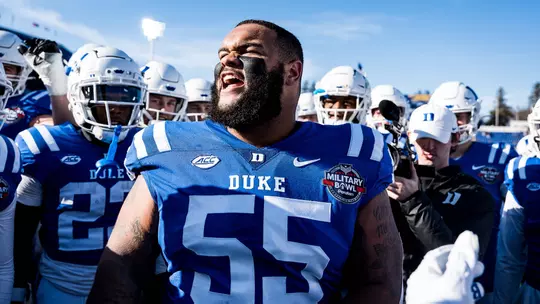
Ja'Mion Franklin
DT • Redshirt Senior
David Shumate: Let’s start with what’s on your jersey this season — we're missing a digit. Tell me about the number change from 55 to 5.
Ja'Mion Franklin: I just felt like it was my last season, let’s try something new. I also have to say that losing a five made me look a little bit slimmer, so I decided to just rock with it (smiling). Again, I think I look pretty slim, so I think I'll keep it.
DS: Okay, on the football side — last season, toward the end of the year in particular, you guys were dominant up front on the defensive line. I talked with DeWayne about this a little bit too — how'd you get there over the course of the season, and is there another step that you guys can take?
JF: Obviously, there's another step we can take, and we pride ourselves in getting better every day. Whether it be the little things like our hands, our footwork, and ultimately, our effort. So, yeah, I think over time we have a very technical coach in Coach Simpson, who was in the NFL coaching some great guys with the Falcons, and he really pushes us. He treats us like men. He treats us like pros. We came into this camp with the idea that we're going treat this like an NFL camp so there's definitely levels to go and the main thing that we're going to work on together consistently is to have great effort and run to the ball because when we get some big guys moving to the ball, we can make some turnovers happen.
DS: In the media, sometimes we can look at stats a lot, but how do you gauge success when you look at the game film to say you guys had a good game or didn't have a great game?
JF: The way that I look at it is that if we're out there, if we're communicating and clicking on all cylinders, then everything will take care of itself. But if we go out there and we're kind of going through the motions and not relaying communication, then that's when the bad games happen, the mistakes start to pile up and the explosives start to happen to us. In order to have a successful game, I think the communication is a premium. We're obviously going to attack the ball — that's what we do, it's in our DNA to throw the mirror hands up to punch at the ball, to rip at the ball, to go attack it, and all the 50/50 balls should be ours. So, I think that as long as the communication is at a premium and we're attacking the ball, then I consider that a successful day.
DS: As important as football is, I know you do a lot of stuff off the field that's important to you as well. You received a pretty big honor being nominated for the AFCA Good Works Team. Take us through some of the things you're involved with.
JF: Absolutely. I work with the Durham Food Pantry, I volunteer in the local community for the elementary schools reading to kids, and I also work with Durham Mission. I’ve just realized all the resources that I have and that I utilized as a kid growing up, and I'm now in a position where I'm a role model and I have people that look up to me and I think it's my duty to give back to the community. Whether it be back home, or the community here that I feel has welcomed me in the last three years. So, I look forward to continuing that throughout the season and anytime I have the opportunity I'm going to give back to the community and give support to those that come out and support us.
DS: You mentioned being a role model in the community, but that dovetails into the last thing I wanted to talk about. Being named a captain is a huge honor and this group is certainly special with what you guys did last year. But being a leader on this team, you kind of already were, but having it formalized, what does it mean to you, that recognition from your peers?
JF: It feels good. I've had a lot of highs and a lot of lows in my football career, and I think that all culminated in being recognized as a captain this year. I agree with you – last year I felt like I was a supporting shadow kind of leader, whether it be giving motivational speeches before the game or making sure that I can mentor the young guys. But it's definitely a great feeling to have that “C” on my chest. Just to have the respect and the acknowledgement of my peers, that they realize I'm a good leader and I'm appreciative of that. I hope to not let them down and continue to lead and mentor the guys like I've been doing.
Dedicated to sharing the stories of Duke student-athletes, present and past, GoDuke The Magazine is published for Duke Athletics by LEARFIELD with editorial offices at 3100 Tower Blvd., Suite 404, Durham, NC 27707. To subscribe, join the Iron Dukes or call 336-831-0767.