
Off-Season Q&A with Jon Scheyer
Looking back and ahead with Duke's second-year coach
GoDuke The Magazine
These interviews originally appeared in the 14.11 Issue of GoDuke The Magazine – June 2023
David Shumate: There’s so much to get into, and so many different directions we could go, but given time and given perspective, I’m curious, just big picture, what your thoughts are on this first season when you look back?
Jon Scheyer: You know, it’s hard because you’re always going to the next thing and there’s not a lot of time to digest or reflect. I’ve made sure to do that, to carve out a little bit of time because, for one, I’m very proud of the year that we had. You’re coming off of a year where we had two returning players, 11 new players (seven freshman, four transfers) — for that group to come together, they were really a great group to coach, especially for a first-year head coach.
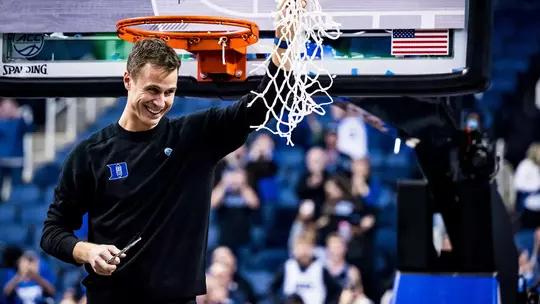
To see us get better and better as the year went on, and for that to amount to an ACC Tournament championship is pretty special. But I’m even more proud of what’s happening in the offseason with, basically, eight players doubling down saying, “I want to come back for more.” We have a great freshman class with four new guys, and I can’t wait for next year. But I have had the chance to digest and I’m very proud of the year that we had this past season.
DS: You referenced the ACC championship — maybe that’s it, but is there a moment that stands out for you as the highlight of the season? It doesn’t necessarily have to be a win, just a moment of seeing, for example, a guy taking a major step forward. Is there something that pops for you?
JS: Well, naturally you think about some of our guys and the individual steps that they took. You think about Dereck Lively, the jump that he made against North Carolina at home, and he took off for the rest of the year. You think about Tyrese Proctor where it was the tale of two halves of the season. Jeremy Roach, he scores 20 points in the ACC championship game in the second half. There are some special individual moments, but for me it’s the way we responded as a team after the Virginia game. That was a defining moment for us, to not make any excuses, to go back to work and to run off 10 in a row from that game on. That’s a very special to me.
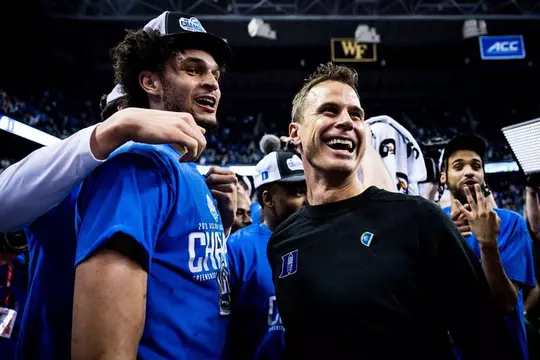
DS: You referenced new, and there’s going be some newcomers this year, but let’s talk about the fact that so many guys are returning. I know every year is different, but in this climate where it feels like when the transfer portal opens, guys go rushing to it, for you guys to have no one go in that direction, what does that say? About you and the strength of this program as well, that the guys want to be a part of this culture in an era of college basketball where it feels like that’s not always the case when you look across the country.
JS: Well, it’s a great thing for Duke and for us, it’s something you hope you can do every year, although I don’t think that’s realistic. It’s probably a combination of having great relationships with these guys, but also, really being mature in their decisions and wanting to take the next step as individuals and as a team. There’s probably a little bit of luck involved as well. You know, Kyle Filipowski, his decision to come back to school, there may be no one else that makes that decision besides him. Tyrese, we’ve had guys before that have left that have been promised less than he was probably promised. Those are mature decisions.
Getting Jeremy back as a senior, how many four-year seniors are there at any school anymore? So, the fact that he’s stuck with it and just been a guy who’s carried our program before the transition and after, his legacy’s going to be remembered in an amazing way. I could go through each individual, but for me, I think it gives us a great base to start from, but also brings different challenges. Just because we have a point of reference with what we did last year doesn’t mean it’s the same from a role standpoint, doesn’t mean it’s the same when you look at what we can accomplish. The best way to attack all of this is to put our heads down and work as hard as we possibly can, and good things will happen from there.
DS: One more thought on that. What is the impact of having so many guys back and having some of that consistency? Is it an acceleration of the offseason timeline or does it lend to a different approach knowing you have that base to build on?
JS: Well, when you think about experience and why that helps everybody, you hear everybody say, “Man, you need to be older,” why is that? Why is experience better? It’s because you understand firsthand what it takes. So, if you haven’t taken what you’ve learned this past season and put it into the work that you put in every single day, then shame on you — then experience doesn’t mean anything. If I’m not better in year two as a coach than I was in year one because I learned things too, just like our players did, then shame on me.
For us, I think understanding why that experience matters and not just saying, “I’m older, therefore I’m better” — no, no, not necessarily. I think that’s where it gets into not skipping steps and really understanding what it takes, saying, “Alright, we weren’t tough enough in this game, we better get to a point where we’re tougher.” Or, “We didn’t make the extra pass the way we needed to in this game.” Sometimes, if you go through our past season, there’s such a small margin of error. There are many games we could have won that we lost. There are some games (on) the flip side, where you win and if one play had gone differently, you lose. So really understanding that and applying that knowledge in the work that we’ve put in and the attention to detail that we have, that’s where having eight players back is such a great thing. I haven’t been a part of a team that has had that probably since I played, so we’re definitely going to use that to our advantage.
DS: We don’t get a lot of time during the season to discuss the big-picture stuff, whether it be the recruiting calendar and all the issues that surround college basketball, including NIL and players economic rights. I know you’re in meetings with other coaches and are in touch with key players in the sport all over the country. Where do you feel like the game is right now? From a big-picture perspective do you feel like things are trending in a positive direction versus maybe where they were a few years ago?
JS: Honestly, I think in some respects yes and in others no. I think the game is in really good hands in regard to our players — they continue to get better. There are other competing interests outside of college where other good players can go professionally in other leagues, which I always think should be an option. But when we’re out recruiting the right players for Duke, we’re still finding them. But there are real challenges when you think about the lack of leadership that our game faces. The fact that we had, in the span of a few years, Coach K, Coach (Roy) Williams, Coach (Jay) Wright all retire, and you have a guy in Coach K who’s been here at Duke for 42 years, in college basketball for 47 overall, and you think about everything he’s done for USA Basketball. The NBA hires him to be a consultant, but yet college basketball doesn’t put him or Coach Williams, Coach Wright — how foolish are we not to soak up all their knowledge of what they’ve gone through to help make our game better? That’s, I think, the disappointing thing.
There’s so much that we need to build on and make sure college basketball doesn’t just stay where it’s at but becomes even better. So, for me, I’m fortunate to be a part of a few coaches’ calls where I listen to some of the best coaches in the game and we talk about different issues. There’s a lot of work to be done, but it’s not going to happen if we don’t have the right leadership that can see down the road and make some things happen.
DS: Everyone wants to look ahead so I’ll ask you about the next couple of months. Obviously, the class is coming in, those guys will be here in July, but when you get into the summer months with that group and the guys that are returning what does that look like? When you get into July and August for fans that aren’t familiar, what are you guys working on? What kind of stuff do you like to get in over the summer?
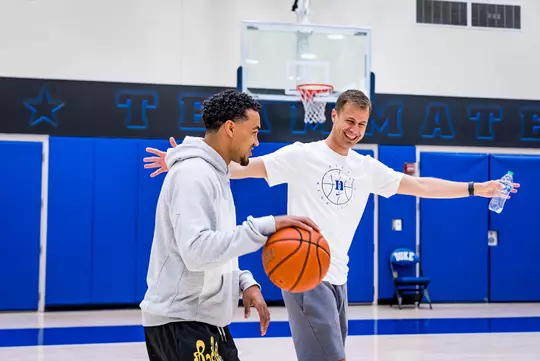
JS: It starts with getting a great feel for where their bodies are at. We do very detailed medical testing — physicals, biomechanical assessments, MRIs of all their feet and knees, just get a baseline for where they’re at. And then we attack, getting them stronger in every way possible. Then there is a huge area of opportunity during the summer for individual work, you know, how to get their individual games better and while we’re doing that, a lot of competition with 2-on-2, 3-on-3 type stuff.
This year we’re also going to take a special trip where we’re going to do a bonding trip to bring our group closer together and really build camaraderie, chemistry and not take anything for granted.
DS: You mention a team trip, why is that important for you? It seems those trips get referenced a lot throughout the season as important for building a team’s foundation, but why is that?
JS: Well, you can do foreign tours, which we didn’t feel this was the year to do it. But we felt it was important to do something special and so we’re going take a trip. I’m not going to say where because we’ll release that at another time as we’re still finalizing the plans. But it’s important just to take a couple days just us, just with our players and put them in a position where they get a chance to get to know what their teammates are all about even better. I think it’ll be something we look back on that really helped bring us closer together. It’s really taking the basketball piece out of it. That to me, more than anything this year, you’ll get sick of me talking about it probably, but for me it’s less about the basketball piece and more about what our culture is about — how hungry we are, how together we are — that’s going to be the difference.
DS: I’ve known you for a while and I know what a competitor you are, and hearing you talk, I can tell you’re kind of chomping at the bit to get going again. The competitive fire as a coach versus when you were playing, obviously you’ve been coaching for a while now, but this past year being a head coach, what do you like most about the process?
JS: You know, my competitive fire just, it’s growing still, and I think the thing that our guys probably don’t even realize, it’s when you look back from your days playing, it was really the journey more so than the actual championship or the win. I mean those feel great, don’t get me wrong, but it’s the fact of getting up in the morning and outworking somebody and it’s bouncing back after you get beat one day.
Those are the moments you look back on, and for us to help our guys as a staff in those special times, that’s what it’s about for me. I’ll tell you Shumate, I’m hungrier than ever. I’m proud of this past year, but I’m also not satisfied in the least bit. There’s a lot of things I want to help our guys more with. We can do better as a staff, I can do better as a coach, and there are things I expect more from our guys and there’s a reason they’re back, because they want to do better. I’m ready to go and really ready for the journey, and we’ll see where the journey takes us, but I know it starts here pretty soon and I’m ready for it.
Dedicated to sharing the stories of Duke student-athletes, present and past, GoDuke The Magazine is published for Duke Athletics by LEARFIELD with editorial offices at 3100 Tower Blvd., Suite 404, Durham, NC 27707. To subscribe, join the Iron Dukes or call 336-831-0767.