
John Roth, GoDuke The Magazine
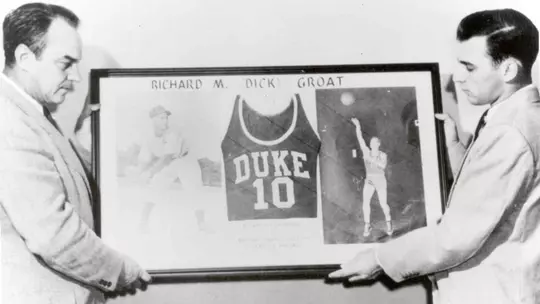
On May 1, 1952, Dick Groat's number 10 became the first jersey ever retired at Duke. That same month, the two-sport star then led the Blue Devil baseball team to its first College World Series in Jack Coombs' final season as head coach.
When Jack Coombs Field sprouted from the Piedmont soil in 1931, careful genetic analysis determined that the newborn baseball stadium shared a few strands of architectural DNA with Shibe Park, then a Philadelphia landmark. The discovery was hardly greeted as a major scientific revelation, since the man who was tilling this particular patch of Mr. Duke’s dirt was the very same Jack Coombs who had risen to professional pitching stardom for the Philadelphia A’s in the early 1900s and was now the Blue Devils’ coach.
But while the topographical settings of the two ballparks differed drastically — city block vs. rolling pine forest — their common ground was apparent: Both were pitcher-friendly in design, with expansive foul territory bordering the infield that converted many typically unplayable pop-ups into routine outs.
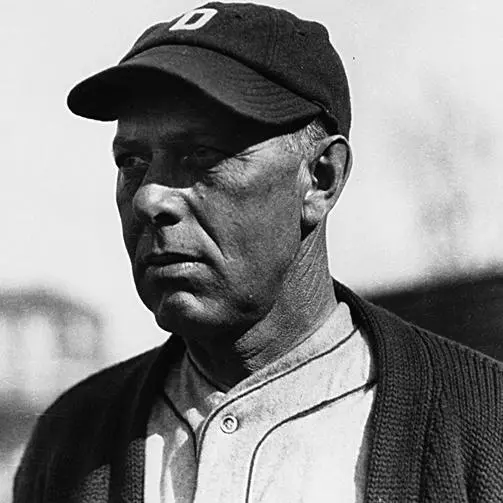
Of course, Coombs did not have the audacity to name this little clearing in the woods after himself. In fact, he may have had no audacity whatsoever. Surviving character sketches from his era portray “Colby Jack” as a respected and beloved campus figure — and possibly the coolest coach in all of Duke history. He and his wife lived in the dorms, for heaven’s sake, right there among the students in a corner apartment of the clocktower quad. No, his stadium was initially labeled generically as Duke Park. But over the years, as he mined and shined one baseball gem after another within its confines, the locals began referring to it as Coombs’ park long before the Board of Trustees did.
Coombs’ heirloom diamond hosted its share of stellar achievements during its formative years, but it was during the coach’s final season in the dugout that history began intersecting with the rites of spring on a regular basis. And not just baseball history, but Duke history. Seventy-one years ago this Monday, for example, the Shibe-inspired expanse between home plate and the grandstand wall was put to ceremonious use. On the afternoon of May 1, 1952, moments before the Blue Devils were to face nemesis North Carolina in a Big Four clash, director of athletics Eddie Cameron assembled a handful of dignitaries in that area of the field for an unprecedented occasion.
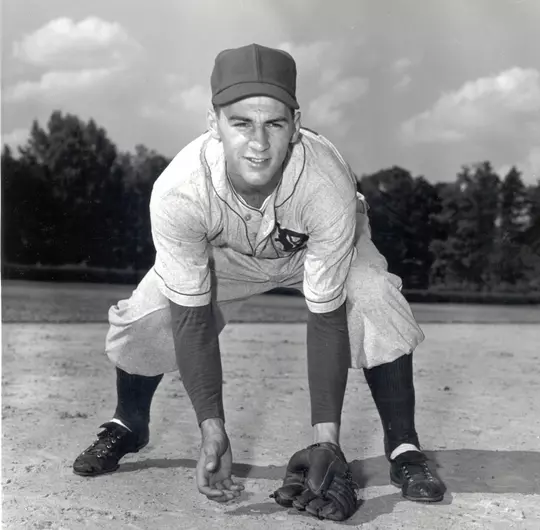
The object of their attention, and affection, was Duke’s senior shortstop, Dick Groat, who eight weeks prior had completed the most prolific basketball career his young university had yet experienced. As a junior he had set the national scoring record with 831 points, and as a senior he had been named national player of the year, a first for a Blue Devil. For the topper, he had scorched the rival Tar Heels for 48 points in a magnificent home finale, setting a stadium record that has yet to be broken.
Groat’s last basketball appearance for the Blue Devils had come in the Southern Conference Tournament championship game in Raleigh — a disappointing loss to N.C. State. Groat had fouled out of that game with about four minutes to play, and every member of the Wolfpack squad had gone over to the Duke bench to shake his hand.
Now, with a bright Thursday sun bathing Groat’s second home, Duke would pay fitting tribute to its star two-sport athlete.
Al Raywid, president of the men’s student government, gave Groat a plaque of appreciation on behalf of the student body. Dr. George Baylin, a major donor, presented Groat with the first Swett Trophy as the most valuable player of the basketball team. Then Cameron took the public address microphone.
“And now, before concluding this presentation program, I have a little surprise for you,” he said. “I’d like to announce that the Duke Athletic Council, on March 17, voted to retire…”
The crowd noticed that Cameron had pulled Groat’s No. 10 basketball jersey out of some wrapping paper and realized what he was about to retire. According to Jack Horner of the Durham Morning Herald, their thunderous approval muffled the remainder of Cameron’s remarks as he told of how No. 10 would be retired forever and put on display in the trophy case at Duke Indoor Stadium.
Cameron handed Groat his white jersey and kept the blue one for display. “I am at a loss for words,” Groat told the crowd. “This is the greatest honor of my life and I want to thank everyone who made it possible.”
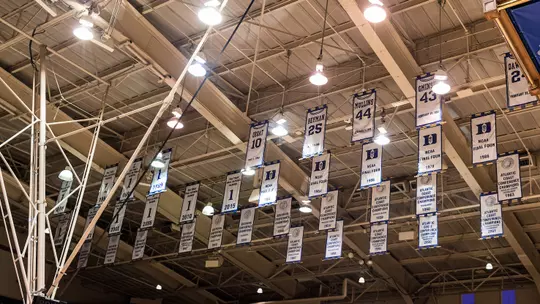
Though barely 10 minutes in length, the ceremony resonates historically to this day as the first of its kind. No Duke athlete had ever seen his jersey retired — and no one else would receive the supreme honor for another 28 years, until Mike Gminski was surprised by athletics director Tom Butters with the retirement of his No. 43 moments before his last home basketball game in 1980.
A total of 16 basketball numbers now hang retired from the rafters overlooking Coach K Court — 13 men and three women. All but one were formally retired in the arena that now bears Cameron’s name. But the only one that Cameron himself retired, behind home plate at a baseball park, started it all — the North Star of a glittering jersey constellation. “Nobody had ever had a jersey retired at Duke, ever, so it was really special,” Groat, who died on Apr. 27 at the age of 92, recalled in an interview several years ago. “Little did I realize that it was going to carry on for all these years. It’s become a tradition at a lot of universities now, but back in 1952 that was unique to have your number retired.”
Likewise, the presentation of the basketball MVP trophy was a unique, historic moment — because that, too, had never happened before. For years, the top players on the Duke football team had been honored with their photographs placed on public display at the old Center Theater in Lakewood Shopping Center. There was nothing comparable for basketball, an oddity that caught the attention of a nine-year-old Little Leaguer and Blue Devil diehard, Stephen Baylin, who asked his father to explain.
The Baylins were ardent Duke supporters, with basketball season tickets on the second row midcourt, and the query from Stephen prompted his father to action. Dr. Baylin marshaled the creation of the MVP trophy and had it endowed in the name of one of the founding faculty members of the Duke Medical School, Dr. Francis Swett, his revered anatomy professor and fellow sports enthusiast who had died in 1943. Several years later, the honor became known as the Swett-Baylin Award and its legacy endures: it continues to be given to the annual Duke basketball MVP, and little Stephen Baylin, who was on the field with his dad for the inaugural presentation, still has a photograph of him holding the original trophy while Groat’s jersey is being retired. That Little Leaguer is now Dr. Stephen Baylin, renowned cancer research professor at Johns Hopkins, a recipient of the American Cancer Society’s Medal of Honor and a member of the National Academy of Sciences.
On With The Show
Important baseball remained to be played following the festivities of May 1, 1952. In fact, it was the start of a most historic month for the Blue Devils. Duke was the class of the Southern Conference that season with one of the most spectacular lineups coach Jack Coombs had compiled in his 24 years. Life magazine profiled the program and called it Coombs’ $250,000 team, an estimate of how much the talent would have been worth in Major League purchase value — a substantial figure in 1952 dollars.
Scouts from all 16 big league teams were regular visitors to Duke Park and some called this Blue Devil edition one of the greatest college teams ever assembled. An Associated Press survey of scouts who evaluated the team concluded that “every player could jump into professional ball and make the grade, some in Class A and Double-A leagues.”
It may have played in a pitcher’s park, but Coombs acknowledged it was his best offensive team. Groat led the Devils in at-bats, hits, doubles and RBI while posting a .370 average, but opponents couldn’t pitch around him because he was embedded in a lineup that often included seven .300 hitters. The team hit .320 for the season while averaging almost nine runs per game.
The heart of the order featured rightfielder Dick Johnson batting second, Groat third and first baseman Billy Werber Jr. in the cleanup slot. Red Smith, a football player who patrolled leftfield, joined Werber and second baseman Billy Lea as the top power hitters. Joe Lewis was the ace of the pitching staff with a 12-1 mark and 107 strikeouts in his 106 innings, with Bob “Diz” Davis hurling a 9-3 record.
Both Groat and Werber were recognized as first team All-Americas. They were joined by Johnson, Lewis and Smith on the All-Southern Conference team.
After Groat was feted for his hoops prowess on May 1, the Blue Devils made it a memorable baseball occasion by rapping out a 10-2 victory over the Tar Heels. Groat (who wore No. 36 on his Duke baseball jersey) was 1-for-4 with two RBI, Werber went 3-for-5 with a double and Johnson extended his hitting streak to 32 games (it would eventually reach a school-record 35). The biggest hero of the day, though, was Lewis, who tossed his third two-hitter of the season and struck out eight UNC batters while giving up no earned runs.
The victory improved Duke to 19-2 overall, 14-1 in the Southern Conference and 6-0 in the Big Four. “Baseball in the Big Four, that was a big thing then. It was awesome,” Werber noted several years later. “It was really the best in the country. Good players wanted to come to those four schools. And there were hardly any scholarships, that’s what made it so amazing.”
Duke played its three Big Four rivals 12 times during its 27-game regular season in 1952 — twice each at home and away. The last of those came on May 12, this time against N.C. State, and marked another historic moment. Not only was it the final home game for Groat and six fellow seniors, but it was also the swan song for their venerable head coach. After 24 years, Coombs was being bureaucratically forced off the field he built because of a university policy that required members of the teaching staff to retire at the end of the academic year in which they reached their 69th birthday. Coombs had turned 69 in November ’51.
No one wanted Coombs to leave. Student columnists protested the policy and the student government passed a resolution asking the trustees to make an exception, but to no avail. “He was the greatest,” said Groat. “It didn’t make any difference if you were a baseball player, a football player or just a student at Duke — everybody on the Duke campus loved Jack Coombs. Every day at noon he was waiting in the student union and he would hold court. And he knew every professor. He knew everything about us, what you were doing academically. He was just a special man.”
So on May 12, the university convened another unique pregame ceremony, this time to recognize Coombs’ legendary career. Over 2,000 spectators attended, with Werber’s father, Bill Werber Sr., an ex-Major League infielder who was on Coombs’ first Duke team, serving as one of the speakers. Knowing their coach always spent his offseasons hunting and fishing in his wife’s hometown of Palestine, Tex., the team gave him a fishing kit to use in retirement.
Coombs choked up briefly when it was his turn to address the crowd, admitting it was hard to believe this was his last home game. “But the time has come for me to say good-bye, and I want to say thanks to my many friends who have supported me in my efforts. Good-bye and good luck.”
One person who did not attend was Coombs’ wife, whom everyone called Miss Mary. She was so overcome with emotion when the team earlier presented her with a string of pearls that she decided the game would be too much for her to handle.
Duke proved too much for N.C. State to handle. Groat, Smith and outfielder Benny Cavaliere produced two runs in the opening inning and that was all the Blue Devils needed, as pitchers Davis and Bill Ward combined on a one-hitter. The final was 6-0, leaving Duke as the Big Four champion at 10-2 and the winner of its division in the conference.
The Finishing Touch
The league tournament at Raleigh’s Devereux Meadows was next, and Duke, the defending champion, was favored to win the double-elimination event again. But an early upset dropped the Devils to the loser’s bracket, meaning they would have to win three games in one day to claim the title. And that’s exactly what they did on May 17, topping George Washington 8-4, then sweeping the Wolfpack 7-0 and 8-3 in a Saturday evening doubleheader that concluded after midnight.
“We were a determined bunch,” said Werber, who passed away in 2021 at the age of 90. “It was Coach Coombs’ last year and we wanted to send him off the right way.”
Coombs, unfortunately, didn’t witness his final SC championship firsthand, bedridden for the weekend with a kidney ailment. But on Sunday afternoon, Groat and team captain John Carroll headed over to Duke Hospital, Room 3021, to bring their coach the trophy.
There was more history still ahead. The year before the Blue Devils had won the conference but the school had declined a bid to compete in the NCAA playoffs. With Coombs retiring, Duke felt it an appropriate gesture to accept its NCAA invitation in 1952 and traveled to the District 3 playoffs in Kannapolis, N.C. Coombs returned to the dugout and Duke won three games in three days to claim a trip to the College World Series in Omaha — another program first.
Once in Omaha, Duke exploded offensively in its opening contest, blasting Oregon State 18-7 as Groat, Werber, Johnson and Smith combined for an astounding 13 hits and 11 runs between them. But successive defeats to Penn State and Western Michigan abruptly eliminated Coombs’ juggernaut.
“Those scouts ruined us,” pitcher Diz Davis told the Herald’s Horner the following year when he was playing for the Durham Bulls. “After we won that first game (in Omaha), they worried us sick. They talked to all of us at one time or another and talked money. I know I couldn’t sleep for thinking about those offers the scouts made…They ought to do something about those scouts coming around to your hotel, calling you up and inviting you out. They get your mind away from what you’re out there for.”
Holy Cross kept its mind on the business at hand and won the NCAA title, while Duke drew the curtain on a 31-7 season of firsts.
Those ubiquitous scouts, meanwhile, bagged four ’52 Blue Devils, headlined by Groat, whose professional life began almost immediately upon his return from Omaha when he fulfilled a promise to Branch Rickey and signed with his hometown Pittsburgh Pirates.
While his three teammates received minor league assignments, Groat went directly to the big leagues and played 14 years, with only a two-year interruption for military service. He was a three-time All-Star, the 1960 National League batting champ and MVP, and a key cog in World Series crowns for the 1960 Pirates and 1964 Cardinals — after ending a brief NBA career to focus on a single sport for the first time.
“We all thought, 90 percent of us who were into sports, that Groat was a better basketball player,” Werber recalled.
“I’ve still got in my file a write-up from the number one New York Yankees scout, who evaluated everything, and he had Groat for baseball down about four or five on our team. I wrote him sometime later and told him he didn’t evaluate the key thing on Dick, which was the will to win, the desire, the combative spirit. He was just a winner.”