
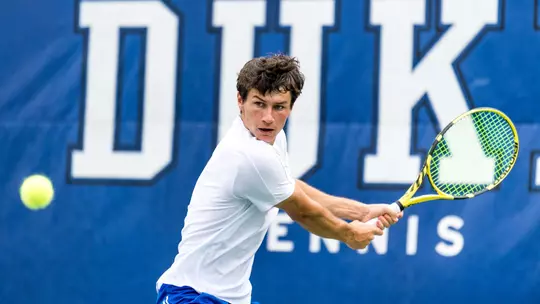
Pushing Through
Senior Garrett Johns playing serious tennis to key surging Blue Devils
Jim Sumner, GoDuke The Magazine
This story originally appeared in the 14.9 Issue of GoDuke The Magazine – April 2023
This is Ramsey Smith’s 15th season as head coach of the Duke men’s tennis team.
It’s too early to call 2023 his best team. That will be determined in May. But through April this team certainly looked like one of his best. It has depth, talent and versatility.
But Smith says the intangibles are what distinguishes this group.
“Good leadership, good assistant coaches, a belief, a toughness.”
Smith cites a very challenging early schedule “where we lost 4-3 early to a bunch of good teams where we just didn’t push through. The whole goal is to be playing our best at tournament time. The team chemistry is really good. They love tennis. They’re working all the time.”
In its first 15 matches of the spring, Duke lost four times by a count of 4-3 or 4-2. Then the Blue Devils went to Virginia on March 19 and got swept 7-0.
There’s no disgrace in losing to the Cavaliers — they won the 2013, 2015, 2016, 2017 and 2022 NCAA titles. And the Blue Devils had been competitive in most of those close defeats.
But after Virginia, Duke started pushing through and winning those competitive matches.
Duke posted ACC wins over Clemson (7-0), Georgia Tech (6-1), 16th-ranked Wake Forest (4-3), 23rd-ranked NC State (5-2) and 13th-ranked North Carolina (5-2), the latter three over a span of only eight days. The win over Wake Forest was Duke’s first over the Deacons since 2015.

Then they closed the regular season by defeating No. 19 Florida State, 4-3, for a school-record 11th ACC win and an 18-5 overall record to head into the postseason on a seven-match winning streak.
Top college teams have a top player at the top and Duke is no exception.
At 5-foot-11 and 155 pounds, Garrett Johns may not have an imposing physical presence. If you’re looking for booming serves and jaw-dropping ground strokes, well, you’re looking in the wrong place.
But Johns makes up for it in a myriad of other ways, some physical, some mental.
Johns is a native of Atlanta. His mother Lynn played tennis at Villanova; paternal grandmother Mary Lou Johns coached women’s basketball at Memphis for 10 years.
He began playing tennis around five or six. He says he was too short to stick with basketball.
But it wasn’t his mother who inspired him.
“I started because of my older (by two years) brother, Cameron. We were super competitive.”
Johns played lacrosse in middle school but says he prefers tennis due to its more individual nature. He also ran cross-country in middle school and continues to run for its conditioning benefits.
By high school he had committed to tennis as his next-level sport and he quickly became one of the south’s best youth players. He was ranked as the fourth-best prep player in the southeast and had no shortage of college options.
Why Duke?
“I had a lot of good options. But I really loved Ramsey [Smith] and the coaches at the time and thought I would fit right in. I really loved the academics at Duke, also the campus and how beautiful it is. I thought it would be the perfect fit, tennis and academics.”
His mention of academics isn’t just lip service. Johns has been named to the ACC Academic Honor Roll and an ITA Student-Athlete. He is majoring in psychology and says a post-playing career as a sports psychologist “would be super cool.”
Johns has already decided he’s going to use his covid bonus year and return next season.
Johns is just as serious about his tennis. Johns came to Duke with a reputation as an excellent athlete with the ability to return balls that other players wouldn’t even reach. Smith says that remains his core strength.
“Ultimately his identity is someone who’s going to make a million balls. That’s sort of his home base from juniors. We’re not taking that away.”
That wasn’t enough to get Johns on the court right away as a freshman.
“The first couple of matches he was listed at seven (for the six-player singles lineup),” Smith recalled. “He didn’t like that very much but he handled it the right way. He went out in practice and proved that he deserved to be there.”
Here’s how Johns recalls that shaky start.
“Adjusting to the college environment was a little difficult at first. Getting used to the whole team environment. Ramsey and the coaches just told me to keep my head up, keep working and cheer the team on and you’ll get a shot eventually. Got my shot, won a lot of matches and kept winning. It was a learning moment.”
Johns has built on the skills he brought to Duke. He plays lots of long points, long games and long matches and is superbly conditioned
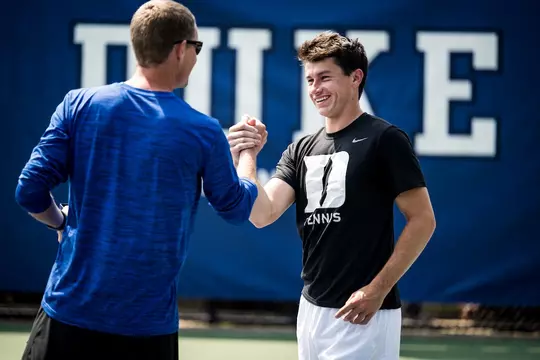
“He prides himself on that,” Smith says. “His mentality is that he’s going to chop the legs out from under his opponent. It might take an hour-and-a-half, it might take two hours, it might take three hours but he’s willing to be out there. The longer the match goes the better he seems to move and feel. He loves long matches.”
But he’s also learned to win points quicker, with less effort.
“We’re adding tools,” Smith said. “He’s serving better. He’s able to play up in the court more. He’s such a great athlete that he’s so good at net.”
“Each year I’ve added a couple of miles-per-hour on my serve,” Johns adds, “or being able to hit the ball and come into the net more and keep the points shorter. Being a little more aggressive. That and getting a lot stronger.”
It’s not just physical. Smith and Johns agree that Johns has improved the mental part of his game.
“It was something I needed to improve on,” Johns acknowledges. “Something I focused on, not getting angry, not taking my time between points, learning when to slow down and control the game.”
College tennis starts with winning the opening doubles point. Three doubles teams play one set each and the team that wins two (or three) matches captures that crucial point.
Six singles matches follow. Win the doubles point and you have to win three of those six singles matches. Lose that point and you have to win four of six.
Duke has one of the nation’s better doubles teams leading off, Johns and Pedro Rodena, a talented freshman from Madrid, Spain.
Johns played doubles last season with graduate student Sean Sculley, who used up his eligibility. Smith made the decision to pair the veteran and the newcomer as his top doubles tandem for this season.
“It made a lot of sense,” Johns said. “I was super-excited. Pedro is a really talented player. As the year has gone on we’ve gotten a really good feel for each other. Him being a lefty gives me angles I’ve never had before. We’re both pretty good athletes and can win points that aren’t going well.”
“It sets a tone,” Smith said of doubles. “It establishes a lot of momentum. We’re playing aggressive doubles on our terms.”
Rodena has become not only a top-notch doubles player but a solid number two in singles. He’s ranked No. 46 nationally in singles.
“He’s playing at an unbelievable level right now,” Smith said of Rodenas. “He’s embraced the team concept, the dual-team concept and he’s played his best tennis in the pressure moments. He’s learned a lot from Garrett. Garrett’s really helped guide him.”
Johns is one of Duke’s tri-captains, along with fellow seniors Andrew Zhang and Michael Heller.
Smith described Johns’ leadership style as “on the quieter side. He’s more leading-by-example. When he does speak the guys really listen. No one is more committed to his game than he is and he’s learning to be more vocal. He’s been a great leader in a lot of ways. He’s invested a lot on the mental side.”
Johns acknowledged that Heller is the most vocal of the three and describes his role as “leading by example, showing players the right way to work hard, be mentally strong, work hard in the gym, things like that.”
Sophomore Connor Krug says Duke feeds off Johns.
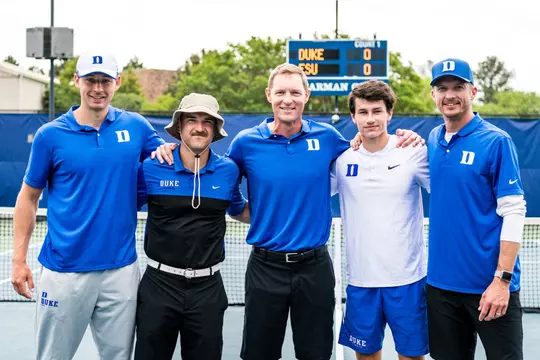
“He’s super-composed. It all starts with him. When he wins, it just gives us so much confidence.”
Heading into postseason play, Johns was ranked 13th nationally in singles with a 19-12 record, most of these matches against the top player from some of the nation’s best teams. He and Rodenas were 19-4 in doubles and riding a 10-match winning streak.
“It’s definitely difficult playing line one because you get a lot of really good players and you have to bring your ‘A’ game every day,” he noted. Beating a top player “gives you a lot of confidence going into the next match.”
Duke lost in the second round of the 2022 NCAA Tournament and Johns lost in the second round of individual competition. He’s looking for better results this time around.
How far can Duke go in the 2023 postseason? Duke reached the championship match of the ACC Tournament and is hopeful of being one of the top 16 teams selected to host opening rounds of the NCAA Tournament.
“The team has a lot of confidence in how hard we’ve worked, doing things the right way,” Johns said. “I really think the sky’s the limit for both (individual and team). I want the team to win the NCAAs or go as far as we can.
“I think we’re right there. Individually, I want to go as far as possible. Get to third round and make All-American but really don’t want to stop there.”
Dedicated to sharing the stories of Duke student-athletes, present and past, GoDuke The Magazine is published for Duke Athletics by LEARFIELD with editorial offices at 3100 Tower Blvd., Suite 404, Durham, NC 27707. To subscribe, join the Iron Dukes or call 336-831-0767.