
Remembering the First Duke Final Four
Legends Bubas, Heyward & Mullins orchestrated first run 60 years ago
Lewis Bowling, GoDuke The Magazine
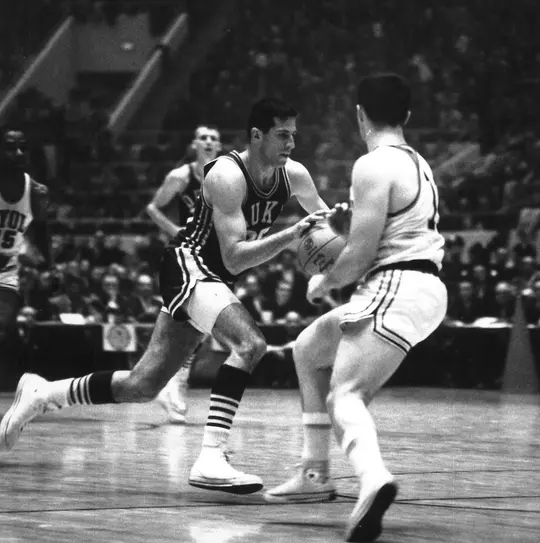
This story originally appeared in the 14.8 edition of GoDuke The Magazine – March 2023.
“We think that we are going to have a fine basketball team. We realize that we are going to be picked among the nation’s elite to start the season. This will give us something to strive toward in our planning.”
These words were spoken by Vic Bubas, the head basketball coach at Duke University, before the start of practice for the 1962-63 season, 60 years ago. After all, two of the greatest players to ever suit up in Duke blue were returning, Art Heyman and Jeff Mullins, both first team All-ACC players in 1961-62. Duke had gone 20-5, so there was not much doubt that the Blue Devils would be good. The 6-foot-10 Jay Buckley also would be back, along with guards Buzzy Harrison and Fred Schmidt. The 6-10 Hack Tison would be joining Duke for the 1962-63 season, up from the freshman team, better known as the Blue Imps.
But no doubt this team would be led by Heyman and Mullins. Ed Seaman, a veteran sports writer, assessed the strengths of the two great Duke players before the season got underway.
“Mullins is the expert of the off-balance shot and has an uncanny ability to fire carom shots off the backboard. Heyman is the master of the drive, especially when opponents are clinging to him. He bulls his way to the basket like Elgin Baylor and Tom Heinsohn. Mullins and Heyman both have good spring in their legs. Ball thefts are a specialty of both.”
In the first game of the season, the “opponents” scored 80 points against Duke. What pleased Bubas about this game was that it bode well for the future, as the opponent was the Duke freshman team. Head frosh coach Bucky Water’s team of newcomers put on a good show, but the varsity boys scored 115 points, led by Heyman’s 35.
Duke opened the regular schedule in Duke Indoor Stadium, now Cameron Indoor Stadium, by beating Lefty Driesell’s Davidson team. Heyman scored 36, with 18 coming in each half. Driesell had been a player for Duke in the early 1950s and was now known as a fiery coach. One writer described him like this: “Lefty will put on quite a show — a live exhibition of a holler man, foot stomper, and twister all rolled into one.”
Also of note from this Davidson game at Duke Indoor Stadium was the presence of Duke’s “Straw Hat Band,” nattily dressed in black and white striped coats, who performed during halftime. The fans were in for another treat at intermission when an eye-catching coed drew loud cheering for her exciting Charleston dance number.
Duke had also beaten Davidson in the 1961-62 season by a score of 117-72. Driesell said after that game, “We’ll be back and we’ll get even. There was no sense in Duke running up the score like that.” Sure enough, in the second game between the two in 1962-63, in a game played at the Charlotte Coliseum in front of over 11,000 spectators, Davidson shocked Duke, which was ranked second in the nation. Davidson’s players carried Lefty around the court on their shoulders.
Duke also lost its next game, to Miami, as 7-1 center Mike McCoy sank a short jumper with five seconds left to beat Duke 71-69.
Duke then went to Louisville and won 76-75. Mullins, a Kentucky native who had been heavily recruited by UK coach Adolph Rupp, played before many of his friends and scored 21 points. Heyman scored 35. In a 90-70 win over Vanderbilt at Duke Indoor Stadium, Vanderbilt’s coach Roy Skinner thought he smelled some home cooking. “I thought the officials let it get too rough. It was a roughhouse game. I don’t like free throw contests, and that is what happens when they blow the whistle every minute. The game lacked something to be desired from the standpoint of officiating.”
It got even rougher when Duke went to the Greensboro Coliseum to play Bones McKinney’s Wake Forest team. During a scramble for a loose ball, the Deacons’ Frank Cristie punched Heyman in the nose, which led to a bloody mess. Cristie was ejected, and the tough Heyman simply wiped the blood away and finished with 27 points in the Duke victory.
After the game Bones was livid, thinking that Heyman, who was known to not mind “mixing it up” (as Larry Brown of UNC found out), had instigated the fracas. “The movies of the game will tell the whole story,” he noted. Upon being told of McKinney’s comments, Bubas indicated that he knew a thing or two about game film also. “I can show movies, too, and it will show that no boy on our team threw a punch whatsoever.”
Another rather odd event occurred during the Wake Forest game. The game was delayed so the distance from the net to the floor could be measured on the Duke basket. It was found to be four inches short, so a maintenance crew promptly corrected the error.
Princeton and its great All-America, Bill Bradley, came to Durham for a December game. Bradley, who almost came to Duke, and Heyman had a good matchup, but Duke beat the nationally-ranked Princeton team. Princeton’s coach, Butch von Breda Kolff, had some colorful remarks after the game. “The officiating? I have no comment. My kids did see a lot of elbows out there. Jeff Mullins is a good boy for Duke. A real good boy.”
Coach von Breda Kolff then reached into his coat pocket and pulled out an envelope which had been given to him by Duke athletic business manager Red Lewis. The envelope contained Princeton’s pay from the game. “Well, we didn’t come away empty handed,” the coach said.
Duke finished with a 14-0- ACC record, which included a 106-93 win over UNC on February 23, 1963. In that game, Heyman scored 40 points and grabbed 24 rebounds in his final home appearance. Billy Cunningham did his part for UNC in the matchup of All-America players, scoring 31 points and pulling down 16 rebounds. After the game, in a hard-to-believe statement, Bubas said of Heyman’s performance, “I think overall we’ve probably seen him play better games.”
Art Loche, an assistant coach at NYU, scouted Duke in the ACC Tournament in Raleigh. After watching several games he realized how popular basketball was in North Carolina. ”Now I know why so many New York, New Jersey and Brooklyn boys go South to play college basketball. People down here take their basketball seriously. I’ve never seen anything like it.”
The Blue Devils defeated Wake Forest in the ACC Tournament championship game, which earned Duke a spot in the NCAA Tournament. Over 3,000 students and fans gathered in front of the Duke Chapel to give the Blue Devils a grand send off to the NCAAs, where they would play NYU in the first round at College Park, Md. The Duke Pep Band and Duke cheerleaders performed. Durham Chamber of Commerce president J. Wesley Lewis said about the Duke team, “You may be number two in the nation but you are number one in the hearts of Durham people.”
Mullins scored 25 as Duke beat NYU 81-76, then totaled 24 as Duke beat St. Joseph’s 73-59 to earn the first Final Four berth in Duke basketball history. Mullins, being from Lexington, Ky., and knowing that a win in this game would send Duke to Louisville for the Final Four, must have been smelling Kentucky bluegrass with each shot, as he made 10 out of 16 attempts. Buckley had 10 points and 18 rebounds in the victory, Schmidt scored 20 and Heyman added 16.
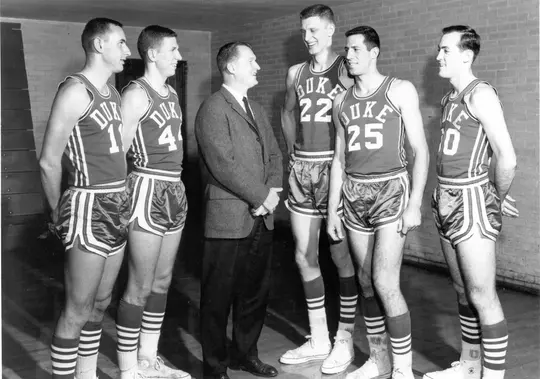
Upon arrival at Raleigh-Durham Airport after winning the East Regional, a crowd of over 6,000 people gathered to greet the Blue Devils. The crowd was so huge and so happy that they started to mass on the runway. Airport officials, before the plane arrived, spoke to the crowd with a loudspeaker to stay behind the fences. They even threatened to land the plane at a different location of the airport if need be. One official proclaimed, “We’ve got 2,000 acres to choose from.”
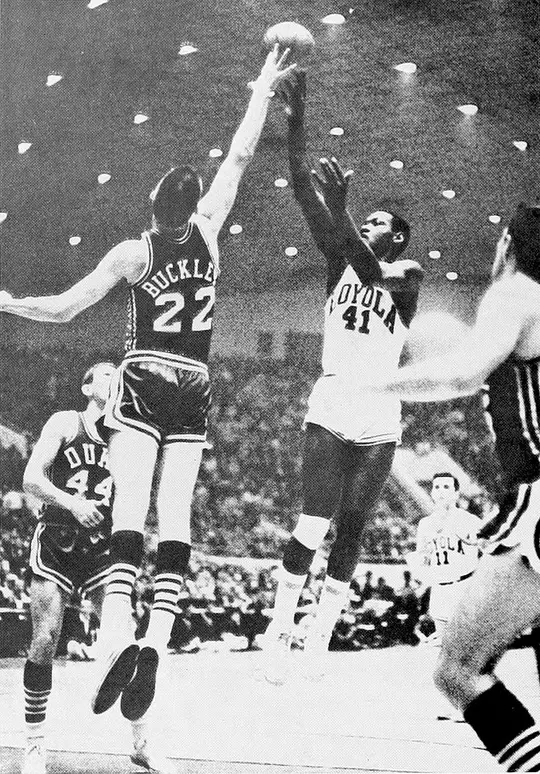
In the first round of the Final Four, Loyola of Chicago jumped out to a 20-5 lead as Duke made only one of its first 11 shots. Loyola won 94-75 despite Heyman scoring 29 points. “We just didn’t shoot well enough,” Bubas said after the game. “I can’t explain it. We had excellent practice sessions and the boys ran the same patterns.”
Unlike today, the two losers in the semifinals played each other for third place. Duke beat Oregon State 85-63 as Heyman led the scoring with 22 points. Schmidt had 20, Mullins had 14, and Tison scored 11. “I am real proud of this team,” Bubas said. “They compiled the best record in Duke history at 27-3 and had the highest ranking nationally of any previous Duke team.”
Heyman had one of the greatest seasons in Duke basketball history. He averaged 24.9 points a game and 10.8 rebounds. He was the ACC Tournament MVP and the Final Four MVP (a rarity for someone who didn’t even play in the championship game) and was named the National Player of the Year. Mullins earned All-America status along with Heyman, averaging 20.3 points a game and 8.0 rebounds. Buckley averaged 11.2 points and 9.9 rebounds.
Bucky Waters, the assistant coach who would eventually succeed Bubas as head coach in 1969, remembers fondly the 1962-63 season. “Of course, having Art Heyman and Jeff Mullins, who were two of the best players in the country, certainly helped us go 14-0 in the ACC and then reach the Final Four in 1963,” he recalled. “Art and Jeff were as different on the court as they were different off the court. Art was free-spirited. Coach Bubas was a master at pulling players together, making differences go away. He was a genius at making a team a unit. Coach Bubas once told me he recruited a tough guy from New York in Art, and he got a tough guy from New Jersey to coach him in me.”
Waters did have to rein in Heyman, on and off the court. But later on, when Heyman was playing for the New York Knicks, Waters received a letter from Heyman that read, “When you are older and mature a little like I have, you begin to appreciate what someone has done for you like you have done for me. In the four years I spent at Duke, you always put me down in the right place, and overall gave me a hard time. You did not let me get away with things I wished to, and how thankful I am today of this. All I can say from the bottom of my heart is thank you for what you did for me, and I will never forget it.”
Waters, who after his coaching career gained even more fame as a popular college basketball television color man, looked back again to the Loyola game. “Loyola jumped out on us 27-9. We battled back to within 72-70. Coach Bubas called a timeout. We had the ball and Jay Buckley set a screen for Jeff Mullins. Jeff scored to tie the game but an illegal screen was called. We went berserk but the call stood. We never got close after that. We lost to Loyola who went on to win the national title. I know going to the Final Four in 1963 helped us to play for the national championship in 1964 against UCLA.”
Duke has played in 17 Final Fours, which is tied for third most in NCAA history with Kentucky. (UNC has the most with 21, and UCLA has 18.) Duke’s history of playing in Final Fours started with the Vic Bubas coached 1962-63 team, 60 years ago this month.
Dedicated to sharing the stories of Duke student-athletes, present and past, GoDuke The Magazine is published for Duke Athletics by LEARFIELD with editorial offices at 3100 Tower Blvd., Suite 404, Durham, NC 27707. To subscribe, join the Iron Dukes or call 336-831-0767.