
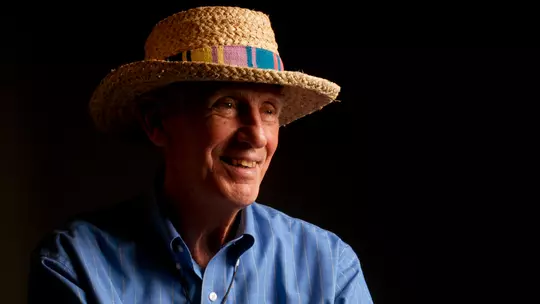
Remembering the Legendary Al Buehler
October 10, 1930 - January 5, 2023
Johnny Moore, GoDuke The Magazine
This story originally appeared in the 14.6 Issue of GoDuke the Magazine – January 2023
If you only think of Al Buehler as a track coach, then you would be missing out on the total man.
One adjective cannot come close to describing the life and times of this legendary figure.
Husband, father, grandfather, coach, teacher, statesman, advocate, leader, sailor and dear friend to so many, are just a few of the titles held by Buehler.
Buehler passed away on Jan. 5 at the age of 92, leaving a large void in so many people’s lives, just like all our mentors do when they depart. He touched an incredible number of lives in a myriad of ways. He may be gone but will never be forgotten.
Buehler was the last of the “Golden Age” of coaches at Duke. Wallace Wade, Eddie Cameron, Bill Murray and a few others all were part of the first threads of fabric in the tapestry of Duke University and Duke athletics. There are statues and buildings on the athletic campus named for them not because of their financial support to the program, but because they “were” the program and made Duke what it is today.
A statue of Buehler sits appropriately at the entrance to the Morris Williams Track & Field facility, but what he would be most proud of is the running trail around the Duke Golf Course that bears his name and allows for anyone, from any walk of life, gender, or ability, to improve their lives in different ways. A run to get in better shape or a walk to clear your mind — his trail gives everyone the ability to get out and make a difference in their lives through physical activity.
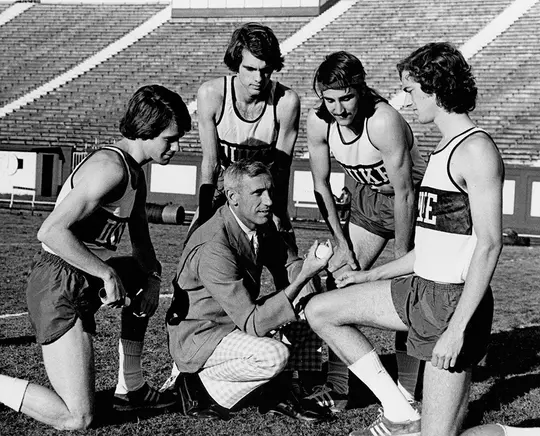
Buehler was one of the original breeds of coaches who actually taught classes and coached at Duke — for 60 years.
Following a stellar undergraduate track career at the University of Maryland, where he was schooled by legendary coach Jim Kehoe, Buehler joined the Blue Devils in 1955 as head cross country coach, a job he would hold for four-and-a-half decades.
In 1964, Buehler was promoted from assistant to head coach of the track and field team, where he had served under another Duke legend, Bob Chambers. His celebrated coaching career ended in 2000 when Buehler retired after Duke hosted the 2000 NCAA Track & Field Championships at Wallace Wade Stadium. He continued at the university as a professor and mentor to his students for another 15 years.
During his tenure with the Blue Devils, which included chairing the physical education department, Buehler coached numerous All-Americas, seven Penn Relays champions, six ACC championship cross country teams and five Olympians, two of whom went on to win medals. Along with his accomplishments as a Blue Devil, Buehler also enjoyed success on the international scene.
In 1972, 1984, and 1988, Buehler served as team manager for the U.S. Olympic Track & Field Teams in Munich, Los Angeles and Seoul, respectively. At the World Indoor Track Championships in Lisbon, Portugal, Buehler served as head manager for the U.S. contingent.
In 2003 Buehler was inducted into the United States Track Coaches Association Hall of Fame.
In between all those accolades there was an incredible life.
He trained athletes, in his early years, here and abroad, quietly gaining attention for promoting civil rights at a time when African-American runners were still expected to take their meals without complaint at the back door of restaurants.
In 1968, he was the only one willing to step up and help John Carlos and Tommie Smith safely leave the Olympic Village in Mexico City. The men, who had won gold and bronze medals in the 200-meter event, were ejected after famously raising black-gloved fists during the playing of “The Star-Spangled Banner” to bring attention to racial discrimination, apartheid and other civil rights concerns.
“It had to be done; I just happened to be there,” Buehler recalled. “The whole world was down on them, saw them as bad characters. But I knew them.”
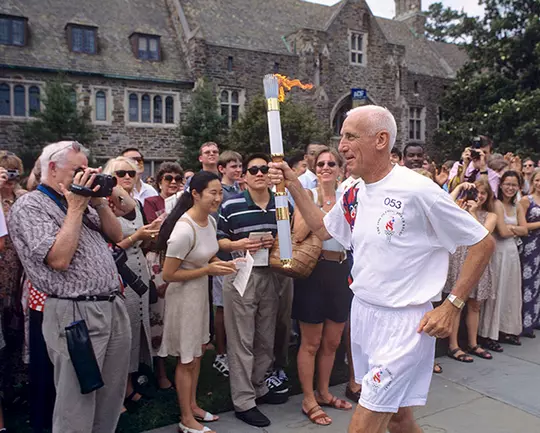
His partner throughout this track and field journey was LeRoy T. Walker, track coach and chancellor at North Carolina Central University. Walker became the first African-American Olympic head coach in 1976 and was appointed the first black president of the United States Olympic Committee in 1992. He was president of the USA delegation to the 1996 Olympic Summer Games in Atlanta.
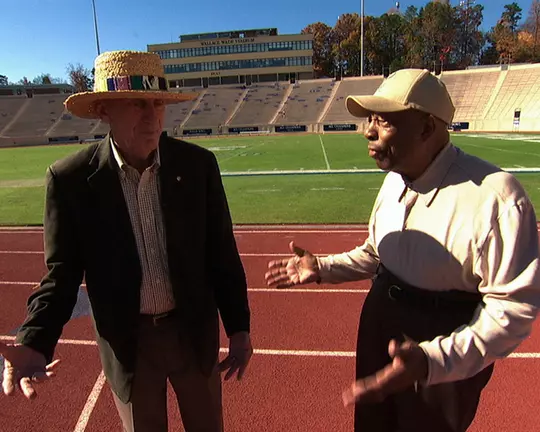
Buehler and Walker were inseparable. They were pioneers in the development of track and field in the United States and across the world.
“Al and LeRoy did an incredible amount for the development of the USA Track and Field program in this country,” said George Williams. “They worked with coaches and athletes to help develop their training programs as well as develop a training facility at Colorado Springs.”
Williams himself was a legendary track coach from St. Augustine’s University in Raleigh, known as the greatest relays coach in the world, and was an assistant coach for the 1996 U.S. Olympic team in Atlanta, where each athlete he coached won a gold medal. He later served as the head U.S. Olympic track coach at the 2004 Athens Olympics.
“Al took us to places to help third-world countries develop their track and field programs and was one of the greatest organizers of meets and programs in the world,” Williams added.
Williams also talked about his generosity of time and knowledge when Williams was just starting as the track coach at St. Augustine’s.
“Al took the time to help me as a young coach to understand how to register for meets and how to work with my athletes. He was very special.”
Buehler and Walker brought big-time, world class track and field to Durham — and the nation — with Duke University hosting the world’s top athletes in meets involving the United States-Soviet Union in 1974, the United States-Pan Africa-West Germany in 1975, and the United States-Pan Africa again in 1994.
The most dynamic of these international meets came in 1971 when Duke and Durham played host to a historic Pan Africa-USA international meet at Duke on July 16-17. The meet pitted some of America’s best athletes against competitors from 14 African nations. It was the largest track event in the western hemisphere that year and the first international track meet held in North Carolina and the Southeast.
An estimated 52,000 people packed Wallace Wade Stadium on two sweltering days that summer. Walker and Buehler partnered to coordinate the international event.
“I managed the logistics, while LeRoy brought the best athletes to compete,” explained Buehler. “People from all over the country came to watch … They wanted to be a part of history.”
And Buehler was definitely a promoter of change in college athletics, especially track and field. He was a strong advocate for the inclusion of women in the sport, pushing hard for Duke to institute a women’s track and field program while promoting Title IX legislation.
His admiration for women’s athletics came from the fact that as a youngster he was beaten in races on a regular basis by a young lady, Francis Caves.
That admiration led to the development of one of Duke’s first female star-athletes — Ellison Goodall. It began with Goodall running with Buehler on the track at Wade Stadium long before there was a women’s track program.
“She was a natural,” he recalled. “She wanted to come and run with me. I could see no reason she shouldn’t.”
Goodall earned track All-America honors in 1978 and cross country All-America accolades in 1977. In addition, she was an AAU national champion. She later become the second woman to be inducted into the Duke University Athletics Hall of Fame.
“Al understood me instantly,” she recalled in a recent interview. “He could see the athlete in me but understood the person within. His insight into the athletic mindset is what sets him apart. Its why Al’s success is legendary. All athletes deserve support and recognition, and Al has fought tirelessly on all our behalf.”
Buehler made his mark off the track at Duke, too. His “History and Issues of American Sport” seminar was so popular, and continued to be 15 years after he retired from coaching, that students routinely signed up for the waitlist, hoping someone would have to withdraw.
One of those students who managed to get off the waitlist was Amy Unell.
“It was in Coach’s class that I developed a deeper understanding of sports and history and an appreciation for how he inspired and sparked social change on and off the track,” recalled Unell, a 2003 Duke grad.
A decade later, the enduring impact of Buehler’s extraordinary leadership skills led Unell to produce her first documentary film, “Starting at the Finish Line: The Coach Buehler Story.” It was narrated by Duke basketball great Grant Hill, who served as one of the project’s key producers and funders. The film premiered in 2011 at the Phoenix Film Festival and was played at the 2012 Olympic Games in London. It later inspired a book filled with Buehler’s coaching advice, which Unell co-wrote with her mother, author and parent educator Barbara C. Unell.
Buehler’s “shrimparoos” at his home each year, prior to the start of the fall semester and a new year for the entire staff of the athletic department, were legendary. Just another way Buehler had of making everyone feel welcome and special.
In other words, Al Buehler was an incredibly complex, wonderful, insightful and caring man, who touched the lives of millions of people in the town of Durham, Duke University and the world. He enriched lives and we are all very fortunate to have had his influence as a part of our lives.
Dedicated to sharing the stories of Duke student-athletes, present and past, GoDuke The Magazine is published for Duke Athletics by LEARFIELD with editorial offices at 3100 Tower Blvd., Suite 404, Durham, NC 27707. To subscribe, join the Iron Dukes or call 336-831-0767.