
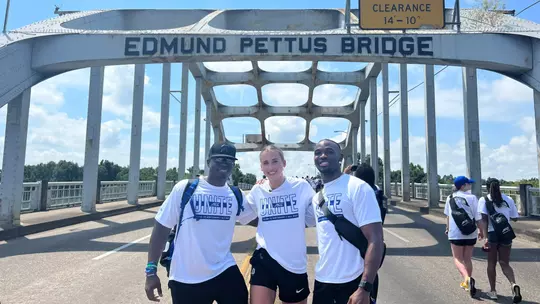
Life-Changing Trip
Two Duke student-athletes part of emotional journey to historic civil rights sites
Meredith Rieder, GoDuke The Magazine
Two days. Two cities. Hundreds of NCAA Division I student-athletes. It was the trip of a lifetime for Duke football redshirt junior running back Jaylen Coleman and volleyball senior Gracie Johnson as they immersed themselves in the history of Selma and Montgomery, Alabama — one of the centers of the American civil rights movement.
They experienced many emotions, from happiness and sadness, disgust and anger to surprise and wonder. Now, they are prepared to bring all of it back to Duke so others can reap even just a sliver of the knowledge they both garnered over the course of the July 15-17 weekend.
The initiative, conducted in collaboration with the Big Ten and Pac-12, was part of the ACC’s commitment to supporting student-athletes through meaningful educational opportunities, including the area of social justice. The trip was part of the league’s social-justice platform, ACC UNITE.
Joined by managing director of recreation facilities and leader of Duke’s DEIB committee Mike Howard, Coleman and Johnson connected with hundreds of other student-athletes and administrators from the ACC, the Big Ten and Pac-12 for the educational journey.
The experience allowed Coleman and Johnson the opportunity to learn about, see and hear inspirational first-hand accounts of what those brave individuals fighting for equal rights for black Americans lived through, while also encouraging everyone to confront that uncomfortable portion of American history.
“I think you can read so much about Selma,” said Johnson. “You can do all the research and read the books, but you don’t get that full impact until you’re there. Until you’re walking the (Edmund Pettus) bridge with everyone. Until you’re kneeling where Bloody Sunday happened. Everything brought so much emotion and it was impactful and truly a life-changing experience I was extremely fortunate and grateful I got to go on. I just hope I can communicate these ideas to my team.”
Those two days allowed the student-athletes to learn about and reflect on the past. They were educated about those who marched, sat and sacrificed their lives and understood the metaphorical baton was being passed to them to return to their campuses and continue the fight for social justice.
Johnson heard about it through the Student-Athlete Advisory Committee and was immediately interested, so when volleyball head coach Jolene Nagel messaged Johnson a couple of months later saying there were still openings, she jumped at the chance. For Coleman it was assistant director of student-athlete development Will Cole who brought the opportunity to his attention, and like Johnson, Coleman said he was “in from the jump.”
“(I thought) it would be a really great opportunity to, first-off immerse myself in the history and learning about everything that went on in Montgomery and Selma, but also being able to connect with different athletes from different schools (was exciting),” said Coleman.
Johnson echoed Coleman’s sentiments about the trip being a once-in-a-lifetime chance she couldn’t let pass.
“It was an opportunity I couldn’t turn down,” said Johnson. “I just thought at the time, ‘When else am I going to meet other athletes from the ACC in this environment?’ I didn’t ever see myself being able to do this in the future.”
Upon arrival in Alabama, Coleman and Johnson welcomed the chance to talk to other student-athletes outside of a competitive environment. They enjoyed learning about other athletes and their experiences at their respective
schools, while also having important and in-depth discussions about everything they were seeing and hearing over the course of the weekend.
“It was great to see so many athletes who cared about this,” Coleman said. “I thought everyone was respectful and understood the gravity of what the trip meant. I think we’ve all been able to take away something that we can give back to the university and our teams as well.”
Those takeaways are different for each person based on their background, current interests, or level of knowledge of what they were about to experience. One experience everyone felt was the weight of the history and the importance of the stories they heard and saw through images and films or from personal testimonies.
Coleman, as a young black man, felt inspired learning about and hearing from those who sacrificed so much during the civil rights movement. He recognized many of those participating in the marches and the protests were young college-aged students, many of whom looked like him. But it was a young girl from Selma who was much younger than him who made the biggest impact.
“I went down there with eyes open,” Coleman said. “I wasn’t quite sure what to expect, but I definitely feel like I came away with a deeper understanding and greater appreciation of those who came before me,” Coleman said. “There was a woman who spoke to us the first night. I think she was the youngest participant in the marches and getting to hear her story was absolutely incredible. She was vivid in her details and seeing how her interactions with (Martin Luther King Jr.) and how he was able to teach her, a little girl just seven years old, the importance of voting, being able to represent yourself and have a voice in politics was pretty incredible.”
Conversely, experiencing the moments and the history through a different lens as a young white woman, Johnson left not only in awe of all the stories, and like Coleman also inspired to bring this information to life within the Duke volleyball team and on Duke’s campus — a duty of sorts to pay it forward.
“I got back on campus and immediately tried to figure out how can I share the information with my team,” Johnson said. “It’s not just the information that I was able to take away. It’s a completely different feeling when you’re in the environment and now I want to work on how I can cultivate that experience with my team and the university, especially (with Duke) being a PWI (predominantly white institution).”
Amidst the speakers and trips to museums and monuments, the student-athletes also shared time at dinner and on bus rides to converse as the student-athletes delved into conversations not only about what they just witnessed or the emotions they felt from a particular experience, but also their individual experiences throughout life.
Like the images they saw and stories they heard, these conversations with their peers often came packed with emotions. However, having them, allowed lasting bond to develop between not only Coleman and Johnson, but also other student-athletes.
“On the trip we got a chance to sit down and have an intimate talk about what we were feeling and experiencing at the moment,” Coleman said. “I think it was really great for me to hear her talk about what she was feeling to just get a different perspective. But then also to be able to talk to her about the way I see things really helped build a relationship. I hope we can continue to have this bond and to use it to help other people and gain more exposure for social injustice.”
“Within the ACC I feel like we were a close group,” Johnson said. “While we may have been one of the smallest groups, I feel like we really got to know each other. We had conversations on the bus about what we just saw, or we shared common interests and I think there was an immediate bond.”
Impactful. That’s the word you’ll hear over and over from Coleman and Johnson when describing their experience. From the museums and speakers to the dinners with their peers, it all left an impact. However, they both had a different moment that left an indelible mark.
For Johnson it was the Legacy Museum, which “provides a comprehensive history of the United States with a focus on the legacy of slavery,” explained on the museum’s website. “From the Transatlantic Slave Trade and its impact on the North and coastal communities across America through the Domestic Slave Trade and Reconstruction, the museum provides detailed interactive content and compelling narratives.”
Johnson most remembers a wall filled with jars of dirt from locations where lynchings occurred throughout the United States. Visitors can get involved by doing research through the Legacy Museum to learn what happened where they live or go to school.
“The whole museum was one of the most impactful museums I have ever been to,” Johnson said. “You can e-mail them to get involved and see if any (lynchings) happened around your campus or your area and go to the site and dig soil from where the lynching happened. You send it to the museum and continue to learn about the history and where you are standing and what has happened on your campus.”
The snapshot in Coleman’s mind is one of Selma as he rode the bus across the Edmund Pettus bridge, the site of what is known as Bloody Sunday and a turning point in the civil rights movement. They watched a black-and-white video about that march led by John Lewis that was met with brutality from the police. The next day when Coleman rode the bus across the bridge, Selma looked the same to him. Nothing seemed to change, except the splash of color.
“Getting to watch (the film) and then on the bus ride from Montgomery to Selma and looking out of the bus window as we were getting to the top of the bridge and looking down at the town of Selma, it was very reminiscent of the video,” Coleman said. “It looked like the town itself was almost frozen in time. I thought it was just so amazing to me because it’s almost like after (all of these) years not a lot has changed. It’s a metaphor for sure, but at the same time the perseverance of the people of the town of Selma to stay there and to embrace the history and educate others of their history and be proud of it (was very powerful).”
The experience of the trip reinforced to Coleman and Johnson the importance of enjoying every moment of playing sports and using lessons they learned, and both are excited about their seasons ahead and look forward to what their teams can do on the field and court.
Johnson enters the season as Duke’s top returning offensive threat, ranking second on the team in kills last season and leading the ACC in service aces.
“I think the spring (volleyball season) was amazing,” said Johnson, a team co-captain. “It was one of the best semesters we have had as a team. Everyone was locked in and really willing to work, especially in the weight room. We’re working on competing hard and the small things. We have eight new girls, so getting out the kinks and working through systems, playing together, getting to know each other. I think we’ve really been going at it and there have been practices that make me super excited for the season. I just know it’s going to be a good year for us.”
On the gridiron, Coleman steps in as one of Duke’s oldest returning running backs after the graduation of Mataeo Durant, who finished his career with 2,562 rushing yards to become the ninth Blue Devil to rush for over 2,000 yards in his career.
The team, according to Coleman, is in the best shape of their lives both physically and mentally and they are excited to hit the ground running. He understands the big shoes Durant left to fill and has worked tirelessly in the offseason on how he can better himself and his teammates to fill the hole.
“I know my role isn’t exactly to fill his (Mataeo's) shoes, but to make sure the team is in a better place since he’s gone," said Coleman. "I think we’ve been able to do that, and we are moving in the right direction. We have a lot to look forward to this season and I’m definitely looking forward to getting things rolling.”