
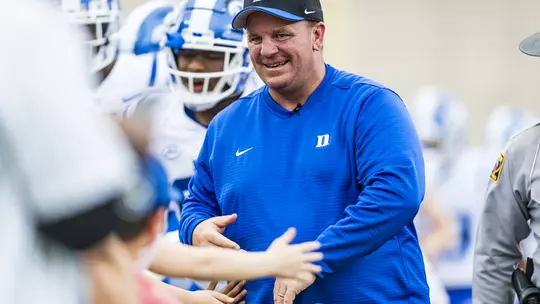
Culture Change: Blue Devils Embrace the Grind Under Coach Elko
Jim Sumner, GoDuke The Magazine
Shortly after the Japanese attack on Pearl Harbor propelled the United States into World War II, Duke football coach Wallace Wade took a leave of absence to join the United States Army. Duke basketball coach Eddie Cameron moved over to take Wade’s job running the football program, while Duke soccer coach Gerry Gerard took over as basketball coach.
The 1942-43 academic year was the last time Duke had a new football coach and a new basketball coach at the same time.
Until now.
Some of that has to do with the extraordinary longevity of Mike Krzyzewski. Eight different football coaches overlapped his tenure at Duke, nine if we count Elko’s seven months at Duke, a span that doesn’t include any games but does include spring ball.
There are some similarities between Jon Scheyer and Mike Elko. It’s the first head coaching job for each and they are in charge of the school’s two highest-profile sports.
But there are some big differences. Scheyer has spent most of his adult life at Duke and has never coached anywhere else. By contrast, Duke is Elko’s 11th coaching stop in a career that has seen him work his way up from graduate assistant to position coach to coordinator to head coach, from Stony Brook to the SEC to Duke.
But the biggest difference may be expectations. Scheyer is taking the reins at one of the iconic programs in college sports. Elko is taking over a program coming off three consecutive losing seasons.
The adage “if it ain’t broke, don’t fix it” may apply to Duke basketball but 23 losses in 29 games suggested Duke football need fixing.
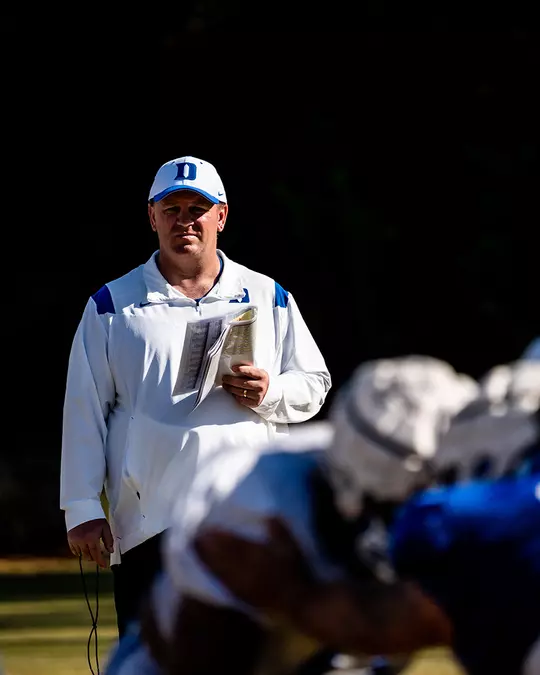
“It was time for a re-direction of the program,” Elko said in a recent interview. “Obviously Coach Cutcliffe did an amazing job over his time here. But after 15 years, sometimes it just needs a fresh perspective and that’s the biggest thing we tried to do, just kind of freshen up, do things a little bit different, try to put our spin on it. And I think the kids have bought in to that and we’re heading in a good direction.”
What is Duke doing differently? Elko cites three things.
One is a “bigger emphasis in nutrition at the training table and how we’re feeding our student-athletes.”
Second is a “much different approach to how we’re in the weight room training and moving weight and how we run and condition.”
Third, and the most apparent, is social media. If you follow Duke football, your smartphone gets a regular reminder of a “much greater emphasis in social media, in branding this program.”
“Those three areas are probably 180 degrees in a different direction than they were before we got here.”
Elko said social media has benefits in two areas.
“We knew there had to be an uptick in recruiting and nowadays so much of that is driven by social media and so we had to have a much stronger presence on social media for recruits to see and be aware of what we were doing. And then obviously, we’ve got to do a better job of creating enthusiasm and passion around the Duke football program, and the more engagement you have with fans, the more likelihood you have of getting fans in your stadium and so we had to do a better job of being relevant 365 days a year.”
The word “culture” pops up a lot in coaching changes and Elko said his culture can be viewed in the “Embrace the GRIND” philosophy he articulated last December.
“Relentless effort and living in the now and conducting ourselves with integrity and being dependable,” he noted. “Within that GRIND acronym have been the pillars of our culture and what we want to be about. Just teaching the kids how to apply that in every aspect of their lives, how do they apply that in practice, how do they apply that in the weight room, how do they apply it in the classroom, in life, in all of that.”
Rising senior lineman Jacob Monk is in a unique situation regarding the change. His father Stanley was a Duke running back who played his first three seasons under Steve Sloan and finished under Steve Spurrier, an almost identical situation to that of his son.
Jacob says he grew up hearing his father talk about that transition and of course they renewed those conversations once Duke and David Cutcliffe decided to part ways.
The message?
“Just buy in to whoever is in charge because you’re going to have a hundred other guys following you,” Monk said. “Buy in, know what they’re teaching you and be a great leader for the program.”
Monk was one of a handful of Duke players who worked with the administration to find Cutcliffe’s replacement.
“We wanted to be competitive,” Monk recalled. “We were tired of losing. Just a mentality that we’re going to out-physical everyone, that we’re going to work harder than everyone and that come Saturday we’ll trust our work. We wanted someone who would bring a new mentality to the program. We were given some suggestions and Coach Elko was a name we really loved and wanted to get him and ended up getting him.”
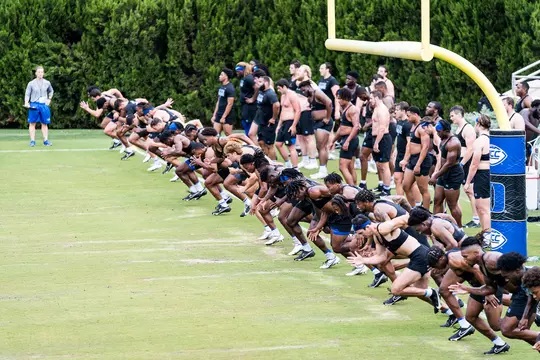
Monk notes the improvement in food — ”pretty amazing” — and has been the focal point of some much-viewed videos, showing him moving around prodigious amounts of iron in the weight room.
“The new weight and strength program is amazing as well,” he said. “It’s electric in the weight room. I try not to look at my phone much. It’s more of a team thing. I was on social media because of the energy in the room. We love that. We see how it’s helped in recruiting and helped in gathering more fan support.”
This is Elko’s first head coaching job and he said he’s still learning things about the job and about himself.
“As an assistant you always assume you know a little bit more about what the head coach does until you’re actually sitting in this chair; the different departments, the different people, the different avenues. You have to do a great job of prioritizing and you have to hire people you trust and then empower them to do their piece of it because you can’t do it all.
“We have something like 60 people in our organization that I’m responsible for. The biggest thing I’m trying to do is create a vision even in the coaching staff and all the people around the program that they know what the expectations are and then empower them to go out and put their spin on it and be responsible for the areas they’re responsible for.”
Elko added that he’s hands-on by nature, “So, getting an opportunity to learn how to delegate has been a piece of the job for me.”
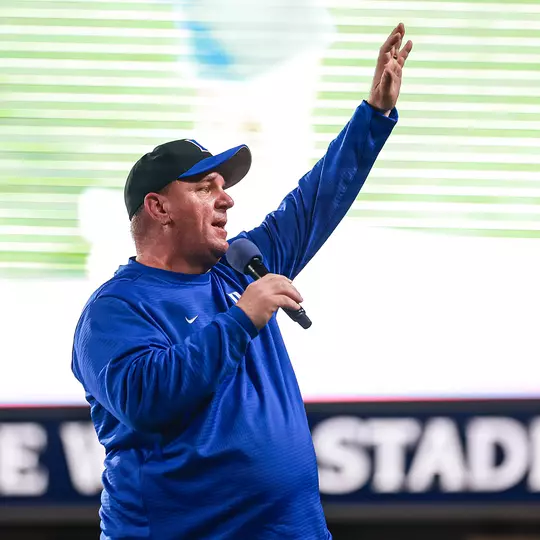
And of course, his new staff is learning how to work together.
“You’re all trying to learn how to make this thing operate at the highest level,” Elko said. “Everybody is getting used to everybody and that’s a piece of being a new staff. When you go out and hire you’re trying to hire great people because great people make the transition better.”
Win now or win later? How about both?
In his first meeting with the Duke community Elko said he would win as soon as possible with the players he had. Monk said the team noticed.
“It showed that he trusted us. He knows what Duke is and he knows what it takes to win and he knows the work we’ve put in and there’s no reason not to trust him."
But Elko also acknowledged that he needed to upgrade the talent base and said he was confident he could leverage Duke’s academic reputation to the program’s advantage. June commitments don’t always translate into fall signings. But on paper Elko and his staff are off to a great start in that area.
“I think we’ve got to make sure we’re selling the complete package and that’s something we really try to do. Everyone is aware that we can convince them that the football program is heading in a better direction. Everybody is well aware of and respects the degree you can get from this university.”
What will constitute a successful 2022?
“I don’t know that you ever want to make decisions for the short term that are going to be negative for the long term if you’re trying to build something that you want to last,” Elko said. “That’s where you can short-stop your program. We want to have as much success as we can as fast as we possibly can but there are certain limitations to that until you get everything up and running the way we want it to.
“But we owe it to the guys in the locker room to try to do everything we can to win now and we owe it to Duke to do everything to build for the future. If we can continue to establish the culture that we want and play the game the way we want, that we’re more physical, that we’re tougher, that we compete for 60 minutes, that we show up every day and do the things we want to do and that we play more winning football than we have in the previous two seasons, I think that’s a success.”
Dedicated to sharing the stories of Duke student-athletes, present and past, GoDuke The Magazine is published for Duke Athletics by LEARFIELD with editorial offices at 3100 Tower Blvd., Suite 404, Durham, NC 27707. To subscribe, join the Iron Dukes or call 336-831-0767.