The Pivotal Year
Breakthroughs in tennis and golf, plus a basketball victory for the ages, made 1998-99 a landmark year for Duke women
John Roth, GoDuke The Magazine
As the 1998 spring semester unfolded on the Duke campus, the university’s athletics department found itself navigating a major transition. Long-time director of athletics Tom Butters had announced his retirement after 20 years at the helm, and a nationwide search for his successor ended with president Nan Keohane naming associate AD Joe Alleva to the post.
Title IX was approaching its 26th birthday, and finding a way to comply with its funding expectations for women athletes (historically referenced as “gender equity”) had been a challenge for the Blue Devil administration, with males receiving 128 scholarships that year compared to only 66 for females. “Women’s athletics is very much in its infant stage here,” Alleva noted early in his tenure.
His point was well-founded: Duke had 12 women’s sports and only five of them were allotted the maximum amount of scholarships permitted by the NCAA. Five other programs were completely non-scholarship. Two were partially funded and a new sport, rowing, had just been named to join the roster the following year.
What’s more, only three of the 12 established women’s sports had ever claimed an official ACC championship at that point, and no one affiliated with Duke had ever won an NCAA title in a women’s sport.
But two events took place in mid-1998 that, looking back, heralded the dawn of a new day for women’s athletics at Duke, a coming of age for the infant program.
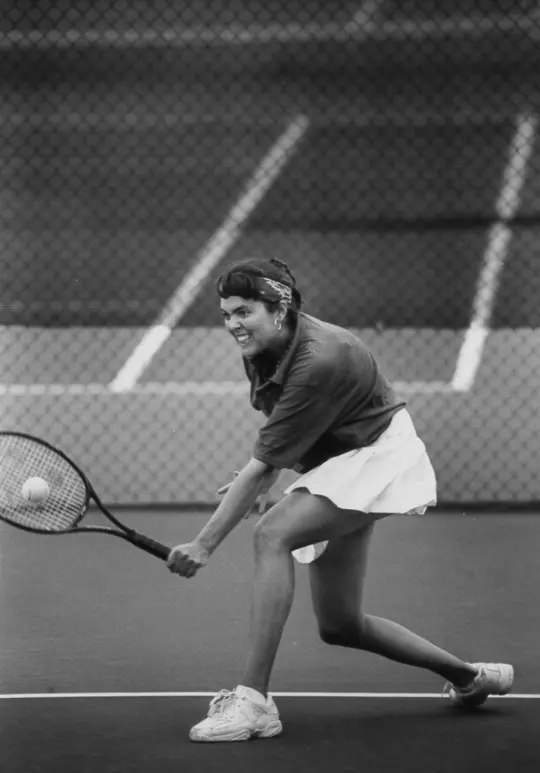
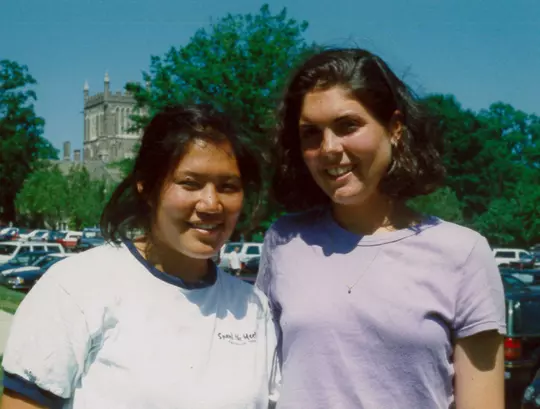
Golfer Jenny Chuasiriporn and tennis player Vanessa Webb were juniors in 1998. They had roomed together as sophomores and enjoyed remarkably parallel careers. Both had sparked their teams to ACC titles in each of their first three years; both were ACC players of the year and All-Americas; and each had been ranked the No. 1 college player in her sport. Both entered 1998 NCAA Tournament action with reasonable hopes of claiming team and individual national championships.
Webb, then a 22-year-old Canadian, led the Blue Devil tennis squad past nemesis Stanford and into its first NCAA final, where it fell to Florida. But after the team competition ended, she completely dominated the singles draw, rolling through six matches in straight sets to take the NCAA crown, the first ever achieved by a Duke woman. Later in the summer she became the first Blue Devil to be named ACC female athlete of the year (all sports).
Chuasiriporn, a Maryland product who had yet to turn 21, grabbed her share of the spotlight when she fired a course record and personal best score of 65 in the opening round of the NCAA golf tournament. She helped lead Duke to a fourth-place team finish, matching its best national showing in school history, while placing fifth individually.
It was several weeks later, though, when Chuasiriporn made an even more enduring mark. Wearing her Duke uniform and playing as an amateur at the U.S. Women’s Open over Fourth of July weekend in Wisconsin, she stunned the professional field and sports fans worldwide with an epic 40-foot putt on the 18th hole of the final round to tie for the lead. That sent the championship to an extra day, where she battled LPGA rookie Se Ri Pak for 20 more holes and the first sudden death in event history before ending as the runnerup.
Twenty-four years later, Webb’s trophy performance at the NCAAs and Chuasiriporn’s iconic, wide-eyed, hand-over-mouth reaction to the improbable putt still stand as landmark, singular, unforgettable entries across 50 years of women’s athletics at Duke. But they were also game-changers from the historical perspective. The year that began in the spring of 1998 and ran through the 1999 school year might well be considered a 12-month period when everything changed for women’s athletics at Duke. In so many ways, major strides were made that year that demonstrated the Blue Devils were on the way to perennial excellence on a nationwide scale.
Webb and Chuasiriporn didn’t trigger all the changes, but they were the ideal ushers for a transformative time.
What happened to make 1998-99 such a pivotal year? Let’s start in their domains. Tennis was Duke’s most dominant women’s sport at the time, having won its 11th straight ACC title in 1998 while running its winning streak against ACC schools to 102 matches. In the spring of ’98 they finally got over a hump nationally by playing for the NCAA team title and winning an NCAA individual title. Then in ’99 they made it to the National Team Indoors final and a fourth straight NCAA final four, while Webb became the first Duke woman to win a Honda Award as national player of the year. No question Duke was now entrenched as a national entity in women’s tennis, with an NCAA team title on the horizon (2009).
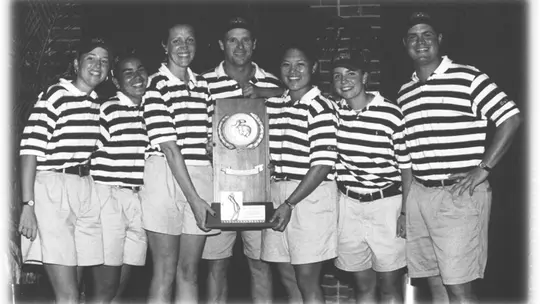
In golf, Chuasiriporn began the fall season ranked No. 1, led her team to four tournament titles, then paced the USA to a World Amateur team title in Chile with the best score of the 99 international participants. But it got even better than that in the spring when the Blue Devils won the ACC for a fourth straight year and followed it up with the first NCAA team championship by a women’s squad in Duke history. Two freshmen who had played with Chuasiriporn in the U.S. Women’s Open the previous summer made major impacts as top recruits, in Candy Hannemann (NCAA runnerup) and Beth Bauer. The program’s ACC title streak would eventually grow to 13 straight and the NCAA trophy total now stands at seven, as coach Dan Brooks’ program is one of the most respected in the country.
But tennis and golf break-throughs notwithstanding, the 1998-99 event with the most profound ramifications was authored by the flagship women’s basketball program, which had been on the rise under young coach Gail Goestenkors. In 1998 the Blue Devils won the ACC regular season title for the first time and reached the Elite Eight of the NCAAs. But 1999 featured an even bigger step forward.
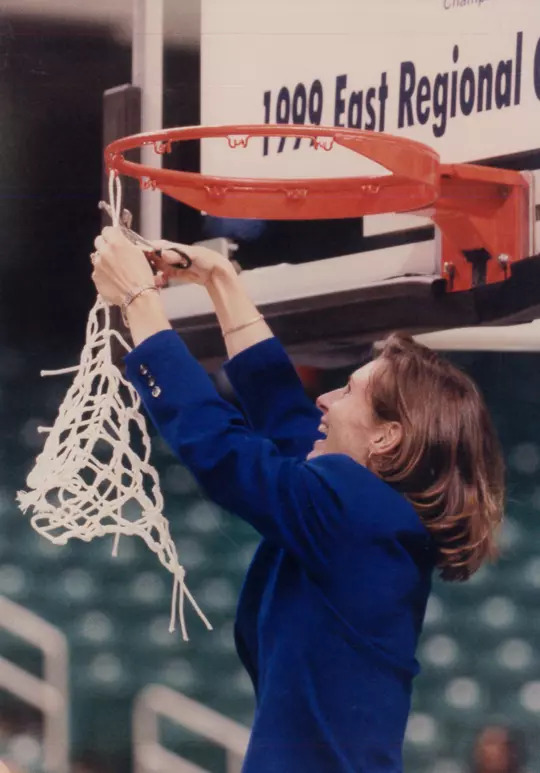
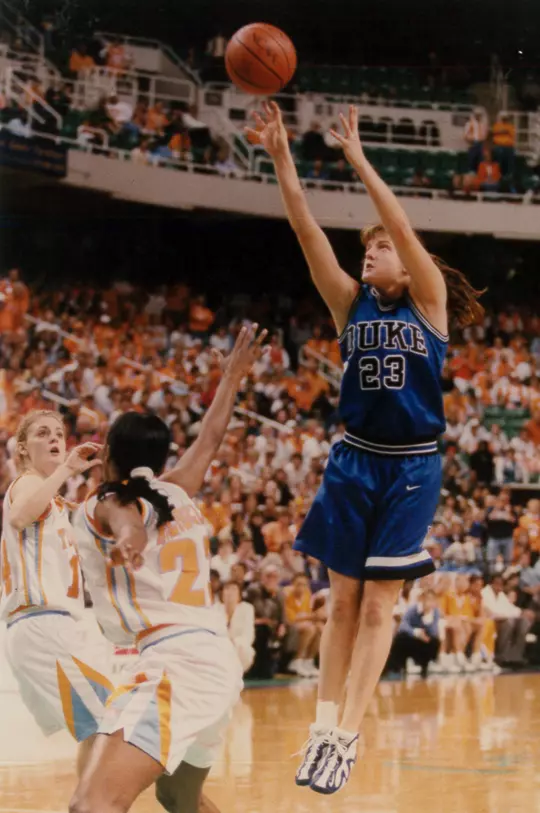
Coming off the ’98 success, with most of the team returning, Goestenkors put together the toughest schedule in school history for ’99. Her club was ranked No. 4 in preseason, with openers against UConn and Stanford on back-to-back nights in San Jose, a headliner against heavyweight Tennessee in Orlando, road trips to Vanderbilt and UCLA, and the ACC slate. There were some ups and downs early, but the team hit its stride in conference play and finished one game shy of perfection in the ACC, losing late to Clemson. They fell again to the Tigers in the ACC Tournament semifinals, but the rest of their postseason was one for the ages — in particular, a 69-63 upset of three-time defending champion Tennessee in a regional final to secure the program’s first trip to the Final Four. It can be argued that this one outcome stands as the most impactful moment in the history of Duke women’s athletics.
“Literally overnight, one game really did put the program on the map,” recalled Georgia (Schweitzer) Beasley, who was regional MVP after a standout performance against the Lady Vols. “Going into the game we were joking around that the other team had already bought their tickets to the Final Four. A lot of us still get together and watch it, and we laugh because when they go to the announcers (at the end of the game), their faces are blank. They can’t really believe what’s going on. And the same thing with the Tennessee folks.”
Duke ultimately lost to top-ranked Purdue in the national championship game, but suddenly everything had changed.

It certainly didn’t hurt that the Duke men were playing in the Final Four at the same time, creating tremendous crossover interest and hype. Now the women were also viewed as a force, and Duke women’s athletics had a national face to go with the name that had been growing in stature. Coach G and her Blue Devils made it stick with five straight ACC Tournament titles, six straight 30-win seasons and three more Final Four trips over the next eight years — not to mention multiple stints at No. 1 and several victories over other traditional powers. There has been no national title, but the 2006 club just missed with an overtime loss to Maryland.
Elsewhere, the women’s lacrosse program was in its infancy in 1998-99, just its fourth year of existence under coach Kerstin Kimel. The Blue Devils had made the NCAAs for the first time in the spring of 1998, then made the final four in 1999. Still the coach, Kimel has since directed her squad to six more national semifinals and had four in a row from 2005-08.
When all was said and done in 1998-99, Duke ranked seventh in the Sears Directors Cup, the national all-sports competition. The Blue Devils had the best showing of any ACC school, and 60 percent of the Duke points came from women’s sports with three final four teams plus the golf championship. The fan newspaper Blue Devil Weekly suggested at the time it might have been Duke’s best-ever sports year.
But really it was just a start, the bridge to a new world. A few of the sports that did not make the NCAAs in 1998-99, such as soccer, volleyball and field hockey, enjoyed major growth spurts after the turn of the century. There were more noteworthy Directors Cup finishes to come, and much more in store for women’s sports. Now, 50 years in, virtually every women’s program has enjoyed NCAA championships or ACC titles, or both — even the youngest outfit, softball, which captured the conference crown in its fourth year and reached the Super Regionals in its fifth.
The 1998-99 year also stands as a pivotal time due to events away from the fields of play. New facilities were under construction or on the drawing board across the athletics complex, including an indoor tennis center that would greatly aid recruiting. And, the Athletic Council moved to ramp up scholarship aid for women’s sports, accelerating its approach to gender equity. In the fall of ’98 Duke announced a plan to add 34 scholarships for women in the following three years — substantial support that would eventually lead to producing individual national champions in women’s track, fencing and diving as well as more NCAA contenders and ACC team titlists in several sports.
During the middle of the 1998-99 season, the athletics department published a color poster saluting its two senior superstars as they wrapped up their careers and headed toward graduation. Photos and accomplishments for Chuasiriporn and Webb were featured with the headline “Duke Duo Rocks.” It marked the first time Duke had produced such promotional material for women student-athletes.
The duo still rocked when both were inducted in the Duke Athletics Hall of Fame in the same year, 2011 — a little more than a decade after they had been front-and-center for the start of a new era for women’s athletics at their alma mater.
1998-99 Milestones for Duke Women
Spring 1998
- First NCAA individual champion (Vanessa Webb, tennis singles)
- First NCAA team championship match for tennis program (lost to Florida)
- First NCAA appearance for lacrosse program
- First ACC champion and NCAA qualifier for track program (Kim Voyticky, 800m)
- First ACC regular season title for basketball program
Fall 1998
- First NCAA qualifier for cross country program (Megan Sullivan)
- First season for rowing program
Spring 1999
- First NCAA team championship (golf)
- First Final Four and championship game appearance for basketball program
- First final four for lacrosse program
- Fourth straight final four for tennis program
Summer 1999
- Duke placed seventh nationally in the Sears Directors Cup competition with 510 points; 300 of the points were produced by women’s sports