Believers
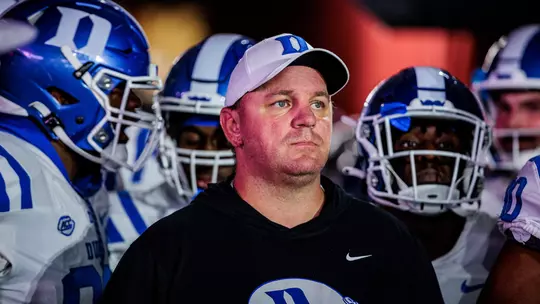
ACC coach of the year Mike Elko got buy-in from a hungry roster to produce a dramatic turnaround
Jim Sumner, GoDuke The Magazine
This story originally appeared in the 14.5 Issue of GoDuke The Magazine -- December 2022
In mid-November Mike Elko was asked if his first Duke football team had exceeded his expectations.
Elko’s response?
“I don't really ever have expectations. Everyone has always asked me that over the years like, did you expect to be here or did you expect it to go this way?”
This probably makes Elko the only person who follows college football who doesn’t think his team exceeded expectations.
The Blue Devils lost 23 of David Cutcliffe’s final 29 games. Elko inherited a 13-game ACC losing streak. Duke was picked to finish last in the ACC’s Coastal Division. Key players entered the transfer portal before his hiring was announced.
No one would have blamed Elko if he had said a complete tear-down was needed, one that might take years and lots of patience.
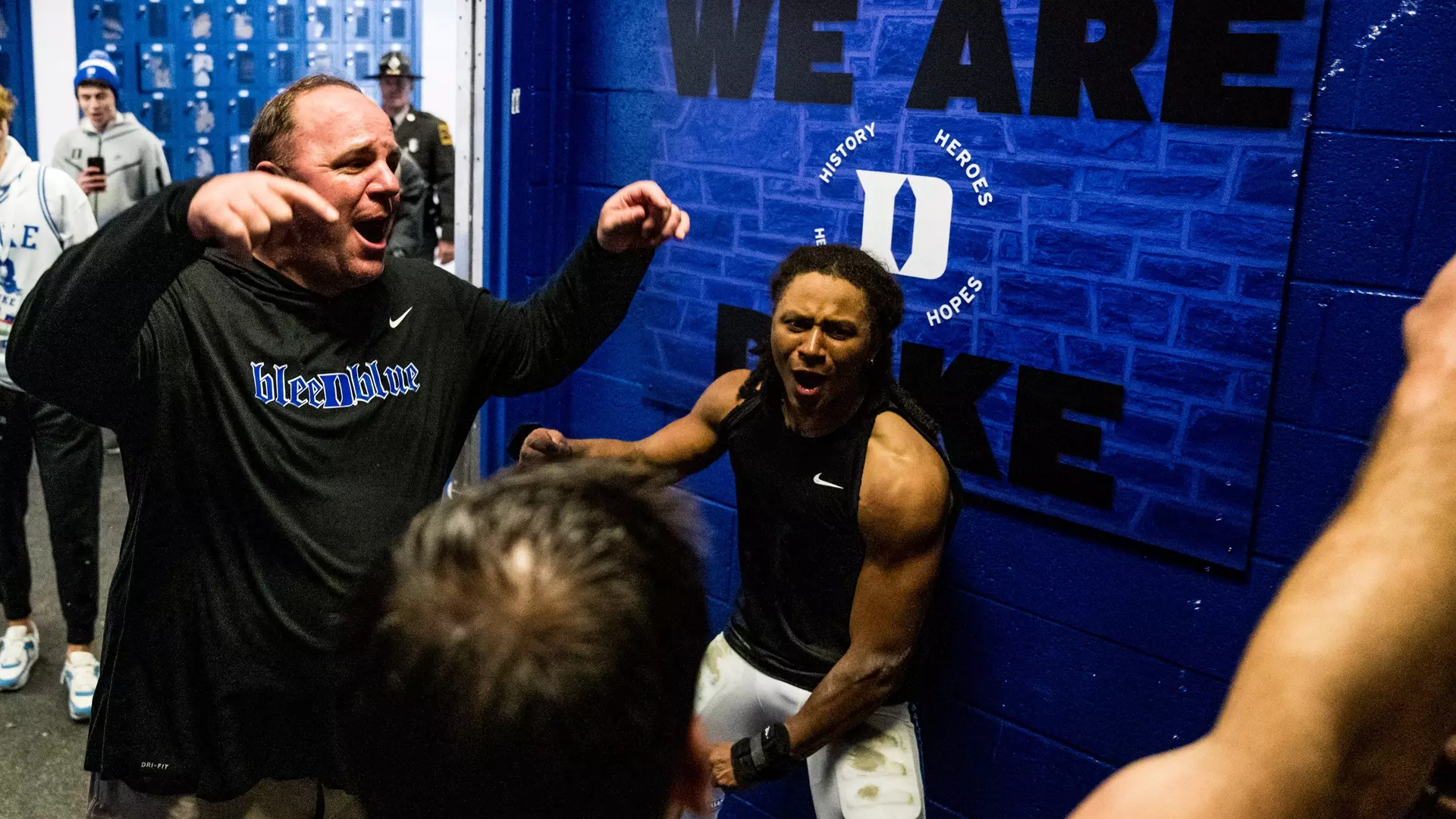
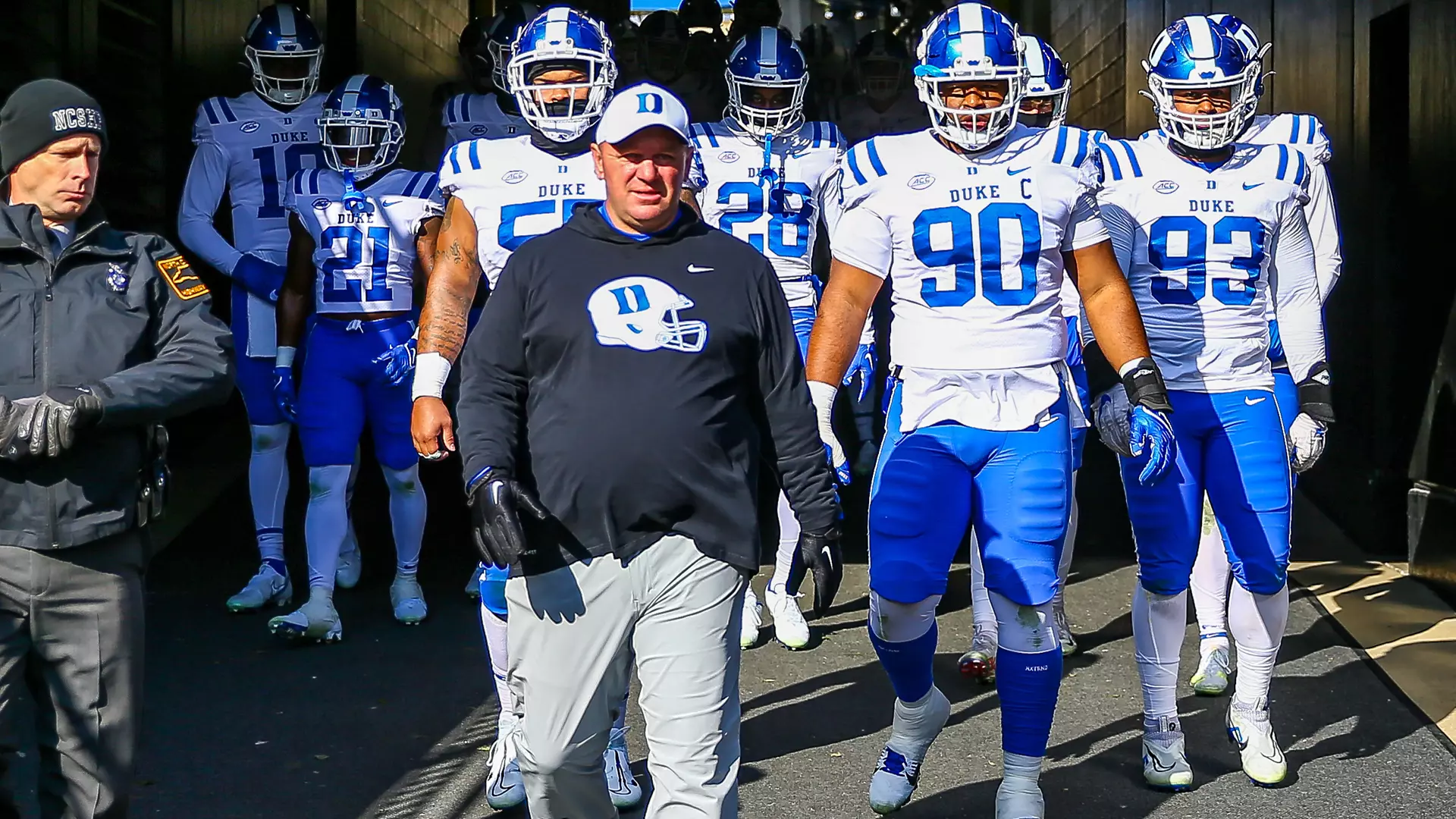
Instead, he proclaimed that Duke’s time was now and he was going to win with the players already in the program.
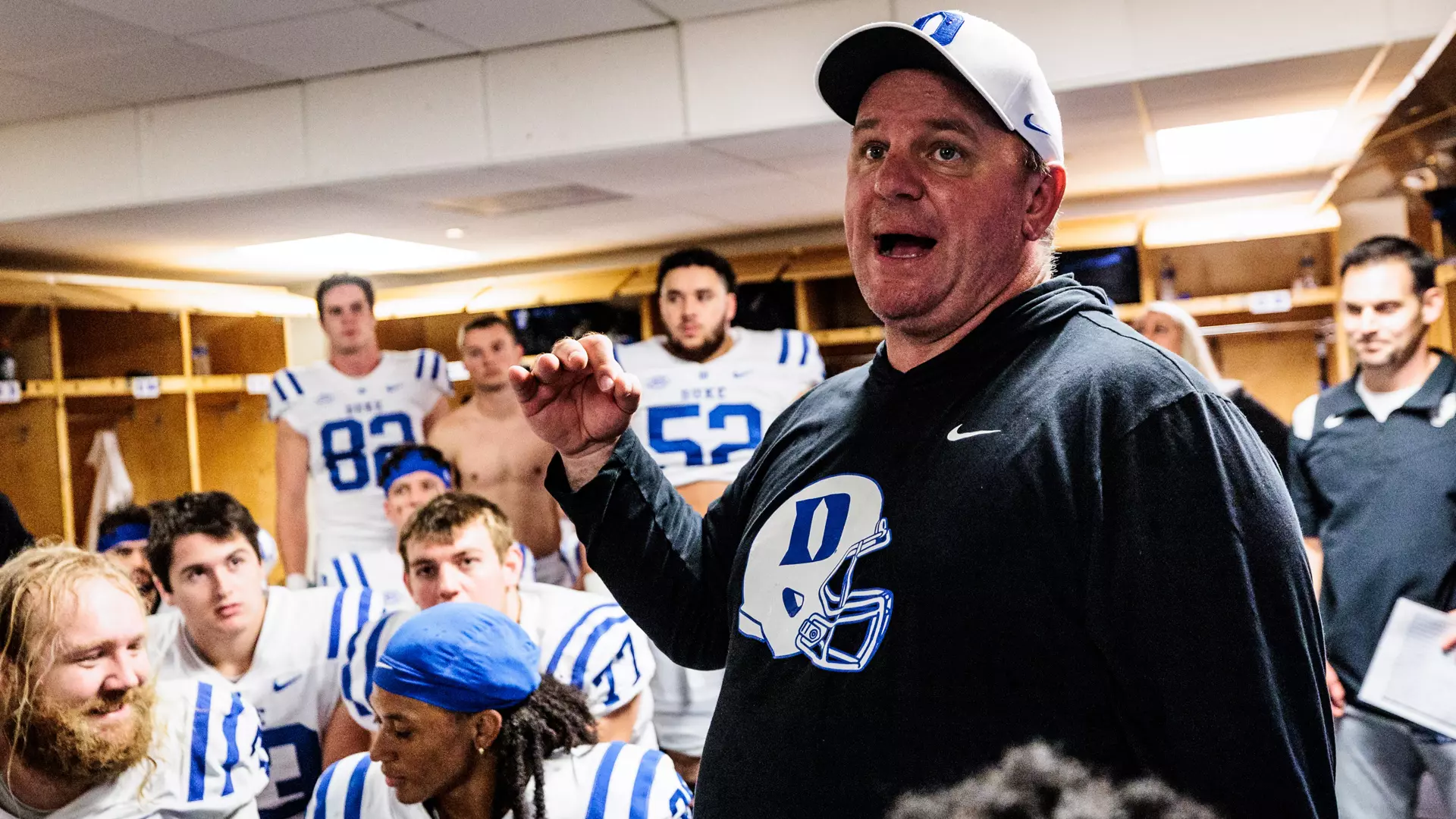
He met with his team, asked for their trust and the exodus stopped.
He had a team. Now he needed a staff.
Elko retained one incumbent assistant, running backs coach Trooper Taylor. Offensive coordinator and quarterback coach Kevin Johns came from Memphis, while defensive coordinator Robb Smith came from Rutgers. Other hires came with resumes that included stops at Texas A&M, Wake Forest, Miami and Northwestern.
Wide receiver coach Zohn Burden came from Maryland after an earlier stint with Virginia Tech. Why Duke?
“I believed in Coach Elko’s culture and what he’s trying to establish and it fits my mentality as well, which is what made the job very intriguing to me,” Burden said. “He is a very, very respected man in this business. It took a couple of phone calls, a couple of conversations. He treats you the right way.”
Elko and his staff went to work. The strength and conditioning program was upgraded. The nutritional program was upgraded. The social media platform was upgraded, sending out videos of linemen breaking individual and school records in assorted lifts.
Elko’s message was simple. We are going to be strong and tough and more physical than anyone we play. You can do more than you thought you could.
“Relentless effort and living in the now and conducting ourselves with integrity and being dependable,” he summed up his approach.
Duke needed to hit the transfer portal. Only defensive back Datrone Young (Iowa State) and offensive lineman Chance Lytle (Colorado) came from Power 5 schools. Both became starters.
But safety Darius Joiner came from Western Illinois and made third-team All-ACC. Offensive lineman Andre Harris came from Arkansas State and was named All-America by the College Football Network. Transfers from Cornell, Harvard, Columbia and Massachusetts made significant contributions.
That’s a pretty impressive talent-evaluation record for a new staff coming off a three-win season.
Elko also wanted his staff to be elite teachers. Throughout the season players talked about learning better techniques for shedding blocks or running routes, better foot placement.
Junior left tackle Graham Barton was named first-team All-ACC. In midseason he talked about how the coaches were helping him and his teammates.
“We use the analogy that we’re chopping down a tree. We’re turning this program around. We’re emphasizing the little things in practice, minute details like communication, anything like that. In the thick of practice where there’s a lot of moving parts, you’ve got to be able to execute the small moments and do the right thing and I think that will take us a long way.”
Elko told his team that nothing was assumed, that playing time would have to be earned. There wasn’t even a depth chart until August.
The staff also had to perform some confidence building. Elko inherited a team that hungered to win but whose confidence was eroded by three consecutive losing seasons.
Quarterback Riley Leonard and wide receiver Jalon Calhoun addressed this after Duke’s 34-31 win over Wake Forest in the regular season finale.
“We always knew it could be special,” Calhoun said. “It was just putting the right pieces and getting the culture back where it needed to be.”
“We go into every single game expecting to win,” Leonard added. “Trusting that if we do our job we’re going to win. I know that in the years past some guys kind of predetermined things in their head. But this year there was not one game we went into thinking we were going to lose. So, the mentality in this organization is definitely the biggest change this season.”
Harris came to Duke over the summer and said that he immediately sensed that Duke was building something special.
“Everybody preached that all offseason — physicality, physicality. We focused all summer on building power, just being powerful, being mean and aggressive and getting after somebody. Once we got through our first game I knew that this unit (the offensive line) was nasty.”
Duke ended the regular season third in the ACC in rushing yards per game, second in yards per carry. The defense was fourth in the ACC against the run.
Physicality was one point of emphasis. Winning the turnover battle was another.
“We emphasize it, we preach it and we live it every day,” Elko said in midseason. “It's not something we just talk about because we need to talk about it. We literally teach it every single rep every single day. I think the kids understand how important that is for our success. They understand that sometimes a four-yard scramble is better than a 50/50 ball into the middle of the field that could become a turnover.”
Leonard is the guy tasked with not making that risky pass over the middle. He said learning to throw the ball away was one of the biggest lessons he learned this season, adding, “It just comes down to efficiency. Each play, stay ahead of the chains, whether it’s a three- or four-yard gain, a complete pass and then execute on third down especially. As quarterback my emphasis is controlling the game and controlling each snap and moving the chains.”
Duke ended the regular season with 10 turnovers committed, 24 forced, their plus-14 differential tied for second best in the country, behind Southern Cal.
Duke opened with a 30-0 win over Temple, Duke’s first shutout over an FBS team since 1989. Leonard sparked the win by completing 24-of-30 passes for 328 yards and two touchdowns, while rushing for 64 more.
And no turnovers.
Leonard came into the season with little experience and even less respect from the media and he thrived on it, taking every snub as an incentive to prove the doubters wrong. ”Adding fuel to the fire” was the expression he used.
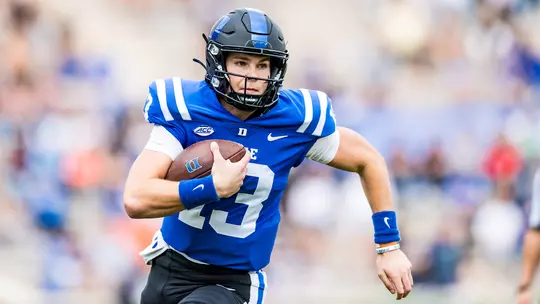
At the end of the season Leonard was fourth in the ACC in quarterback efficiency and led all quarterbacks with 636 rushing yards.
And the quarterback he beat out for the starting nod? Well, Jordan Moore moved to wide receiver, where he led Duke with 57 receptions, while finishing second to Calhoun in receiving yardage.
After beating Temple, Duke held off a late Northwestern comeback and won 31-23 in Evanston and had the expected win over North Carolina A&T.
Another question lingered. How would Duke handle adversity? Duke was 3-1 last season before losing its final eight games. A last-second loss to Georgia Tech was followed by six blowout losses. A turnover, a penalty, a missed kick and a good start became a blowout loss.
Elko consistently said that the culture of the team would not allow a game or a season to spiral out of control.
We had a chance to find out when Duke lost at Kansas, 35-27. Duke trailed 28-13 and 35-20 in the second half and fought back to give themselves a chance to win before losing the ball on downs in Kansas territory.
“I am proud of the fact that we fought until the end, but that didn't surprise me,” Elko said after that game. “They are passionate about representing this program the right way, so at the end of the day we are always going to fight until the end."
Duke followed with a 38-17 win over Virginia, ending that long ACC losing streak.
Duke’s resiliency was tested with a two-game losing streak, 23-20 at Georgia Tech in overtime and 38-35 to North Carolina. Duke fought back from two-possession deficits in both games but crucial penalties down the stretch proved fatal.
Duke went to Miami at 4-3, needing a win to stay above .500. The Blue Devils led 17-7 at the half but fell behind 21-17 in the first two minutes of the second half.
The season was in danger of unraveling. This is where all the offseason work would be would put to the test.
Duke responded with an epic drive — 18 plays, 79 yards, converting two fourth downs, to go ahead 24-21. Duke finished it off by forcing a rash of Miami turnovers — eight in all — and won 45-21.
Duke achieved bowl eligibility with a 24-7 win over Virginia Tech and subsequently defeated Boston College and Wake Forest to finish 8-4. Duke recovered a late onside kick to beat BC while Joiner intercepted Sam Hartman late to beat Wake.
That fourth loss was 28-26 at Pittsburgh, another game where Duke fought back from a two-possession deficit to have a chance to win at the end. Duke’s four losses were by a combined 16 points. With the Military Bowl pending this is the first season since 1953 without a double-digit loss.
“Coach Elko absolutely deserves all the credit,” Leonard said. “He has done an incredible job with us, not only in the scheme but in the mentality in general. He has created a winning atmosphere here and we really took that and are running with it.”
Elko returns the favor.
“They had to make a decision that they wanted to do this,” said the coach. “I think every man in that locker room decided that they didn't want it to be the same and because of that, they have allowed themselves to grow and through that growth we have been able to find success."
Dedicated to sharing the stories of Duke student-athletes, present and past, GoDuke The Magazine is published for Duke Athletics by LEARFIELD with editorial offices at 3100 Tower Blvd., Suite 404, Durham, NC 27707. To subscribe, join the Iron Dukes or call 336-831-0767.